Forming Second-Order Partial Differential Equations
[20/0%]A perfectly flexible homogeneous string, under the influence of a strong tension , is in a rectilinear position of equilibrium.
Prove that the equation of small vibrations of the string has the form
where is the displacement of the point with abscissa , --- time, and --- the linear density of the string (Fig. 15.1).
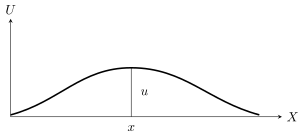 Fig. 15.1
A thin homogeneous rod undergoes longitudinal vibrations in which its cross-sections, remaining planar, move along the axis . Prove that the equation of small vibrations has the form
where is the displacement of the cross-section with abscissa , --- the density, and --- the modulus of elasticity of the material of the rod (Fig. 15.2).
 Fig. 15.2
Prove that the equation of longitudinal vibrations of a conical rod has the form
where is the displacement of the rod with abscissa , and --- the height of the cone (Fig. 15.3).
 Fig. 15.3
Torsional vibrations of a rod are vibrations in which its cross-sections rotate relative to one another, each rotating about the axis of the rod. Prove that the equation of small vibrations of a round rod is
where is the angle of rotation of the cross-section with abscissa , --- the shear modulus, --- the polar moment of inertia of the cross-section, and --- the moment of inertia of a unit-length portion of the rod relative to the axis of the rod.
A perfectly flexible homogeneous string is fastened at one end and, under the action of its own weight, is in a vertical position of equilibrium. Prove that the equation of small vibrations of the string has the form
where is the displacement of the point with abscissa , --- the length of the string, and --- the acceleration of gravity (Fig. 15.4).
 Fig. 15.4
A perfectly flexible string of length is suspended by the end , and to the other end a weight of kg is attached. The linear density of the string varies according to the law
where the constants and are related to the mass of the weight by
Prove that the equation of small vibrations of the string about its equilibrium position has the form
A heavy homogeneous string of length , fastened by its upper end () to a vertical axis, rotates about this axis with constant angular velocity (Fig. 15.5).
Prove that the equation of small vibrations of the string about its vertical equilibrium position has the form
where .
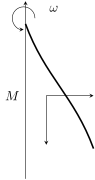 Fig. 15.5
A perfectly flexible homogeneous string is fastened at one end, and in equilibrium lies along the axis . Taken out of equilibrium, it rotates with constant angular velocity about the axis (Fig. 15.6).
Prove that the equation of small vibrations of the string about its relative equilibrium position has the form
where denotes the length of the string.
 Fig. 15.6
An inhomogeneous string, whose density varies according to the law
is fastened by the end to a fixed axis, while to the other end a ball is attached, whose mass is expressed by the equality
Prove that when the string rotates with constant angular velocity about the indicated axis, the equation of small vibrations has the form
where
Derive the equation of transverse vibrations of a string fastened at its ends, taking as the starting point Hamilton's principle of minimal action.
Hint. For small vibrations of the string, the potential and kinetic energies are expressed by the formulas:
where is the magnitude of the initial tension, and --- the length of the string. According to Hamilton's principle, for any moments of time and the equality
holds.
Starting from Hamilton's principle, solve problems 5801 and 5804 (problem 5801: a perfectly flexible homogeneous string is fastened at one end and, under the action of its own weight, is in a vertical position of equilibrium; it is required to derive the equation of small vibrations of the string about this position; problem 5804: a perfectly flexible homogeneous string is fastened at one end and in equilibrium lies along the axis , and, taken out of equilibrium, rotates with constant angular velocity about the axis ; it is required to derive the equation of small vibrations of the string about its relative equilibrium position).
A flexible homogeneous string is stretched over a perfectly smooth sphere of radius and, in equilibrium, is directed along the equator. Prove that the equation of small vibrations of the string has the form
where and denote the geographic coordinates of the point , is the initial tension, and --- the linear density of the string (Fig. 15.7).
 Fig. 15.7
Hint. One may use Hamilton's principle, taking into account the following expressions for the potential and kinetic energies:
where and denotes the length of the string.
A flexible homogeneous string of length is fastened by one of its ends at the pole of a perfectly smooth sphere and, under the action of its own weight, lies along an arc of a great circle. Prove that the equation of small vibrations of the string has the form
where denotes the acceleration of gravity, and --- the radius of the sphere (Fig. 15.8).
 Fig. 15.8
Hint. The expressions for the potential and kinetic energies have the following form:
Prove that for a wire with continuously distributed ohmic resistance , capacitance , inductance , and insulation leakage , the differential equations satisfied by the voltage and the current have the form
Hint. The first equation is derived from the law of induction applied to a very small portion of the wire. The second equation is obtained from the condition of continuity of current in the wire.
A perfectly flexible homogeneous film (membrane) is stretched over a frame . This position of the membrane is taken as the coordinate plane . Prove that the equation of small transverse vibrations of the membrane has the form
where is the force of the initial tension, computed per unit of the contour , and denotes the surface density of the membrane (Fig. 15.9).
 Fig. 15.9
A thin homogeneous rod is isolated from the external space and has at the point a temperature , changing with time. Prove that this temperature satisfies the equation
where is the specific heat, --- the coefficient of internal thermal conductivity, and --- the density of the material of the rod.
Prove that the equation of heat propagation in a thin insulated plate has the form
where the value of the constant is the same as in the previous problem (problem 5812: , where is the specific heat, --- the coefficient of internal thermal conductivity, and --- the density of the material).
Given a homogeneous ring with a very small cross-section (Fig. 15.10). Taking into account the loss of heat into the medium surrounding the ring due to radiation through the lateral surface, prove that the equation of heat propagation in the ring is
where denotes the length of the arc of the ring, and the constants entering the equation have the following meaning: , --- coefficients of internal and external thermal conductivity, , --- the specific heat and density of the material of the ring, , --- the area and perimeter of the cross-section.
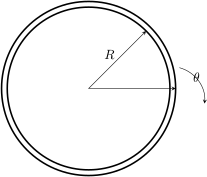 Fig. 15.10
Prove that the temperature of a homogeneous conductor, subject to the action of a constant current, satisfies the differential equation
where and denote the current strength and the resistivity of the conductor, and --- the perimeter and area of its cross-section, and --- the temperature of the surrounding medium; the meanings of the letters , , , are the same as in problem 5813 (problem 5813: --- the coefficient of internal thermal conductivity, --- the specific heat, --- the density of the material).
Prove that the equation of radial heat propagation in a homogeneous insulated sphere has the form
where is the temperature of the sphere at a point at distance from its center; the meanings of the letters are the same as in problem 5814 (problem 5814: , --- coefficients of internal and external thermal conductivity, , --- the specific heat and density of the material, , --- the area and perimeter of the cross-section).