Chapter 28

Cayley Digraphs of Groups

[37/68%]
Show
LaTeX
Problem 28.1

Find a Hamiltonian circuit in the digraph given in Example 7 different from the one in Figure 28.3.

?
Problem 28.2

Find a Hamiltonian circuit in

Cay({(a,0),(b,0),(e,1)}:Q4⊕Z2). \mathrm{Cay}(\left\{ (a, 0), (b, 0), (e, 1)\right\} : Q_4 \oplus Z_2).
?
Problem 28.3

Find a Hamiltonian circuit in

Cay({(a,0),(b,0),(e,1)}:Q4⊕Zm) \mathrm{Cay}(\left\{ (a, 0), (b, 0), (e, 1)\right\} : Q_4 \oplus Z_m)

where mm is even.

?
Problem 28.4

Write the sequence of generators for each of the circuits found in Exercises 1, 2, and 3.

?
Problem 28.5

Use the Cayley digraph in Example 7 to evaluate the product a3ba−1ba3b−1a^3ba^{-1}ba^3b^{-1}.

?
Problem 28.6

Let xx and yy be two vertices of a Cayley digraph. Explain why two paths from xx to yy in the digraph yield a group relation--- that is, an equation of the form a1a2⋯am=b1b2⋯bna_1a_2 \cdots a_m = b_1b_2 \cdots b_n, where the aia_i's and bjb_j's are generators of the Cayley digraph.

?
Problem 28.7

Use the Cayley digraph in Example 7 to verify the relation aba−1b−1a−1b−1=a2ba3aba^{-1}b^{-1}a^{-1}b^{-1} = a^2ba^3.

?
Problem 28.8

Identify the following Cayley digraph of a familiar group.
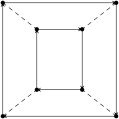
?
Problem 28.9

Let D4=⟨r,f∣r4=e=f2,rf=fr−1⟩D_4 = \langle r, f \mid r^4 = e = f^2, rf = fr^{-1} \rangle. Verify that

6∗(3∗(r,0),(f,0),3∗(r,0),(e,1)) 6 * (3 * (r, 0), (f, 0), 3 * (r, 0), (e, 1))

is a Hamiltonian circuit in

Cay({(r,0),(f,0),(e,1)}:D4⊕Z6). \mathrm{Cay}(\left\{ (r, 0), (f, 0), (e, 1)\right\} : D_4 \oplus Z_6).
?
Problem 28.10

Draw a picture of Cay({2,5}:Z8)\mathrm{Cay}(\left\{ 2, 5\right\} : Z_8).

?
Problem 28.11

If s1,s2,…,sns_1, s_2, \ldots , s_n is a sequence of generators that determines a Hamiltonian circuit beginning at some vertex, explain why the same sequence determines a Hamiltonian circuit beginning at any point. (This exercise is referred to in this chapter.)

?
Problem 28.12

Show that the Cayley digraph given in Example 7 has a Hamiltonian path from ee to aa.

?
Problem 28.13

Show that there is no Hamiltonian path in

Cay({(1,0),(0,1)}:Z3⊕Z2) \mathrm{Cay}(\left\{ (1, 0), (0, 1)\right\} : Z_3 \oplus Z_2)

from (0,0)(0, 0) to (2,0)(2, 0).

?
Problem 28.14

Draw Cay({2,3}:Z6)\mathrm{Cay}(\left\{ 2, 3\right\} : Z_6). Is there a Hamiltonian circuit in this digraph?

?
Problem 28.15
?
(a)

Let GG be a group of order nn generated by a set SS. Show that a sequence s1,s2,…,sn−1s_1, s_2, \ldots , s_{n-1} of elements of SS is a Hamiltonian path in Cay(S:G)\mathrm{Cay}(S : G) if and only if, for all ii and jj with 1≤i≤j<n1 \le i \le j < n, we have sisi+1⋯sj≠es_is_{i+1} \cdots s_j \ne e.

(b)

Show that the sequence s1s2⋯sns_1s_2 \cdots s_n is a Hamiltonian circuit if and only if s1s2⋯sn=es_1s_2 \cdots s_n = e, and that whenever 1≤i≤j<n1 \le i \le j < n, we have sisi+1⋯sj≠es_is_{i+1} \cdots s_j \ne e.

Problem 28.16

Let D4=⟨a,b∣a2=b2=(ab)4=e⟩D_4 = \langle a, b \mid a^2 = b^2 = (ab)^4 = e \rangle. Draw Cay({a,b}:D4)\mathrm{Cay}(\left\{ a, b\right\} : D_4). Why is it reasonable to say that this digraph is undirected?

?
Problem 28.17

Let DnD_n be as in Example 10. Show that 2∗[(n−1)∗r,f]2 * [(n - 1) * r, f] is a Hamiltonian circuit in Cay({r,f}:Dn)\mathrm{Cay}(\left\{ r, f\right\} : D_n).

?
Problem 28.18

Let Q8=⟨a,b∣a8=e,a4=b2,b−1ab=a−1⟩Q_8 = \langle a, b \mid a^8 = e, a^4 = b^2, b^{-1}ab = a^{-1} \rangle. Find a Hamiltonian circuit in Cay({a,b}:Q8)\mathrm{Cay}(\left\{ a, b\right\} : Q_8).

?
Problem 28.19

Let Q8Q_8 be as in Exercise 18. Find a Hamiltonian circuit in

Cay({(a,0),(b,0),(e,1)}:Q8⊕Z5). \mathrm{Cay}(\left\{ (a, 0), (b, 0), (e, 1)\right\} : Q_8 \oplus Z_5).
?
Problem 28.20

Prove that the Cayley digraph given in Example 6 does not have a Hamiltonian circuit. Does it have a Hamiltonian path?

?
Problem 28.21

Find a Hamiltonian circuit in

Cay({(R90,0),(H,0),(R0,1)}:D4⊕Z3). \mathrm{Cay}(\left\{ (R_{90}, 0), (H, 0), (R_0, 1)\right\} : D_4 \oplus Z_3).

Does this circuit generalize to the case Dn+1⊕ZnD_{n+1} \oplus Z_n for all n≥3n \ge 3?

?
Problem 28.22

Let Q8Q_8 be as in Exercise 18. Find a Hamiltonian circuit in

Cay({(a,0),(b,0),(e,1)}:Q8⊕Zm) for all even m. \mathrm{Cay}(\left\{ (a, 0), (b, 0), (e, 1)\right\} : Q_8 \oplus Z_m) \text{ for all even } m.
?
Problem 28.23

Let Q4Q_4 be as in Example 7. Find a Hamiltonian circuit in

Cay({(a,0),(b,0),(e,1)}:Q4⊕Z3). \mathrm{Cay}(\left\{ (a, 0), (b, 0), (e, 1)\right\} : Q_4 \oplus Z_3).
?
Problem 28.24

Let Q4Q_4 be as in Example 7. Find a Hamiltonian circuit in

Cay({(a,0),(b,0),(e,1)}:Q4⊕Zm) for all odd m≥3. \mathrm{Cay}(\left\{ (a, 0), (b, 0), (e, 1)\right\} : Q_4 \oplus Z_m) \text{ for all odd } m \ge 3.
?
Problem 28.25

Write the sequence of generators that describes the Hamiltonian circuit in Example 9.

?
Problem 28.26

Let DnD_n be as in Example 10. Find a Hamiltonian circuit in

Cay({(r,0),(f,0),(e,1)}:D4⊕Z5). \mathrm{Cay}(\left\{ (r, 0), (f, 0), (e, 1)\right\} : D_4 \oplus Z_5).

Does your circuit generalize to the case Dn⊕Zn+1D_n \oplus Z_{n+1} for all n≥4n \ge 4?

?
Problem 28.27

Prove that Cay({(0,1),(1,1)}:Zm⊕Zn)\mathrm{Cay}(\left\{ (0, 1), (1, 1)\right\} : Z_m \oplus Z_n) has a Hamiltonian circuit for all mm and nn greater than 1.

?
Problem 28.28

Suppose that a Hamiltonian circuit exists for Cay({(1,0),(0,1)}:Zm⊕Zn)\mathrm{Cay}(\left\{ (1, 0), (0, 1)\right\} : Z_m \oplus Z_n) and that this circuit exits from vertex (a,b)(a, b) vertically. Show that the circuit exits from every member of the coset (a,b)+⟨(1,−1)⟩(a, b) + \langle (1, -1) \rangle vertically.

?
Problem 28.29

Let D2=⟨r,f∣r2=f2=e,rf=fr−1⟩D_2 = \langle r, f \mid r^2 = f^2 = e, rf = fr^{-1} \rangle. Find a Hamiltonian circuit in Cay({(r,0),(f,0),(e,1)}:D2⊕Z3)\mathrm{Cay}(\left\{ (r, 0), (f, 0), (e, 1)\right\} : D_2 \oplus Z_3).

?
Problem 28.30

Let Q8Q_8 be as in Exercise 18. Find a Hamiltonian circuit in Cay({(a,0),(b,0),(e,1)}:Q8⊕Z3)\mathrm{Cay}(\left\{ (a, 0), (b, 0), (e, 1)\right\} : Q_8 \oplus Z_3).

?
Problem 28.31

In Cay({(1,0),(0,1)}:Z4⊕Z5)\mathrm{Cay}(\left\{ (1, 0), (0, 1)\right\} : Z_4 \oplus Z_5), find a sequence of generators that visits exactly one vertex twice and all others exactly once and returns to the starting vertex.

?
Problem 28.32

In Cay({(1,0),(0,1)}:Z4⊕Z5)\mathrm{Cay}(\left\{ (1, 0), (0, 1)\right\} : Z_4 \oplus Z_5), find a sequence of generators that visits exactly two vertices twice and all others exactly once and returns to the starting vertex.

?
Problem 28.33

Find a Hamiltonian circuit in Cay({(1,0),(0,1)}:Z4⊕Z6)\mathrm{Cay}(\left\{ (1, 0), (0, 1)\right\} : Z_4 \oplus Z_6).

?
Problem 28.34

Let GG be the digraph obtained from Cay({(1,0),(0,1)}:Z3⊕Z5)\mathrm{Cay}(\left\{ (1, 0), (0, 1)\right\} : Z_3 \oplus Z_5) by deleting the vertex (0,0)(0, 0). Prove that GG has a Hamiltonian circuit.

?
Remark.
?

Also, delete each arc to or from (0,0)(0, 0).

Problem 28.35

Prove that the digraph obtained from Cay({(1,0),(0,1)}:Z4⊕Z7)\mathrm{Cay}(\left\{ (1, 0), (0, 1)\right\} : Z_4 \oplus Z_7) by deleting the vertex (0,0)(0, 0) has a Hamiltonian circuit.

?
Problem 28.36

Let GG be a finite group generated by aa and bb. Let s1,s2,…,sns_1, s_2, \ldots , s_n be the arcs of a Hamiltonian circuit in the digraph Cay({a,b}:G)\mathrm{Cay}(\left\{ a, b\right\} : G). We say that the vertex s1s2⋯sis_1s_2 \cdots s_i travels by aa if si+1=as_{i+1} = a. Show that if a vertex xx travels by aa, then every vertex in the coset x⟨ab−1⟩x\langle ab^{-1} \rangle travels by aa.

?
Problem 28.37

A finite group is called Hamiltonian if all of its subgroups are normal. (One non-Abelian example is Q4Q_4.) Show that Theorem 28.3 can be generalized to include all Hamiltonian groups.

?
Remark.
?

Theorem 28.3, "Abelian Groups Have Hamiltonian Paths," states: Let GG be a finite Abelian group, and let SS be any generating set for GG. Then Cay(S:G)\mathrm{Cay}(S : G) has a Hamiltonian path.