Graph Colorings and Polynomials
[23/57%]A coloring of a graph (i.e., of the vertices of a graph) in several colors is called proper if the endpoints of every edge are colored in different colors.
Prove that the following three conditions are equivalent:
-
the graph is bipartite;
-
the graph can be properly colored with 2 colors;
-
the graph contains only cycles of even length.
A coloring of a graph (i.e., of the vertices of a graph) in several colors is called proper if the endpoints of every edge are colored in different colors.
If the degree of each vertex of a graph is at most , then the graph can be properly colored with colors.
If in a connected graph the degree of each vertex is at most and there is a vertex of degree less than , then the graph can be properly colored with colors.
If in a connected graph the degree of each vertex is at most and there is a vertex whose removal makes the graph disconnected, then the graph can be properly colored with colors.
If a connected graph with more than two vertices splits, upon the removal of some edge, into two graphs each of which can be properly colored with colors, then the original graph can also be properly colored with colors.
A coloring of a graph (i.e., of the vertices of a graph) in several colors is called proper if the endpoints of every edge are colored in different colors.
If a graph with vertices contains no -anticlique, then the graph cannot be properly colored with fewer than colors.
Several diagonals having no common interior points are drawn in a convex polygon. The resulting plane graph can be properly colored with 3 colors.
In a connected graph the degree of each vertex is at most three. It is known that the graph can be properly colored with 3 colors so that the neighbors of some vertex all have the same color. One vertex and the edges emanating from it were added so that the degrees of all vertices are still at most three. Prove that the resulting graph can be properly colored with 3 colors.
In a connected graph the degree of each vertex is at most three. It is known that the graph can be properly colored with 3 colors and that in any such coloring every vertex has neighbors of different colors. One vertex and the edges emanating from it were added so that the degrees of all vertices are still at most three and the resulting graph is different from . Prove that the resulting graph can be properly colored with 3 colors.
Brooks’ theorem. If the degree of each vertex of a graph is at most and there is no -clique, then the graph can be properly colored with colors.
Positive integers are such that . The degree of every vertex of a graph is at most . Prove that the vertices can be partitioned into groups so that every vertex of the -th group is joined to at most vertices of its own group.
Three clever girls, Ira, Tanya and Yulia, were each given a copy of the same graph. Yulia and Tanya colored their graphs properly. Yulia used fewer colors than Tanya, but Tanya colored at least two vertices in each color. Prove that Ira can properly color her graph using no more colors than Yulia and so that at least two vertices are colored in each color.
If a graph cannot be properly colored with colors, then for any proper coloring of it with colors there exists a path containing exactly one vertex of each color.
If the longest of the paths in a graph that pass through each of their vertices only once passes through vertices, then the graph can be properly colored with colors.
If the longest odd non-self-intersecting cycle in a graph passes through vertices, then the graph can be properly colored with colors.
A directed graph in which at most edges leave each vertex can be properly colored with colors.
There are several colors. Each vertex of a bipartite graph with vertices is assigned at least colors. (The ``lists'' of colors assigned to different vertices may be either the same or different.) Then there exists a proper coloring of the graph that assigns to each vertex some color assigned to it.
An edge coloring of a graph is called proper if any two edges having a common vertex are colored with different colors.
If the degree of every vertex of a graph does not exceed , then the edges of the graph can be properly colored with colors.
There exists a coloring of the edges of the graph with two colors such that the number of monochromatic subgraphs is at most .
The chromatic number of a graph is the minimum number of colors with which the vertices of the graph can be properly colored.
If deleting any vertex from the graph decreases the chromatic number, then .
The chromatic number of a graph is the minimum number of colors with which the vertices of the graph can be properly colored.
By how much can the chromatic number of a graph change if one edge is added to the graph? Or, formally, find all integers for which there exist a graph and an edge of it such that .
. (Recall that denotes the graph with vertex set and edge set .)
For any construct graphs and such that , , and .
The following algorithm for coloring the vertices of a graph is called greedy. First, all vertices are numbered arbitrarily. After that, successively, starting from the first one, each vertex is colored with the color of the smallest number that is absent among the already colored neighbors of this vertex.
The vertices of an arbitrary graph can be numbered so that the greedy algorithm for coloring it uses exactly colors.
For each integer construct a bipartite graph and a numbering of its vertices such that the coloring of the graph produced by the greedy algorithm corresponding to the constructed numbering has at least colors.
This problem shows that the ``quality'' of the coloring produced by the greedy algorithm depends heavily on the ordering of the vertices.
Investigate for planarity (see Sec. 2.4), and find the chromatic number and the chromatic index of the graphs in Figs. 11 and 12.
The chromatic index of a graph is the minimum number of colors with which the edges of this graph can be properly colored.
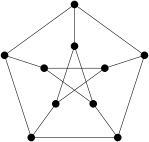 Fig. 11. The Petersen graph
 Fig. 12. Investigate for planarity, find the chromatic number and the chromatic index of the graphs
The value of the chromatic function of a graph at a point is the number of proper colorings of this graph with colors.
Find the chromatic function of
the complete graph;
the graph having no edges;
the path;
the cycle;
a tree
with vertices.
The value of the chromatic function of a graph at a point is the number of proper colorings of this graph with colors.
for every edge of the graph .
Birkhoff–Whitney theorem. For every graph there exists exactly one polynomial such that for every the number of proper colorings of the graph with colors equals the value of this polynomial at the point .
The degree of the chromatic polynomial equals , the leading coefficient equals 1, the second coefficient equals , and the coefficients alternate in sign (i.e., the coefficient of is nonnegative and the coefficient of is nonpositive for every integer ).
The third coefficient of the chromatic polynomial of a graph, counting from the leading one, is uniquely determined by the collection of subgraphs of the graph containing 3 vertices.
The number equals the number of acyclic orientations of the graph , i.e., the number of ways to put arrows on its edges so that the resulting directed graph contains no directed cycles.
In view of this theorem the chromatic function is called the chromatic polynomial and is regarded as defined not only for integers (cf. part (5)).
If the chromatic polynomial of a graph equals , then the graph is a tree.
There is no graph with chromatic polynomial .
A path on vertices is ``attached'' by one of its ends to one of the vertices of a graph containing vertices. Express the chromatic polynomial of the resulting graph with vertices in terms of .
If are the graphs into which a connected graph splits when one of its edges is deleted, then .
Denote by the number of proper colorings of the edges of a graph with colors.
The function is a polynomial in .
The leading monomial of equals .
The coefficient of in equals .
A bridge is an edge whose removal increases the number of connected components of the graph. A graph is called a forest if it contains no non-self-intersecting cycles.
Recall that when an edge is contracted in multigraphs, unlike in graphs, the resulting edges of multiplicity greater than 1 are not replaced by edges of multiplicity 1.
For any multigraph the equality holds, where is any edge of the multigraph that is neither a loop nor a bridge, and is the number of
spanning forests in the graph (i.e., unions of spanning trees of its components);
sets of edges of the graph such that for every connected component of the graph the edges of the set lying in it form a connected subgraph;
subgraphs of the graph that are forests.
Let a connected multigraph be given, together with a set of its edges that contains no non-self-intersecting cycles and no edge of some maximal tree. In a multiset (i.e., in an unordered collection with multiplicities) of multigraphs it is allowed, for any multigraph and any edge of it that is neither a loop nor a bridge, to replace the one multigraph by the two multigraphs , . This replacement is applied to all edges of the set (more precisely, to the corresponding edges of the multigraphs obtained from the original one by means of this operation). Then the resulting multiset is well defined up to isomorphisms of the multigraphs in it, i.e., it does not depend on the order of the edges to which we apply the replacements.
The Tutte polynomial of a multigraph is the polynomial in two variables defined by the recurrence formula if is neither a loop nor a bridge, and if has bridges, loops and no other edges. Using without proof the fact that the Tutte polynomial is well defined, express in terms of it
the number from part (1) of Problem 3.3.6;
the number from part (2) of Problem 3.3.6;
the number from part (3) of Problem 3.3.6;
the chromatic polynomial.