Homology Theory
[39/100%]Prove the Lemma.
Consider the following commutative diagram of abelian groups
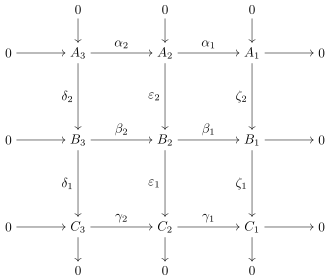
If all 3 columns and the first two rows are short exact, then the last row is also short exact.
Prove that if is a compact manifold of odd dimension, then . Show examples of compact 4-manifolds with .
Let be a topological space. The suspension of is defined to be the identification space obtained from by identifying to a point and to another point. For example the sphere is the suspension of with the north and south poles corresponding to the two identification points.
Compute the homology of in terms of the homology of .
Consider the chain complex
Compute for all .
Construct a CW complex which has the following -homology groups:
Compute , , for all .
Build a CW complex by adding two 2-cells to , one by the map and the other by the map . What is the homology of this space?
Let
Compute .
Prove that any homeomorphism must leave the origin fixed.
Write down the Mayer--Vietoris sequence in reduced homology which relates the spaces , , and a disk in about the point . (-sphere.)
Use (a) to calculate the homology of .
Let the real projective plane be embedded in the standard way in the real projective 5-space . Compute , where is the space obtained from by identifying to a point.
Let
Prove that is not homeomorphic to .
Let be a non-empty subset of and be the union of with the cone of ; that is, is obtained from the subset of by identifying to a point.
Prove that the reduced homology group is isomorphic to , for every .
For any topological space let denote its (unreduced) suspension. ( is the quotient space , where denotes the equivalence relation generated by requiring that if or .) If is a map, let be the map of suspensions induced by the map of .
Prove that if is a homotopy equivalence then so is .
Using only the Eilenberg--Steenrod axioms (Homotopy, Exactness, Excision, Dimension) for a homology theory prove that is naturally isomorphic to . (Here denotes reduced singular homology.)
Consider the following commutative diagram of abelian groups in which the row and column are exact sequences.

Suppose that and are surjective. Prove that is injective.
Suppose that a topological space is expressed as the union of two open path-connected subspaces such that is path connected, , and the inclusion induces a surjective homomorphism . (Here denotes singular homology.)
Prove that .
Give an example to show that the analogous assertion becomes false in general if is replaced everywhere by .
Let
denote the standard unit ball in Euclidean space , and
denote the standard -sphere. Suppose that is a continuous map such that the restriction of to is a homeomorphism from to . Prove that is surjective.
Let be a connected CW complex with two 0-cells, three 1-cells, three 2-cells, and no higher-dimensional cells. Assume . Compute the Euler characteristic of and determine (with proof) all possibilities for .
Let be a CW complex with exactly one -cell. Prove that if is a non-trivial finite group then .
Let
and
Let . Compute the relative homology groups for all .
Let be a path connected and locally path connected space and let . Let . Show that if is finite, then any continuous map induces the trivial map for all different from 0 and 2.
Call a commutative diagram of abelian groups
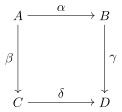
``exact'' if the sequence of groups and homomorphisms
It is an interesting fact that if
and
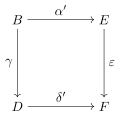
are exact, then so is
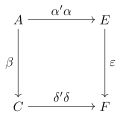
Prove exactness of
Let be a non-empty compact Hausdorff space and be a continuous map. Prove that there exists a non-empty closed subset of such that . Give an example to show that compactness is essential for this assertion.
Recall that
( is the -dimensional real projective space.) Prove that there is no function inducing an isomorphism on the third homology.
Let
Compute .
Using part (a), show that is not homeomorphic to .
Prove or disprove: is homotopy equivalent to .
Let be the standard ball and sphere pair in , . Suppose that is a continuous map and is a homeomorphism. Show that if then .
Describe a CW structure on and use it to compute the homology of .
Compute the homology of with 2 points removed.
Let be a subspace of homeomorphic to the 2-sphere . State what the homology groups are (no proof is required). What can you say about the possibilities for the relative homology groups ?
Compute the homology groups of the space obtained as the union of the 2-sphere and the -axis in .
Define the unreduced suspension'' $\Sigma X$ of a space $X$ to be the quotient space of $I \times X$ obtained by identifying $\left\{ 0\right\} \times X$ to one point and $\left\{ 1\right\} \times X$ to one point. (This is the union of two cones'' on .) Show that there is a natural isomorphism , for all .
Denote by the union of the torus with the disc , where is attached to by identifying with a meridian curve in the torus, where .

Calculate for all .
Is a retract of ? Why or why not?
Given homomorphism and , the pull back of via is the group
Let be the homomorphism obtained by restricting the projection onto the first factor to . Prove that the kernel of is isomorphic to the kernel of .
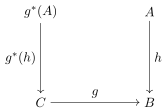
Let , , and let be the surjection defined by . Let and let be the surjection defined by . Identify the group , with explanation.
Recall that if is a homeomorphic copy of the circle in , then is infinite cyclic for equal to 0 or 1 and is zero otherwise. Assuming this fact compute
The homology of , when is a homeomorphic copy of the circle in .
The homology of , where is a homeomorphic copy of the ``figure-eight space'' (i.e., the one-point union of two circles.)
It is known that if is homeomorphic to then . Use this fact to compute the homology of where is a subspace of homeomorphic to the disjoint union of two copies of .
Sketch pictures of the universal covering of the one point union and of the connected 2-fold covering (no proofs required).
Compute the homology of the connected 2-fold covering space of .
Compute the homology of .
Suppose the following diagram is commutative, the rows are exact, and is an isomorphism for all .

Construct an exact sequence
Write out the proof of exactness at .
Suppose that is a space and , are two maps of into contractible spaces and . Let be the mapping cylinder of and , that is, is the identification space obtained from the disjoint union of , and by identifying each with , and each with . Prove that .
Let be an infinite sequence of topological spaces and be maps. The mapping telescope of this sequence is defined to be the identification space , where if , and describes the identification. Consider the case where all () and is a map of degree .
Compute when .
Compute when .
Let be a commutative ring with 1. Define an -homology sphere to be a Hausdorff topological space such that for some sphere .
Let be a compact connected -manifold and let . Suppose that for all . Prove that is a -homology sphere.
Give an example of and an -homology sphere which is a non-orientable connected compact manifold. Justify your answer by quoting appropriate theorems. You may quote standard computations without proof.