Finite Automata and Regular Expressions
[7/43%]Find a DFA accepting the language .
Construct an NFA accepting the set of binary strings of an odd length which contain the substring 00.
Find a regular expression for the language accepted by NFA in Figure 2.29(a).
For each of the following regular expressions , construct a DFA that accepts :
.
.
.
For each of the following languages, find an NFA that accepts it:
.
.
.
Figure 2.41 shows an NFA accepting , constructed based on the method of Example 2.22. The four -moves cannot be eliminated by the rule of Theorem 1.25. Apply the method in the proof of Theorem 2.31 to reduce some of its -moves. Can you find, from this example, a more general rule (than Theorem 1.25) to eliminate redundant -transitions?
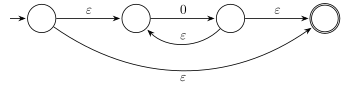 Figure 2.41: An NFA accepting 0*.
For each of the languages accepted by NFA's of Figure 2.42, find a regular expression for it.
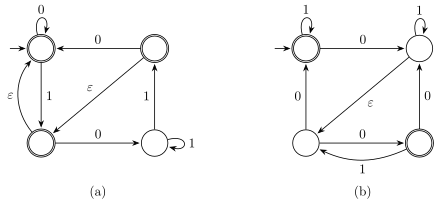 Figure 2.42: Two NFA’s for Exercise 4.