Nondeterministic Finite Automata
[10/60%]Find an NFA that accepts the set of binary strings having a substring 010.
Find an NFA that accepts the set of binary strings beginning with 010 or ending with 110.
Find an NFA that accepts the set of binary strings with at least two occurrences of substring 01 and ends with 11.
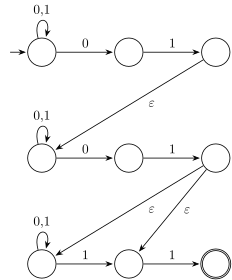 Figure 2.22: The Solution to Example 2.19.
Find an NFA that accepts the set .
Let and be two NFA's. Construct an NFA such that .
Let be an NFA. Construct an NFA such that .
Consider the NFA of Figure 2.26.
What are -closure and -closure ?
What are and ?
Draw the computation trees of on strings and . Does accept or reject and ?
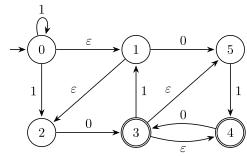 Figure 2.26: The NFA of Exercise 1.
For each NFA shown in Figure 2.27, determine what is.
For each of the following languages, construct an NFA that accepts the language:
The set of binary strings that contain at least three occurrences of substring 010.
The set of binary strings that contain both substrings 010 and 101. [Hint: This is equivalent to the set of binary strings that contain either a substring 0101 or a substring 1010 or a substring 010 followed by 101 or a substring 101 followed by 010.]
The set of binary strings that contain either a substring 010 or a substring 101, and end with 111 or 000.
The set of binary strings of which the th symbol is 0 for each .
The set of binary strings of length for some , such that, for each , at least one of the nd, st and th symbols of is 0.
The set .
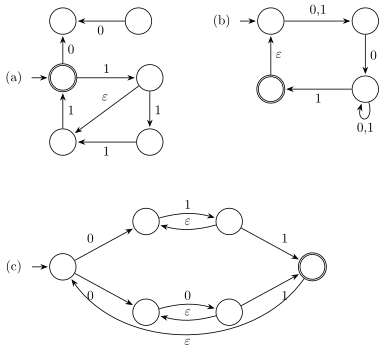 Figure 2.27: Three NFA’s of Exercise 2.
Prove that the new initial state and the final state in the construction of Example 2.22 are necessary. That is, find NFA's and such that the NFA's and of Figure 2.28 have the property and .