Section 2.1

Deterministic Finite Automata

[8/63%]
Show
LaTeX
Example 2.1

Consider a DFA M=(Q,Σ,δ,q0,F)M=\left(Q, \Sigma , \delta , q_{0}, F\right) where Q={q0,q1,q2, q3},Σ={0,1},F={q1,q2}Q=\left\{ q_{0}, q_{1}, q_{2}\text{, }q_{3}\right\} , \Sigma =\left\{ 0,1\right\} , F=\left\{ q_{1}, q_{2}\right\}, and δ\delta is the function defined by the following table:

δ\delta01
q0q_{0}q1q_{1}q3q_{3}
q1q_{1}q2q_{2}q3q_{3}
q2q_{2}q2q_{2}q2q_{2}
q3q_{3}q3q_{3}q3q_{3}

Draw the transition diagram of MM.

?
Example 2.2

Consider the DFA MM given by Figure 2.2 Determine whether MM accepts strings 000 and 010.

?
Example 2.3

What is the language L(M)L(M) accepted by the DFAMD F A M of Figure 2.2?

?
Example 2.4

What is the language L(M)L(M) accepted by the DFA MM of Figure 2.3?

?
Example 2.5

What is the language L(M)L(M) accepted by the DFAMD F A M of Figure 2.4?

?
Problem 2.1.1

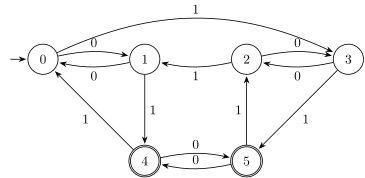
Consider the DFA MM with the transition diagram of Figure 2.5.

?
(a)

Which state is the initial state of MM, and which states are the final states of MM?

(b)

For each of the strings 0001, 010101, and 001110101101, find the computation path of MM on the string and determine whether MM accepts it.

(c)

Among all strings in (01)*, which ones are in L(M)L(M)?

Figure 2.5: DFA of Exercise 1.Figure 2.5: DFA of Exercise 1.

Problem 2.1.2

For integers n,d≥1n, d \geq 1, consider a DFA Mn,d=(Q,Σ,δ,q0,F)M_{n, d}=\left(Q, \Sigma , \delta , q_{0}, F\right), where Q={q0,q1,q2,⋯ ,qn−1},Σ={a0,a1,⋯ ,ad−1},δ(qi,ak)=q(di+k) mod nQ= \left\{ q_{0}, q_{1}, q_{2}, \cdots , q_{n-1}\right\} , \Sigma =\left\{ a_{0}, a_{1}, \cdots , a_{d-1}\right\} , \delta \left(q_{i}, a_{k}\right)=q_{(d i+k) \bmod n}, and F={q1}F=\left\{ q_{1}\right\}.

?
(a)

Draw the transition diagram of Mn,dM_{n, d} with n=7n=7 and d=2d=2.

(b)

Suppose n=7,d=2,a0=0n=7, d=2, a_{0}=0 and a1=1a_{1}=1. Find δ(q3,0101)\delta \left(q_{3}, 0101\right) and δ(q1,11010)\delta \left(q_{1}, 11010\right).

(c)

Suppose n=7,d=2,a0=0n=7, d=2, a_{0}=0 and a1=1a_{1}=1. Find binary strings xx and yy such that δ(q0,x)=q5\delta \left(q_{0}, x\right)=q_{5} and δ(q0,y)=q6\delta \left(q_{0}, y\right)=q_{6}.

(d)
  • Show that for any state qj∈Qq_{j} \in Q, there exists a string x∈Σ∗x \in \Sigma^{*} such that δ(q0,x)=qj\delta \left(q_{0}, x\right)=q_{j}.

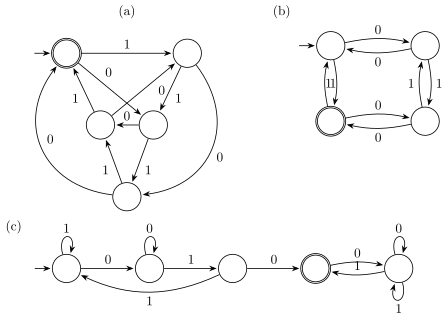
Figure 2.6: Three DFA’s of Exercise 3.Figure 2.6: Three DFA’s of Exercise 3.

Problem 2.1.3

For each of the DFA's M1,M2M_{1}, M_{2} and M3M_{3}, as shown in Figure 2.6(a), (b) and (c), respectively, describe in English the language accepted by it.

?