Double Integrals
[83/100%]Regarding the integral as the limit of an integral sum, use the lines
to divide the domain of integration into a number of squares, and take the value of the integrand at the right-hand vertex of each of these squares, to compute the value of the integral in question.
Use the lines
to divide the domain , into a number of rectangles. Form the lower integral sum and the upper integral sum of the function over this domain; as , what do the limits of the upper and lower sums equal?
Using a system of inscribed squares as an approximating domain for the region of integration, where the vertices of these squares lie at integer points, and taking the value of the integrand at the vertex of each square that is farthest from the origin, approximately compute the integral
and compare it with the exact value.
Using the lines const, const, const, divide the domain into four equal triangles, and taking the value of the integrand at the intersection point of the medians of each triangle, approximately compute the integral
where denotes the triangle bounded by the lines , , and .
Divide the domain into finitely many quadrable subdomains each of diameter less than . For what values of can we guarantee that the inequality
holds, where ?
Compute the integral: .
Compute the integral: .
Compute the integral: .
Let be the rectangle
prove the equality
Let
compute
Let be a function continuous on the closed interval . Prove the inequality
where equality holds only when constant.
What sign does the following integral have:
What sign does the following integral have: ?
What sign does the following integral have: ?
What sign does the following integral have: ?
Find the average value of the function
over the square: , .
Using the mean value theorem, estimate the value of the integral
Find the average value of the squared distance from a point on the disk to the origin.
For the double integral , over the indicated region , set up the limits of integration in two different orders: is the triangle with vertices , , .
For the double integral , over the indicated region , set up the limits of integration in two different orders: is the triangle with vertices , , .
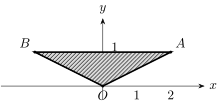 Fig. 8.1
For the double integral , over the indicated region , set up the limits of integration in two different orders: is the trapezoid with vertices , , , .
 Fig. 8.2
For the double integral , over the indicated region , set up the limits of integration in two different orders: is the disk .
For the double integral , over the indicated region , set up the limits of integration in two different orders: is the disk .
 Fig. 8.3
For the double integral , over the indicated region , set up the limits of integration in two different orders: is the parabolic segment bounded by the curves and .
For the double integral , over the indicated region , set up the limits of integration in two different orders: is the annulus .
 Fig. 8.4
Prove the Dirichlet formula
Change the order of integration in the following integral: .
 Fig. 8.6
Change the order of integration in the following integral: .
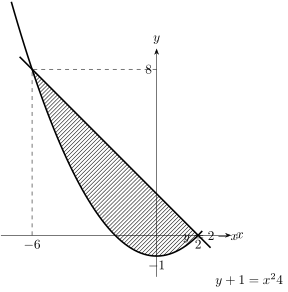 Fig. 8.7
Change the order of integration in the following integral: .
 Fig. 8.8
In the following integral, change the order of integration: .
 Figure 8.9
In the following integral, change the order of integration: .
 Figure 8.10
In the following integral, change the order of integration: .
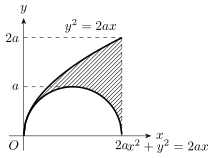 Figure 8.11
In the following integral, change the order of integration: .
 Figure 8.12
In the following integral, change the order of integration: .
 Figure 8.13
Compute the following integral: , where is the region bounded by the parabola and the line .
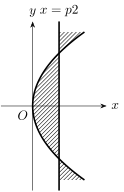 Figure 8.14
Compute the following integral: , where is the region bounded by the shorter arc of the circle centered at with radius and tangent to the coordinate axes, together with the coordinate axes.
 Figure 8.15
Compute the following integral: , where is the disk of radius centered at the origin.
Compute the following integral: , where is the parallelogram with sides , , , and .
 Figure 8.16
Compute the following integral: , where is the region bounded by the horizontal axis and the first arch of the cycloid
In the double integral , suppose and ; transform to the polar coordinates and , and set up the limits of integration, where is the disk .
In the double integral , suppose and ; transform to the polar coordinates and , and set up the limits of integration, where is the disk .
In the double integral , suppose and ; transform to the polar coordinates and , and set up the limits of integration, where is the annulus .
In the double integral , suppose and ; transform to the polar coordinates and , and set up the limits of integration, where is the triangle , .
In the double integral , suppose and ; transform to the polar coordinates and , and set up the limits of integration, where is the parabolic segment , .
 Figure 8.17
Under what circumstances are the limits of integration constant after transforming to polar coordinates?
In the following integral, assuming and , transform to polar coordinates and , and set up the limits of integration in two different orders: .
 Fig. 8.18
In the following integral, assuming and , transform to polar coordinates and , and set up the limits of integration in two different orders: .
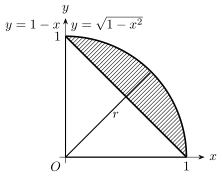 Fig. 8.19
In the following integral, assuming and , transform to polar coordinates and , and set up the limits of integration in two different orders: .
 Fig. 8.20
In the following integral, assuming and , transform to polar coordinates and , and set up the limits of integration in two different orders: .
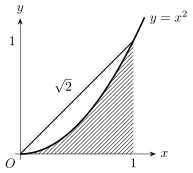 Fig. 8.21
Compute the following integral: , where is the region bounded by the curve .
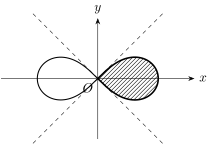 Fig. 8.22
Assuming and are polar coordinates, change the order of integration in the following integral: .
 Fig. 8.23
Assuming and are polar coordinates, change the order of integration in the following integral: .
 Fig. 8.24
Assuming and are polar coordinates, change the order of integration in the following integral: .
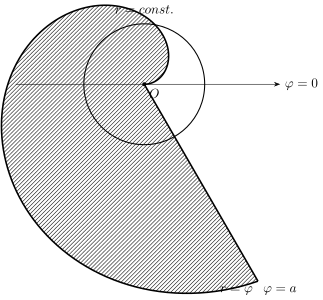 Fig. 8.25
Transform to polar coordinates, replacing the double integral by a single integral: .
Transform to polar coordinates, replacing the double integral by a single integral: , where .
 Fig. 8.26
Transform to polar coordinates, replacing the double integral by a single integral: .
Transform to polar coordinates to compute the following double integral: .
Convert to polar coordinates in order to evaluate the following double integral: .
Using the system of functions
transform the rectangle into a domain . Find the ratio of the area of the domain to the area of . What does this ratio tend to as ?
Introduce new variables , in place of , , and determine the limits of integration in the following double integral: , if , .
Introduce new variables , in place of , , and determine the limits of integration in the following double integral: , if , .
Introduce new variables , in place of , , and determine the limits of integration in the following double integral: , where is the region bounded by the curves , , , if , .
Prove that the change of variables
transforms the triangle , into the unit square , .
Under what change of variables does the curvilinear quadrilateral bounded by the curves , , , become a rectangle with sides parallel to the coordinate axes?
Perform a suitable change of variables to reduce the following double integral to a single integral: .
Perform a suitable change of variables to reduce the following double integral to a single integral: .
Perform a suitable change of variables to reduce the following double integral to a single integral: , where is the region bounded by the curves , , , .
Perform a suitable change of variables to reduce the following double integral to a single integral: , where is the region enclosed by the curve .
Compute the following double integral: .
Compute the following double integral: , where the domain of integration is the region bounded by the ellipse .
Compute the following double integral: .
Compute the following double integral: , where the domain of integration is the region bounded by the curves , , .
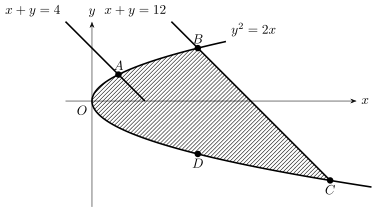 Fig. 8.28
Compute the following double integral: , where is the region bounded by the curves , .
Compute the following double integral: .
Compute the following double integral: .
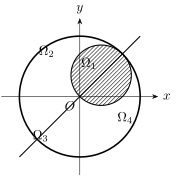 Fig. 8.29
Evaluate the following double integral: .
Evaluate the integral of the discontinuous function: .
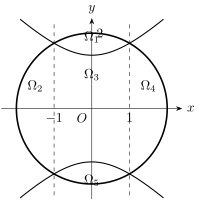 Figure 8.30
Evaluate the integral of the discontinuous function: .
 Figure 8.31
Evaluate the integral of the discontinuous function: .
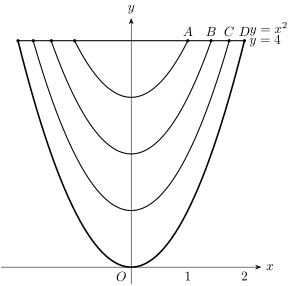 Figure 8.32
Let and be positive integers with at least one of them odd. Prove that
Find:
where is a continuous function.
Let
find .
Let
find .
Let
find .
Let be continuous; prove that the function
satisfies the equation
Let the level curves of the function be simple closed curves, and let be the region bounded by the curves and . Prove that
where is the area enclosed by the curve .