Section 1.2

Theory of Sequences

[111/99%]
Show
LaTeX
Problem 41

Let

xn=nn+1(n=1,2,…) x_{n}=\frac{n}{n+1} \quad (n=1,2,\ldots )

Prove that

lim⁡n→∞xn=1, \lim _{n \to \infty } x_{n}=1,

that is: for any given ε>0\varepsilon >0, find a number N=N(ε)N=N(\varepsilon ) such that when n>Nn>N, ∣xn−1∣<ε\left|x_{n}-1\right|<\varepsilon. Fill in the table below:

ε\varepsilon0.10.010.0010.0001⋯\cdots
NN
?
Problem 42

Suppose:

?
(a)

xn=(−1)n+1nx_{n}=\dfrac {(-1)^{n+1}}{n};

(b)

xn=2nn3+1x_{n}=\dfrac {2n}{n^{3}+1};

(c)

xn=1n!x_{n}=\dfrac {1}{n!};

(d)

xn=(−1)n⋅0.999nx_{n}=(-1)^{n} \cdot 0.999^{n}.

For any ε>0\varepsilon >0, find a number N=N(ε)N=N(\varepsilon ) such that when n>Nn>N, ∣xn∣<ε\left|x_{n}\right|<\varepsilon; that is, prove that xn(n=1,2,…)x_{n}(n=1,2,\ldots ) is infinitesimal (that is, has limit value 0). Corresponding to the four cases above, fill in the table below:
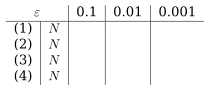
Problem 43

Prove that the sequences

?
(a)

xn=(−1)nnx_{n}=(-1)^{n} n;

(b)

xn=2nx_{n}=2^{\sqrt{n}};

(c)

xn=lg⁡(lg⁡n)(n≥2)x_{n}=\lg (\lg n) \quad (n \geq 2)

have infinite limits as n→∞n \to \infty (that is, become infinite), that is: for any E>0E>0, find a number N=N(E)N=N(E) such that when n>Nn>N, ∣xn∣>E\left|x_{n}\right|>E. Corresponding to each case above, fill in the table below:

EE10100100010000⋯\cdots
NN
Problem 44

Prove that

xn=n(−1)n(n=1,2,…) x_{n}=n^{(-1)^{n}} \quad (n=1,2,\ldots )

is unbounded, but as n→∞n \to \infty it does not become infinite.

?
Problem 45

Express the following statements using inequalities:

?
(a)

lim⁡n→∞xn=∞\lim \limits_{n \to \infty } x_{n}=\infty;

(b)

lim⁡n→∞xn=−∞\lim \limits_{n \to \infty } x_{n}=-\infty;

(c)

lim⁡n→∞xn=+∞\lim \limits_{n \to \infty } x_{n}=+\infty.

Problem 46

Let nn run through the sequence of natural numbers; find the value of the following expression:lim⁡n→∞10000nn2+1\lim \limits_{n \to \infty } \dfrac {10000n}{n^{2}+1}.

?
Problem 47

Let nn run through the sequence of natural numbers; find the value of the following expression:lim⁡n→∞(n+1−n)\lim \limits_{n \to \infty } (\sqrt{n+1}-\sqrt{n}).

?
Problem 48

Let nn run through the sequence of natural numbers; find the value of the following expression:lim⁡n→∞n23sin⁡n!n+1\lim \limits_{n \to \infty } \dfrac {\sqrt[3]{n^{2}}\sin n!}{n+1}.

?
Problem 49

Let nn run through the sequence of natural numbers; find the value of the following expression:lim⁡n→∞(−2)n+3n(−2)n+1+3n+1\lim \limits_{n \to \infty } \dfrac {(-2)^{n}+3^{n}}{(-2)^{n+1}+3^{n+1}}.

?
Problem 50

Let nn run through the sequence of natural numbers; find the value of the following expression:lim⁡n→∞1+a+a2+⋯+an1+b+b2+⋯+bn(∣a∣<1,∣b∣<1)\lim \limits_{n \to \infty } \dfrac {1+a+a^{2}+\cdots +a^{n}}{1+b+b^{2}+\cdots +b^{n}} \quad (\left|a\right|<1, \left|b\right|<1).

?
Problem 51

Let nn run through the sequence of natural numbers; find the value of the following expression:lim⁡n→∞(1n2+2n2+⋯+n−1n2)\lim \limits_{n \to \infty } \left(\dfrac {1}{n^{2}}+\dfrac {2}{n^{2}}+\cdots +\dfrac {n-1}{n^{2}}\right).

?
Problem 52

Let nn run through the sequence of natural numbers; find the value of the following expression:lim⁡n→∞[1n−2n+3n−⋯+(−1)n−1nn]\lim \limits_{n \to \infty } \left[\dfrac {1}{n}-\dfrac {2}{n}+\dfrac {3}{n}-\cdots +\dfrac {(-1)^{n-1}n}{n}\right].

?
Problem 53

Let nn run through the sequence of natural numbers; find the value of the following expression:lim⁡n→∞[12n3+22n3+⋯+(n−1)2n3]\lim \limits_{n \to \infty } \left[\dfrac {1^{2}}{n^{3}}+\dfrac {2^{2}}{n^{3}}+\cdots +\dfrac {(n-1)^{2}}{n^{3}}\right].

?
Problem 54

Let nn run through the sequence of natural numbers; find the value of the following expression:lim⁡n→∞[12n3+32n3+⋯+(2n−1)2n3]\lim \limits_{n \to \infty } \left[\dfrac {1^{2}}{n^{3}}+\dfrac {3^{2}}{n^{3}}+\cdots +\dfrac {(2n-1)^{2}}{n^{3}}\right].

?
Problem 55

Let nn run through the sequence of natural numbers; find the value of the following expression:lim⁡n→∞(12+322+523+⋯+2n−12n)\lim \limits_{n \to \infty } \left(\dfrac {1}{2}+\dfrac {3}{2^{2}}+\dfrac {5}{2^{3}}+\cdots +\dfrac {2n-1}{2^{n}}\right).

?
Problem 56

Let nn run through the sequence of natural numbers; find the value of the following expression:lim⁡n→∞[11⋅2+12⋅3+⋯+1n(n+1)]\lim \limits_{n \to \infty } \left[\dfrac {1}{1 \cdot 2}+\dfrac {1}{2 \cdot 3}+\cdots +\dfrac {1}{n(n+1)}\right].

?
Problem 57

Let nn run through the sequence of natural numbers; find the value of the following expression:lim⁡n→∞(2⋅24⋅28⋯22n)\lim \limits_{n \to \infty } \left(\sqrt{2} \cdot \sqrt[4]{2} \cdot \sqrt[8]{2} \cdots \sqrt[2^{n}]{2}\right).

?
Problem 58

Prove the following identity:lim⁡n→∞n2n=0\lim \limits_{n \to \infty } \dfrac {n}{2^{n}}=0.

?
Problem 59

Prove the following identity:lim⁡n→∞2nn!=0\lim \limits_{n \to \infty } \dfrac {2^{n}}{n!}=0.

?
Problem 60

Prove the following identity:lim⁡n→∞nkan=0(a>1)\lim \limits_{n \to \infty } \dfrac {n^{k}}{a^{n}}=0 \quad (a>1).

?
Problem 61

Prove the following identity:lim⁡n→∞ann!=0\lim \limits_{n \to \infty } \dfrac {a^{n}}{n!}=0.

?
Problem 62

Prove the following identity:lim⁡n→∞nqn=0\lim \limits_{n \to \infty } nq^{n}=0, if ∣q∣<1\left|q\right|<1.

?
Problem 63

Prove the following identity:lim⁡n→∞an=1(a>0)\lim \limits_{n \to \infty } \sqrt[n]{a}=1 \quad (a>0).

?
Problem 64

Prove the following identity:lim⁡n→∞log⁡ann=0(a>1)\lim \limits_{n \to \infty } \dfrac {\log_{a}n}{n}=0 \quad (a>1).

?
Problem 65

Prove the following identity:lim⁡n→∞nn=1\lim \limits_{n \to \infty } \sqrt[n]{n}=1.

?
Problem 66

Prove the following identity:lim⁡n→∞1n!n=0\lim \limits_{n \to \infty } \dfrac {1}{\sqrt[n]{n!}}=0.

?
Problem 67

When nn is sufficiently large, which of the following expressions is larger?

?
(a)

100n+200100n+200 or 0.01n20.01n^{2}?

(b)

2n2^{n} or n1000n^{1000}?

(c)

1000n1000^{n} or n!n!?

Problem 68

Prove that

lim⁡n→∞(12⋅34⋯2n−12n)=0. \lim _{n \to \infty } \left(\frac{1}{2} \cdot \frac{3}{4} \cdots \frac{2n-1}{2n}\right)=0 .
?
Problem 69

Prove that the sequence

xn=(1+1n)n(n=1,2,…) x_{n}=\left(1+\frac{1}{n}\right)^{n} \quad (n=1,2,\ldots )

is monotonically increasing and bounded above, while the sequence

yn=(1+1n)n+1(n=1,2,…) y_{n}=\left(1+\frac{1}{n}\right)^{n+1} \quad (n=1,2,\ldots )

is monotonically decreasing and bounded below. From this, deduce that these sequences have a common limit:

lim⁡n→∞(1+1n)n=lim⁡n→∞(1+1n)n+1=e. \lim _{n \to \infty } \left(1+\frac{1}{n}\right)^{n}=\lim _{n \to \infty } \left(1+\frac{1}{n}\right)^{n+1}=e .
?
Problem 70

Prove that

0<e−(1+1n)n<3n(n=1,2,…). 0<e-\left(1+\frac{1}{n}\right)^{n}<\frac{3}{n} \quad (n=1,2,\ldots ) .

For what values of the exponent nn does the expression (1+1n)n\left(1+\dfrac {1}{n}\right)^{n} differ from the number ee by less than 0.0010.001?

?
Problem 71

Let pn(n=1,2,…)p_{n}(n=1,2,\ldots ) be an arbitrary sequence tending to +∞+\infty, and let qn(n=1,2,…)q_{n}(n=1,2,\ldots ) be an arbitrary sequence tending to −∞-\infty. Prove that

lim⁡n→∞(1+1pn)pn=lim⁡n→∞(1+1qn)qn=e. \lim _{n \to \infty } \left(1+\frac{1}{p_{n}}\right)^{p_{n}}=\lim _{n \to \infty } \left(1+\frac{1}{q_{n}}\right)^{q_{n}}=e .
?
Problem 72

Given that

lim⁡n→∞(1+1n)n=e, \lim _{n \to \infty } \left(1+\frac{1}{n}\right)^{n}=e,

prove that

lim⁡n→∞(1+1+12!+13!+⋯+1n!)=e. \lim _{n \to \infty } \left(1+1+\frac{1}{2!}+\frac{1}{3!}+\cdots +\frac{1}{n!}\right)=e .

From this, deduce the formula

e=1+1+12!+13!+⋯+1n!+θnn! n, e=1+1+\frac{1}{2!}+\frac{1}{3!}+\cdots +\frac{1}{n!}+\frac{\theta _{n}}{n! \, n},

where 0<θn<10<\theta_{n}<1, and compute the number ee to an accuracy of 10−510^{-5}.

?
Problem 73

Prove that the number ee is irrational.

?
Problem 74

Prove the inequality

(ne)n<n!<e(n2)n. \left(\frac{n}{e}\right)^{n}<n!<e\left(\frac{n}{2}\right)^{n} .
?
Problem 75

Prove the inequalities:

?
(a)

1n+1<ln⁡(1+1n)<1n\dfrac {1}{n+1}<\ln \left(1+\dfrac {1}{n}\right)<\dfrac {1}{n}, where nn is any natural number.

(b)

1+a<ea1+a<e^{a}, where aa is a nonzero real number.

Problem 76

Prove that

lim⁡n→∞n(a1n−1)=ln⁡a(a>0), \lim _{n \to \infty } n\left(a^{\frac{1}{n}}-1\right)=\ln a \quad (a>0),

where ln⁡a\ln a is the logarithm of the number aa taken to base e=2.718…e=2.718\ldots.

?
Problem 77

Using the theorem on the existence of the limit of a monotone and bounded sequence, prove the convergence of the sequence

xn=p0+p110+⋯+pn10n(n=1,2,…), x_{n}=p_{0}+\frac{p_{1}}{10}+\cdots +\frac{p_{n}}{10^{n}} \quad (n=1,2,\ldots ),

where pi(i=0,1,2,…)p_{i}(i=0,1,2,\ldots ) are nonnegative integers, and from p1p_{1} onward not exceeding 9.

?
Problem 78

Using the theorem on the existence of the limit of a monotone and bounded sequence, prove the convergence of the sequencexn=101⋅113⋯n+92n−1x_{n}=\dfrac {10}{1} \cdot \dfrac {11}{3} \cdots \dfrac {n+9}{2n-1}.

?
Problem 79

Using the theorem on the existence of the limit of a monotone and bounded sequence, prove the convergence of the sequencexn=(1−12)(1−14)⋯(1−12n)x_{n}=\left(1-\dfrac {1}{2}\right)\left(1-\dfrac {1}{4}\right)\cdots \left(1-\dfrac {1}{2^{n}}\right).

?
Problem 80

Using the theorem on the existence of the limit of a monotone and bounded sequence, prove the convergence of the sequencexn=(1+12)(1+14)⋯(1+12n)x_{n}=\left(1+\dfrac {1}{2}\right)\left(1+\dfrac {1}{4}\right)\cdots \left(1+\dfrac {1}{2^{n}}\right).

?
Problem 81

Using the theorem on the existence of the limit of a monotone and bounded sequence, prove the convergence of the sequencex1=2x_{1}=\sqrt{2}, x2=2+2x_{2}=\sqrt{2+\sqrt{2}}, …\ldots,

xn=2+2+⋯+2⏟n nested radicals,… x_{n}=\underbrace{\sqrt{2+\sqrt{2+\cdots +\sqrt{2}}}}_{n \text{ nested radicals}}, \ldots
?
Problem 82

Using the Cauchy criterion, prove the convergence of the sequencexn=a0+a1q+⋯+anqnx_{n}=a_{0}+a_{1}q+\cdots +a_{n}q^{n}, where ∣ak∣<M(k=0,1,2,…)\left|a_{k}\right|<M (k=0,1,2,\ldots ) and ∣q∣<1\left|q\right|<1.

?
Problem 83

Using the Cauchy criterion, prove the convergence of the sequencexn=sin⁡12+sin⁡222+⋯+sin⁡n2nx_{n}=\dfrac {\sin 1}{2}+\dfrac {\sin 2}{2^{2}}+\cdots +\dfrac {\sin n}{2^{n}}.

?
Problem 84

Using the Cauchy criterion, prove the convergence of the sequencexn=cos⁡1!1⋅2−cos⁡2!2⋅3+⋯+cos⁡n!n(n+1)x_{n}=\dfrac {\cos 1!}{1 \cdot 2}-\dfrac {\cos 2!}{2 \cdot 3}+\cdots +\dfrac {\cos n!}{n(n+1)}.

?
Problem 85

Using the Cauchy criterion, prove the convergence of the sequencexn=1+122+⋯+1n2x_{n}=1+\dfrac {1}{2^{2}}+\cdots +\dfrac {1}{n^{2}}.

?
Problem 86

If there exists a number cc such that

∣x2−x1∣+∣x3−x2∣+⋯+∣xn−xn−1∣<c(n=2,3,…), \left|x_{2}-x_{1}\right|+\left|x_{3}-x_{2}\right|+\cdots +\left|x_{n}-x_{n-1}\right|<c \quad (n=2,3,\ldots ),

then the sequence xn(n=1,2,…)x_{n}(n=1,2,\ldots ) is said to have bounded variation. Prove that any sequence of bounded variation is convergent. Give an example of a convergent sequence that does not have bounded variation.

?
Problem 87

State the meaning of "a certain sequence does not satisfy the Cauchy criterion."

?
Problem 88

Using the Cauchy criterion, prove the divergence of the sequence

xn=1+12+13+⋯+1n x_{n}=1+\frac{1}{2}+\frac{1}{3}+\cdots +\frac{1}{n}
?
Problem 89

Prove that if the sequence xn(n=1,2,…)x_{n}(n=1,2,\ldots ) converges, then any of its subsequences xpnx_{p_{n}} also converges, and has the same limit:

lim⁡n→∞xpn=lim⁡n→∞xn. \lim _{n \to \infty } x_{p_{n}}=\lim _{n \to \infty } x_{n} .
?
Problem 90

Prove that if some subsequence of a monotone sequence converges, then the monotone sequence itself is convergent.

?
Problem 91

Prove that if

lim⁡n→∞xn=a, \lim _{n \to \infty } x_{n}=a,

then

lim⁡n→∞∣xn∣=∣a∣. \lim _{n \to \infty } \left|x_{n}\right|=\left|a\right| .
?
Problem 92

Let xn→ax_{n} \to a, then what is the limit

lim⁡n→∞xn+1xn \lim _{n \to \infty } \frac{x_{n+1}}{x_{n}}
?
Problem 93

Prove that a convergent sequence is bounded.

?
Problem 94

Prove that a convergent sequence either attains its supremum, or attains its infimum, or attains both. Give examples of each of these three types of sequences.

?
Problem 95

Prove that a sequence xn(n=1,2,…)x_{n}(n=1,2,\ldots ) tending to +∞+\infty necessarily attains its infimum.

?
Problem 96

Find the largest term of the sequence xnx_{n} (n=1,2,…)(n=1,2,\ldots ), wherexn=n22nx_{n}=\dfrac {n^{2}}{2^{n}}.

?
Problem 97

Find the largest term of the sequence xnx_{n} (n=1,2,…)(n=1,2,\ldots ), wherexn=n100+nx_{n}=\dfrac {\sqrt{n}}{100+n}.

?
Problem 98

Find the largest term of the sequence xnx_{n} (n=1,2,…)(n=1,2,\ldots ), wherexn=1000nn!x_{n}=\dfrac {1000^{n}}{n!}.

?
Problem 99

Find the smallest term of the sequence xnx_{n} (n=1,2,…)(n=1,2,\ldots ), ifxn=n2−9n−100x_{n}=n^{2}-9n-100.

?
Problem 100

Find the smallest term of the sequence xnx_{n} (n=1,2,…)(n=1,2,\ldots ), ifxn=n+100nx_{n}=n+\dfrac {100}{n}.

?
Problem 101

Find inf⁡{xn}\inf \left\{ x_{n}\right\}, sup⁡{xn}\sup \left\{ x_{n}\right\}, lim‾⁡n→∞xn\varliminf \limits_{n \to \infty } x_{n} and lim‾⁡n→∞xn\varlimsup \limits_{n \to \infty } x_{n} for the sequence xnx_{n} (n=1,2,…)(n=1,2,\ldots ), given:xn=1−1nx_{n}=1-\dfrac {1}{n}.

?
Problem 101.1
[NO TASK]
Problem 102

Find inf⁡{xn}\inf \left\{ x_{n}\right\}, sup⁡{xn}\sup \left\{ x_{n}\right\}, lim‾⁡n→∞xn\varliminf \limits_{n \to \infty } x_{n} and lim‾⁡n→∞xn\varlimsup \limits_{n \to \infty } x_{n} for the sequence xnx_{n} (n=1,2,…)(n=1,2,\ldots ), given:xn=(−1)nn+1+(−1)n2x_{n}=\dfrac {(-1)^{n}}{n}+\dfrac {1+(-1)^{n}}{2}.

?
Problem 103

Find inf⁡{xn}\inf \left\{ x_{n}\right\}, sup⁡{xn}\sup \left\{ x_{n}\right\}, lim‾⁡n→∞xn\varliminf \limits_{n \to \infty } x_{n} and lim‾⁡n→∞xn\varlimsup \limits_{n \to \infty } x_{n} for the sequence xnx_{n} (n=1,2,…)(n=1,2,\ldots ), given:xn=1+nn+1cos⁡nπ2x_{n}=1+\dfrac {n}{n+1}\cos \dfrac {n\pi }{2}.

?
Problem 104

Find inf⁡{xn}\inf \left\{ x_{n}\right\}, sup⁡{xn}\sup \left\{ x_{n}\right\}, lim‾⁡n→∞xn\varliminf \limits_{n \to \infty } x_{n} and lim‾⁡n→∞xn\varlimsup \limits_{n \to \infty } x_{n} for the sequence xnx_{n} (n=1,2,…)(n=1,2,\ldots ), given:xn=1+2(−1)n+1+3(−1)n(n−1)2x_{n}=1+2(-1)^{n+1}+3(-1)^{\frac{n(n-1)}{2}}.

?
Problem 105

Find inf⁡{xn}\inf \left\{ x_{n}\right\}, sup⁡{xn}\sup \left\{ x_{n}\right\}, lim‾⁡n→∞xn\varliminf \limits_{n \to \infty } x_{n} and lim‾⁡n→∞xn\varlimsup \limits_{n \to \infty } x_{n} for the sequence xnx_{n} (n=1,2,…)(n=1,2,\ldots ), given:xn=n−1n+1cos⁡2nπ3x_{n}=\dfrac {n-1}{n+1}\cos \dfrac {2n\pi }{3}.

?
Problem 106

Find inf⁡{xn}\inf \left\{ x_{n}\right\}, sup⁡{xn}\sup \left\{ x_{n}\right\}, lim‾⁡n→∞xn\varliminf \limits_{n \to \infty } x_{n} and lim‾⁡n→∞xn\varlimsup \limits_{n \to \infty } x_{n} for the sequence xnx_{n} (n=1,2,…)(n=1,2,\ldots ), given:xn=(−1)nnx_{n}=(-1)^{n}n.

?
Problem 107

Find inf⁡{xn}\inf \left\{ x_{n}\right\}, sup⁡{xn}\sup \left\{ x_{n}\right\}, lim‾⁡n→∞xn\varliminf \limits_{n \to \infty } x_{n} and lim‾⁡n→∞xn\varlimsup \limits_{n \to \infty } x_{n} for the sequence xnx_{n} (n=1,2,…)(n=1,2,\ldots ), given:xn=−n[2+(−1)n]x_{n}=-n\left[2+(-1)^{n}\right].

?
Problem 108

Find inf⁡{xn}\inf \left\{ x_{n}\right\}, sup⁡{xn}\sup \left\{ x_{n}\right\}, lim‾⁡n→∞xn\varliminf \limits_{n \to \infty } x_{n} and lim‾⁡n→∞xn\varlimsup \limits_{n \to \infty } x_{n} for the sequence xnx_{n} (n=1,2,…)(n=1,2,\ldots ), given:xn=n(−1)nx_{n}=n(-1)^{n}.

?
Problem 109

Find inf⁡{xn}\inf \left\{ x_{n}\right\}, sup⁡{xn}\sup \left\{ x_{n}\right\}, lim‾⁡n→∞xn\varliminf \limits_{n \to \infty } x_{n} and lim‾⁡n→∞xn\varlimsup \limits_{n \to \infty } x_{n} for the sequence xnx_{n} (n=1,2,…)(n=1,2,\ldots ), given:xn=1+nsin⁡nπ2x_{n}=1+n\sin \dfrac {n\pi }{2}.

?
Problem 110

Find inf⁡{xn}\inf \left\{ x_{n}\right\}, sup⁡{xn}\sup \left\{ x_{n}\right\}, lim‾⁡n→∞xn\varliminf \limits_{n \to \infty } x_{n} and lim‾⁡n→∞xn\varlimsup \limits_{n \to \infty } x_{n} for the sequence xnx_{n} (n=1,2,…)(n=1,2,\ldots ), given:xn=1n−10.2x_{n}=\dfrac {1}{n-10.2}.

?
Problem 111

Find lim‾⁡n→∞xn\varliminf \limits_{n \to \infty } x_{n} and lim‾⁡n→∞xn\varlimsup \limits_{n \to \infty } x_{n}, given:xn=n21+n2cos⁡2nπ3x_{n}=\dfrac {n^{2}}{1+n^{2}}\cos \dfrac {2n\pi }{3}.

?
Problem 112

Find lim‾⁡n→∞xn\varliminf \limits_{n \to \infty } x_{n} and lim‾⁡n→∞xn\varlimsup \limits_{n \to \infty } x_{n}, given:xn=(1+1n)n⋅(−1)n+sin⁡nπ4x_{n}=\left(1+\dfrac {1}{n}\right)^{n} \cdot (-1)^{n}+\sin \dfrac {n\pi }{4}.

?
Problem 113

Find lim‾⁡n→∞xn\varliminf \limits_{n \to \infty } x_{n} and lim‾⁡n→∞xn\varlimsup \limits_{n \to \infty } x_{n}, given:xn=nn+1sin⁡2nπ4x_{n}=\dfrac {n}{n+1}\sin^{2}\dfrac {n\pi }{4}.

?
Problem 114

Find lim‾⁡n→∞xn\varliminf \limits_{n \to \infty } x_{n} and lim‾⁡n→∞xn\varlimsup \limits_{n \to \infty } x_{n}, given:xn=1+2n⋅(−1)nnx_{n}=\sqrt[n]{1+2^{n} \cdot (-1)^{n}}.

?
Problem 115

Find lim‾⁡n→∞xn\varliminf \limits_{n \to \infty } x_{n} and lim‾⁡n→∞xn\varlimsup \limits_{n \to \infty } x_{n}, given:xn=cos⁡n2nπ3x_{n}=\cos^{n}\dfrac {2n\pi }{3}.

?
Problem 116

Find the limit points of the sequence12,12,14,34,18,78,…,12n,2n−12n,…\dfrac {1}{2}, \dfrac {1}{2}, \dfrac {1}{4}, \dfrac {3}{4}, \dfrac {1}{8}, \dfrac {7}{8}, \ldots , \dfrac {1}{2^{n}}, \dfrac {2^{n}-1}{2^{n}}, \ldots.

?
Problem 117

Find the limit points of the sequence1,12,1+12,13,1+13,12+13,14,1+14,12+14,13+14,15,…,1n,1+1n,12+1n,1n−1+1n,1n+1,…1, \dfrac {1}{2}, 1+\dfrac {1}{2}, \dfrac {1}{3}, 1+\dfrac {1}{3}, \dfrac {1}{2}+\dfrac {1}{3}, \dfrac {1}{4}, 1+\dfrac {1}{4}, \dfrac {1}{2}+\dfrac {1}{4}, \dfrac {1}{3}+\dfrac {1}{4}, \dfrac {1}{5}, \ldots , \dfrac {1}{n}, 1+\dfrac {1}{n}, \dfrac {1}{2}+\dfrac {1}{n}, \dfrac {1}{n-1}+\dfrac {1}{n}, \dfrac {1}{n+1}, \ldots.

?
Problem 118

Find the limit points of the sequence12,13,23,14,24,34,15,25,35,45,…\dfrac {1}{2}, \dfrac {1}{3}, \dfrac {2}{3}, \dfrac {1}{4}, \dfrac {2}{4}, \dfrac {3}{4}, \dfrac {1}{5}, \dfrac {2}{5}, \dfrac {3}{5}, \dfrac {4}{5}, \ldots.

?
Problem 119

Find the limit points of the sequencexn=3(1−1n)+2(−1)nx_{n}=3\left(1-\dfrac {1}{n}\right)+2(-1)^{n}.

?
Problem 120

Find the limit points of the sequencexn=12[(a+b)+(−1)n(a−b)]x_{n}=\dfrac {1}{2}\left[(a+b)+(-1)^{n}(a-b)\right].

?
Problem 121

Give an example of a sequence having the given numbers

a1,a2,…,ap a_{1}, a_{2}, \ldots , a_{p}

as its limit points.

?
Problem 122

Give an example of a sequence for which every term of the given sequence

a1,a2,…,an,… a_{1}, a_{2}, \ldots , a_{n}, \ldots

is a limit point of it. What other limit points must the given sequence then necessarily have?

?
Problem 123

Give examples of sequences:

?
(a)

having no finite limit point;

(b)

having a unique finite limit point, yet not convergent;

(c)

having infinitely many limit points;

(d)

having every real number as a limit point.

Problem 124

Prove that the sequences xnx_{n} and yn=xn⋅nn(n=1,2,…)y_{n}=x_{n}\cdot \sqrt[n]{n} (n=1,2,\ldots ) have the same limit points.

?
Problem 125

Prove that from a bounded sequence xn(n=1,2,…)x_{n} (n=1,2,\ldots ) one can always select a convergent subsequence xpn(n=1,2,…)x_{p_{n}} (n=1,2,\ldots ).

?
Problem 126

Prove that if the sequence xn(n=1,2,…)x_{n} (n=1,2,\ldots ) is unbounded, then there exists a subsequence xpn(n=1,2,…)x_{p_{n}} (n=1,2,\ldots ) such that

lim⁡n→∞xpn=∞. \lim _{n\to \infty }x_{p_{n}}=\infty .
?
Problem 127

Suppose the sequence xn(n=1,2,…)x_{n} (n=1,2,\ldots ) converges, while the sequence yn(n=1,2,…)y_{n} (n=1,2,\ldots ) diverges. Can one then determine the convergence or divergence of the sequences

?
(a)

xn+ynx_{n}+y_{n};

(b)

xnynx_{n}y_{n}

Give appropriate examples.

Problem 128

Suppose the sequences xnx_{n} and yny_{n} both diverge (n=1,2,…)(n=1,2,\ldots ). Can one conclude that the sequences

?
(a)

xn+ynx_{n}+y_{n};

(b)

xnynx_{n}y_{n}

also diverge? Give appropriate examples.

Problem 129

Suppose lim⁡n→∞xn=0\lim \limits_{n\to \infty }x_{n}=0 and yn(n=1,2,…)y_{n} (n=1,2,\ldots ) is an arbitrary sequence. Can one conclude that lim⁡n→∞xnyn=0\lim \limits_{n\to \infty }x_{n}y_{n}=0? Give an appropriate example.

?
Problem 130

Suppose:

lim⁡n→∞xnyn=0. \lim _{n\to \infty }x_{n}y_{n}=0 .

Does it follow that either lim⁡n→∞xn=0\lim \limits_{n\to \infty }x_{n}=0 or lim⁡n→∞yn=0\lim \limits_{n\to \infty }y_{n}=0?

?
Problem 131

Prove

?
(a)

lim‾⁡n→∞xn+lim‾⁡n→∞yn⩽lim‾⁡n→∞(xn+yn)⩽lim‾⁡n→∞xn+lim‾⁡n→∞yn\varliminf \limits_{n\to \infty }x_{n}+\varliminf \limits_{n\to \infty }y_{n}\leqslant \varliminf \limits_{n\to \infty }(x_{n}+y_{n})\leqslant \varliminf \limits_{n\to \infty }x_{n}+\varlimsup \limits_{n\to \infty }y_{n};

(b)

lim‾⁡n→∞xn+lim‾⁡n→∞yn⩽lim‾⁡n→∞(xn+yn)⩽lim‾⁡n→∞xn+lim‾⁡n→∞yn\varliminf \limits_{n\to \infty }x_{n}+\varlimsup \limits_{n\to \infty }y_{n}\leqslant \varlimsup \limits_{n\to \infty }(x_{n}+y_{n})\leqslant \varlimsup \limits_{n\to \infty }x_{n}+\varlimsup \limits_{n\to \infty }y_{n}.

Give an example where strict inequality holds throughout in the relations above.

Problem 132

Suppose xn⩾0x_{n}\geqslant 0 and yn⩾0(n=1,2,…)y_{n}\geqslant 0 (n=1,2,\ldots ). Prove:

?
(a)

lim‾⁡n→∞xn⋅lim‾⁡n→∞yn⩽lim‾⁡n→∞(xnyn)⩽lim‾⁡n→∞xn⋅lim‾⁡n→∞yn\varliminf \limits_{n\to \infty }x_{n}\cdot \varliminf \limits_{n\to \infty }y_{n}\leqslant \varliminf \limits_{n\to \infty }(x_{n}y_{n})\leqslant \varliminf \limits_{n\to \infty }x_{n}\cdot \varlimsup \limits_{n\to \infty }y_{n};

(b)

lim‾⁡n→∞xn⋅lim‾⁡n→∞yn⩽lim‾⁡n→∞(xnyn)⩽lim‾⁡n→∞xn⋅lim‾⁡n→∞yn\varliminf \limits_{n\to \infty }x_{n}\cdot \varlimsup \limits_{n\to \infty }y_{n}\leqslant \varlimsup \limits_{n\to \infty }(x_{n}y_{n})\leqslant \varlimsup \limits_{n\to \infty }x_{n}\cdot \varlimsup \limits_{n\to \infty }y_{n}.

Give an example where strict inequality holds throughout in these relations.

Problem 133

Prove: if lim⁡n→∞xn\lim \limits_{n\to \infty }x_{n} exists, then for any sequence yn(n=1,2,…)y_{n} (n=1,2,\ldots ), we have

?
(a)

lim‾⁡n→∞(xn+yn)=lim⁡n→∞xn+lim‾⁡n→∞yn\varlimsup \limits_{n\to \infty }(x_{n}+y_{n})=\lim \limits_{n\to \infty }x_{n}+\varlimsup \limits_{n\to \infty }y_{n}

and

(b)

lim‾⁡n→∞(xnyn)=lim⁡n→∞xn⋅lim‾⁡n→∞yn(xn⩾0)\varlimsup \limits_{n\to \infty }(x_{n}y_{n})=\lim \limits_{n\to \infty }x_{n}\cdot \varlimsup \limits_{n\to \infty }y_{n} (x_{n}\geqslant 0).

Problem 134

Prove: if for some nonnegative sequence xn(xn⩾0,n=1,2,…)x_{n} (x_{n}\geqslant 0,n=1,2,\ldots ), every sequence yn(n=1,2,…)y_{n} (n=1,2,\ldots ) makes at least one of the following two identities hold:

?
(a)

lim‾⁡n→∞(xn+yn)=lim‾⁡n→∞xn+lim‾⁡n→∞yn\varlimsup \limits_{n\to \infty }(x_{n}+y_{n})=\varlimsup \limits_{n\to \infty }x_{n}+\varlimsup \limits_{n\to \infty }y_{n}

or

(b)

lim‾⁡n→∞(xnyn)=lim‾⁡n→∞xn⋅lim‾⁡n→∞yn\varlimsup \limits_{n\to \infty }(x_{n}y_{n})=\varlimsup \limits_{n\to \infty }x_{n}\cdot \varlimsup \limits_{n\to \infty }y_{n},

then the sequence xnx_{n} is convergent.

Problem 135

Prove: if xn>0(n=1,2,…)x_{n}>0 (n=1,2,\ldots ) and

lim‾⁡n→∞xn⋅lim‾⁡n→∞1xn=1, \varlimsup _{n\to \infty }x_{n}\cdot \varlimsup _{n\to \infty }\frac{1}{x_{n}}=1 ,

then the sequence xnx_{n} is convergent.

?
Problem 136

Prove: if the sequence xn(n=1,2,…)x_{n} (n=1,2,\ldots ) is bounded, and

lim⁡n→∞(xn+1−xn)=0, \lim _{n\to \infty }(x_{n+1}-x_{n})=0 ,

then the limit points of this sequence densely fill the interval between the limit inferior and the limit superior

l=lim‾⁡n→∞xnandL=lim‾⁡n→∞xn l=\varliminf _{n\to \infty }x_{n} \quad \text{and} \quad L=\varlimsup _{n\to \infty }x_{n}

that is, every number in the interval (l,L)(l,L) is a limit point of the given sequence.

?
Problem 137

Let the sequence x1,x2,…,xn,…x_{1},x_{2},\ldots ,x_{n},\ldots satisfy the condition

0⩽xm+n⩽xm+xn(m,n=1,2,…) 0\leqslant x_{m+n}\leqslant x_{m}+x_{n} \quad (m,n=1,2,\ldots )

Prove that lim⁡n→∞xnn\lim \limits_{n\to \infty }\dfrac {x_{n}}{n} exists.

?
Problem 138

Prove that if the sequence xn(n=1,2,…)x_{n} (n=1,2,\ldots ) converges, then the sequence of arithmetic means

ζn=1n(x1+x2+⋯+xn)(n=1,2,…) \zeta _{n}=\frac{1}{n}(x_{1}+x_{2}+\cdots +x_{n}) \quad (n=1,2,\ldots )

also converges, and

lim⁡n→∞x1+x2+⋯+xnn=lim⁡n→∞xn. \lim _{n\to \infty }\frac{x_{1}+x_{2}+\cdots +x_{n}}{n}=\lim _{n\to \infty }x_{n} .

Conversely, the conclusion does not hold; give an example to illustrate this.

?
Problem 139

Prove that if

lim⁡n→∞xn=+∞, \lim _{n\to \infty }x_{n}=+\infty ,

then

lim⁡n→∞x1+x2+⋯+xnn=+∞. \lim _{n\to \infty }\frac{x_{1}+x_{2}+\cdots +x_{n}}{n}=+\infty .
?
Problem 140

Prove that if the sequence xn(n=1,2,…)x_{n} (n=1,2,\ldots ) converges, and xn>0x_{n}>0, then

lim⁡n→∞x1x2⋯xnn=lim⁡n→∞xn. \lim _{n\to \infty }\sqrt[n]{x_{1}x_{2}\cdots x_{n}}=\lim _{n\to \infty }x_{n} .
?
Problem 141

Prove that if xn>0(n=1,2,…)x_{n}>0 (n=1,2,\ldots ) and lim⁡n→∞xn+1xn\lim \limits_{n\to \infty }\dfrac {x_{n+1}}{x_{n}} exists, then

lim⁡n→∞xnn=lim⁡n→∞xn+1xn. \lim _{n\to \infty }\sqrt[n]{x_{n}}=\lim _{n\to \infty }\frac{x_{n+1}}{x_{n}} .
?
Problem 142

Prove that

lim⁡n→∞nn!n=e. \lim _{n\to \infty }\frac{n}{\sqrt[n]{n!}}=e .
?
Problem 143

Prove that if

?
(a)

yn+1>yn(n=1,2,…)y_{n+1}>y_{n} (n=1,2,\ldots ),

(b)

lim⁡n→∞yn=+∞\lim \limits_{n\to \infty }y_{n}=+\infty,

(c)

lim⁡n→∞xn+1−xnyn+1−yn\lim \limits_{n\to \infty }\dfrac {x_{n+1}-x_{n}}{y_{n+1}-y_{n}} exists,

then

lim⁡n→∞xnyn=lim⁡n→∞xn+1−xnyn+1−yn. \lim _{n\to \infty }\frac{x_{n}}{y_{n}}=\lim _{n\to \infty }\frac{x_{n+1}-x_{n}}{y_{n+1}-y_{n}} .
Problem 144

Find

?
(a)

lim⁡n→∞n2an(a>1)\lim \limits_{n\to \infty }\dfrac {n^{2}}{a^{n}} (a>1);

(b)

lim⁡n→∞lg⁡nn\lim \limits_{n\to \infty }\dfrac {\lg n}{n}.

Problem 145

Prove that if pp is a natural number, then

?
(a)

lim⁡n→∞1p+2p+⋯+npnp+1=1p+1\lim \limits_{n\to \infty }\dfrac {1^{p}+2^{p}+\cdots +n^{p}}{n^{p+1}}=\dfrac {1}{p+1};

(b)

lim⁡n→∞(1p+2p+⋯+npnp−np+1)=12\lim \limits_{n\to \infty }\left(\dfrac {1^{p}+2^{p}+\cdots +n^{p}}{n^{p}}-\dfrac {n}{p+1}\right)=\dfrac {1}{2};

(c)

lim⁡n→∞1p+3p+⋯+(2n−1)pnp+1=2pp+1\lim \limits_{n\to \infty }\dfrac {1^{p}+3^{p}+\cdots +(2n-1)^{p}}{n^{p+1}}=\dfrac {2^{p}}{p+1}.

Problem 146

Prove that the sequence

xn=1+12+13+⋯+1n−ln⁡n(n=1,2,…) x_{n}=1+\frac{1}{2}+\frac{1}{3}+\cdots +\frac{1}{n}-\ln n \quad (n=1,2,\ldots )

converges. Consequently, there is a formula

1+12+13+⋯+1n=C+ln⁡n+εn, 1+\frac{1}{2}+\frac{1}{3}+\cdots +\frac{1}{n}=C+\ln n+\varepsilon _{n} ,

where C=0.577216…C=0.577216\ldots is called Euler's constant, and εn→0\varepsilon_{n}\to 0 as n→∞n\to \infty.

?
Problem 147

Find

lim⁡n→∞(1n+1+1n+2+⋯+12n). \lim _{n\to \infty }\left(\frac{1}{n+1}+\frac{1}{n+2}+\cdots +\frac{1}{2n}\right) .
?
Problem 148

The sequence xn(n=1,2,…)x_{n} (n=1,2,\ldots ) is determined by the following formulas

x1=a,x2=b,xn=xn−1+xn−22(n=3,4,…) x_{1}=a,x_{2}=b,x_{n}=\frac{x_{n-1}+x_{n-2}}{2} \quad (n=3,4,\ldots )

Find

lim⁡n→∞xn. \lim _{n\to \infty }x_{n} .
?
Problem 149

Let a>0a>0 and let xn(n=1,2,…)x_{n} (n=1,2,\ldots ) be the sequence determined by the following formulas

x0>0,xn+1=12(xn+axn)(n=0,1,2,…) x_{0}>0,x_{n+1}=\frac{1}{2}\left(x_{n}+\frac{a}{x_{n}}\right) \quad (n=0,1,2,\ldots )

Prove that

lim⁡n→∞xn=a. \lim _{n\to \infty }x_{n}=\sqrt{a} .
?
Problem 150

Prove that the sequences xnx_{n} and yn(n=1,2,…)y_{n} (n=1,2,\ldots ) determined by the following formulas

x1=a,y1=b,xn+1=xnyn,yn+1=xn+yn2, x_{1}=a,y_{1}=b,x_{n+1}=\sqrt{x_{n}y_{n}},y_{n+1}=\frac{x_{n}+y_{n}}{2} ,

have a common limit

μ(a,b)=lim⁡n→∞xn=lim⁡n→∞yn \mu (a,b)=\lim _{n\to \infty }x_{n}=\lim _{n\to \infty }y_{n}

(the arithmetic-geometric mean of the numbers aa and bb).

?