Regular Languages and Finite Automata
[23/100%]Determine the concatenation for the following pairs of languages and :
and ;
and ;
and .
Let . Which of the following languages is the iteration of this language?
;
;
;
.
Which of the following regular expressions define all words made of zeros and ones that contain no two consecutive 0's?
;
;
;
;
;
.
Let the regular expression define some language over the alphabet . Which of the following regular expressions define the same language?
 Fig. 29: Automaton programs from Problem 460.
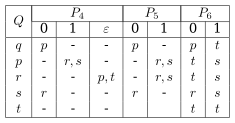 Fig. 30: Automaton programs from Problem 461.
;
;
;
;
;
.
Determine which of the following three automata recognize the language represented by the regular expression :
;
;
.
The programs of the automata are given in the table in Fig. 29 (a dash means the absence of the corresponding transitions).
Determine which of the following three automata recognize the language represented by the regular expression :
;
;
.
The programs of the automata are given in the table in Fig. 30 on the facing page (a dash means the absence of the corresponding transitions).
Prove that the regular expression represents the language consisting of all words in the alphabet that do not contain the substring 000.
Determine which language is represented by the following regular expressions:
;
;
;
.
Prove the equivalences
(commutativity of union);
(associativity of union);
(associativity of concatenation);
(idempotence of iteration);
(distributivity).
Prove the following equivalences for regular expressions:
;
;
.
Simplify the following regular expressions:
;
;
;
.
Using equivalent transformations of regular expressions, simplify the regular expression .
Prove that every regular expression is equivalent to a regular expression of the form , where the regular expressions do not contain .
Construct a regular expression defining the language over the alphabet
;
;
;
.
Let be an arbitrary word of length , and let be pairwise distinct natural numbers arranged in increasing order. Prove that the language can be described by a regular expression of length at most (taking into account all symbols required by the definition).
Above, in Problem 445 on p. 132, it was proposed to construct an automaton that verifies the correctness of addition. Construct a regular expression defining the language recognized by this automaton, that is, the following set of words over the alphabet :
Construct a regular expression for the language from Problem 447 on p. 133.
Construct deterministic finite automata recognizing the languages defined by the following regular expressions:
;
;
;
;
;
.
For the following pairs of regular expressions and , construct a regular expression representing the intersection of the languages and :
;
;
;
.
For the following regular expressions , construct a regular expression representing the complement of the language :
;
;
;
.
For the following regular expressions , construct a regular expression with the fewest symbols such that the equality holds:
;
;
;
.
Fig. 31 on the next page shows the diagrams of four nondeterministic finite automata. Construct regular expressions representing the languages recognized by these automata.
 Fig. 31: Finite automata from Problem 477.
???
???
???
???
Write a regular expression for the language recognized by the automaton in Fig. 28 on p. 136.