Directed Graphs
[16/100%]For a given set of vertices , find
the total number of graphs;
the number of graphs without loops;
the number of graphs in which there is at most one edge between any two vertices;
the number of graphs without loops in which there is at most one edge between any two vertices;
the number of tournaments. A tournament is a graph without loops in which there is exactly one edge between any two distinct vertices.
Prove that a directed graph without cycles has at least one source and at least one sink.
Let be an acyclic graph. Prove that its vertices can be numbered so that if , then .
Let be a graph, , the adjacency matrix, , and let the column vector contain zeros and ones, where means . Determine the meaning of the Boolean products and .
Prove that in a tournament, from the vertex with the largest out-degree there is a path of length at most two to any other vertex.
By induction on the number of vertices, prove the following statement: a tournament has a simple path passing through all vertices.
A championship is organized as a round-robin tournament (each team plays one match against every other team, and the winner is determined by the number of matches won). Prove that if the champion lost to team , then lost to some team , which in turn lost to the champion.
Determine what the reachability graph is for
a graph with vertices and an empty set of edges;
a graph with vertices: , whose edges form a cycle: .
Compute the reachability matrix * for the following graph
and construct its corresponding reachability graph. Find all bases of the graph .
Construct the adjacency matrices and adjacency lists for the directed graphs and shown in Fig. 27. Compute the reachability matrices and construct the corresponding reachability graphs.
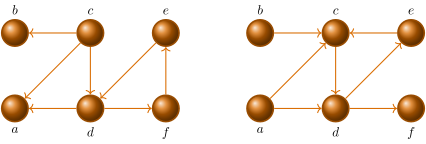 Fig. 27. Graphs \mathfrak {G}{1} and \mathfrak {G}{2}.
Prove Lemma 60 on page 193.
Lemma 60: The relation of strict reachability on the strongly connected components is a relation of strict partial order, i.e., it is antireflexive, antisymmetric, and transitive.
Let the graph be given by its adjacency matrix:
Construct the reachability graph for and determine how many new edges it has, i.e., what the difference equals.
Prove that a loopless graph is acyclic if and only if every strongly connected component contains exactly one element.
Show that for every positive there exists an acyclic graph with vertices and edges. Prove that in any graph with more edges than that, there is necessarily a cycle.
Prove that in a directed graph without cycles there exists a unique basis, consisting of all sources.
For the graphs and in Fig. 28, determine the strongly connected components and the strict reachability relation on them.
 Fig. 28. Graphs \mathfrak {G}{1} and \mathfrak {G}{2}.