Chapter 7

The Language of Predicate Logic

[22/95%]
Show
LaTeX
Problem 121

For each of the following formulas, determine which occurrences of variables in them are free and which are bound (and by which quantifier). Here QQ is a three-place predicate symbol.

?
(a)

(∀x)((∃z)Q(x,z,y)→(∀x)(Q(z,x,y)→(∃y)(Q(z,y,x)∨x≈z)))(\forall x)((\exists z) Q(x, z, y) \rightarrow (\forall x)(Q(z, x, y) \rightarrow (\exists y)(Q(z, y, x) \vee x \approx z)));

(b)

(∃y)((∃x)(¬x≈y∧Q(x,x,y)∧(∀x)(Q(x,z,y)→(∃z)(Q(x,y,z)∨Q(z,z,y))))(\exists y)((\exists x)(\neg x \approx y \wedge Q(x, x, y) \wedge (\forall x)(Q(x, z, y) \rightarrow (\exists z)(Q(x, y, z) \vee Q(z, z, y))));

(c)

(∀x)((∃z)Q(z,z,x)∧(∃x)Q(y,y,x))∨(∃x)((∃z)Q(x,x,z)→(∀x)Q(x,y,y))(\forall x)((\exists z) Q(z, z, x) \wedge (\exists x) Q(y, y, x)) \vee (\exists x)((\exists z) Q(x, x, z) \rightarrow (\forall x) Q(x, y, y));

(d)

(∃y)Q(x,y,z)∨(∃x)(Q(z,x,y)∧(∀y)Q(y,x,y))∧(∀z)(∃x)Q(z,z,x)(\exists y) Q(x, y, z) \vee (\exists x)(Q(z, x, y) \wedge (\forall y) Q(y, x, y)) \wedge (\forall z)(\exists x) Q(z, z, x).

Problem 122

For each formula Φ\Phi from the previous problem, determine which of the following substitutions are possible: (Φ)yx,(Φ)zx,(Φ)xy,(Φ)zy,(Φ)xz,(Φ)yz(\Phi )_{y}^{x},(\Phi )_{z}^{x},(\Phi )_{x}^{y},(\Phi )_{z}^{y},(\Phi )_{x}^{z},(\Phi )_{y}^{z}. Explain why. In the cases where it is possible, find the result of the substitution. Consider the formula:

?
(a)

(a) from problem 121;

(b)

(b) from problem 121;

(c)

(c) from problem 121;

(d)

(d) from problem 121.

Problem 123

Using the signature from example 27 on p. 140 — the two-place predicate symbols P(2)P^{(2)} ("to be a parent of," so P(x,y)P(x,y) means "xx is a parent of yy") and S(2)S^{(2)} ("to be married to," S(x,y)S(x,y) means "xx is married to yy"), and the one-place predicate symbol M(1)M^{(1)} ("to be male") — write formulas meaning:

?
(a)

xx is a grandson of yy;

(b)

xx has at least two children;

(c)

xx and yy have one common child;

(d)

xx has an unmarried sister;

(e)

xx and yy are cousins;

(f)

xx is married, and only one of his sons is married.

Problem 124

The domain includes only the real numbers R\mathbb {R} and the one-place infinitely differentiable functions on the set R\mathbb {R}. The signature contains the three-place predicate symbol V,V(f,x,y)V, V(f, x, y) says "the value of the function ff at the argument xx equals yy"; and the two-place symbol DD, where D(f,g)D(f, g) means "ff is the derivative of gg". Write formulas denoting the following. You may build auxiliary formulas and use ones constructed earlier:

?
(a)

xx is a number;

(b)

ff is a function;

(c)

ff is a constant function;

(d)

ff is a function identically equal to zero;

(e)

x=0x=0;

(f)

ff is the identity function;

(g)

x=1x=1;

(h)

ff is the exponential exe^{x};

(i)

x+y=z−x+y=z- for numbers x,y,zx, y, z;

(j)

xy=zx y=z — for numbers x,y,zx, y, z;

(k)

xx is a non-negative number;

(l)

the number xx is less than the number yy;

(m)

the function ff takes all real values;

(n)

the function ff is one-to-one;

(o)

the function ff is sine;

(p)

the number xx equals π\pi;

(q)

the number xx is a natural number.

Problem 125

Write formulas with free variables from {x,y,z}\left\{ x, y, z\right\} that are true in elementary arithmetic of natural numbers if and only if

?
(a)

xx is an even number;

(b)

xx and yy are relatively prime;

(c)

zz lies in the interval between xx and yy;

(d)

xx is the greatest common divisor of yy and zz;

(e)

xx is the least common multiple of all numbers in the interval [y;z)[y ; z).

Problem 126

Let the signature contain two predicate symbols L(3)L^{(3)} and E(4)E^{(4)}. Tarski's geometry is the interpretation whose domain is the set of points in the Euclidean plane, L(x,y,z)L(x, y, z) means that the points x,yx, y, and zz lie on one line and in exactly that order (yy between xx and zz; not necessarily distinct), and E(x,y,u,v)E(x, y, u, v) means that the lengths of the segments xyx y and uvu v are equal.

Write formulas with free variables from the set {x,y,z,u}\left\{ x, y, z, u\right\} that are true in Tarski's geometry if and only if

?
(a)

x,yx, y, and zz form a triangle;

(b)

xx is the midpoint of the segment yzy z;

(c)

the ray xyx y is the bisector of the angle ∠zxu\angle z x u;

(d)

the angle ∠xyz\angle x y z is a right angle;

(e)

the points x,y,z,ux, y, z, u lie on one circle;

(f)

the triangle △xyz\triangle x y z is acute;

(g)

the segment xyx y is shorter than zuz u;

(h)

the point xx lies inside the circle with center yy and a point zz lying on it.

Problem 127

Represent each of the following sentences by a formula of predicate logic, defining in each case a suitable signature.

?
(a)

Not all students study both analysis and history.

(b)

Only one student did not take the discrete mathematics exam.

(c)

Only one student passed all exams with 100 points.

(d)

The maximum score obtained in discrete mathematics exceeds the maximum score obtained in computer science.

(e)

There is a barber who shaves only those residents of the town who do not shave themselves.

(f)

There are politicians who can fool all the people some of the time; there are politicians who can fool some people all the time; but no one can fool all the people all the time.

Problem 128

Write a formula of predicate logic that is true only in interpretations whose domain contains one element (two, three, ..., kk elements).

?
Problem 129

Write a formula of predicate logic that is true only in interpretations in which the (n+1)(n+1)-place relation FF represents a function.

?
Problem 130

Determine which of the following formulas are true in elementary arithmetic, and explain what they mean:

?
(a)

(∀x)(∃y)(∃z)(A(x,y,z)∧M(x,y,z))(\forall x)(\exists y)(\exists z)(A(x, y, z) \wedge M(x, y, z));

(b)

(∀x)(∃y)(A(y,y,x)∨(∃z)(A(y,y,z)∧A(z,1,x)))(\forall x)(\exists y)(A(y, y, x) \vee (\exists z)(A(y, y, z) \wedge A(z, 1, x)));

(c)

(∀x)(∀y)(∀z)((∃u)M(x,u,y)∧(∃u)M(y,u,z)→(∃u)M(x,u,z))(\forall x)(\forall y)(\forall z)((\exists u) M(x, u, y) \wedge (\exists u) M(y, u, z) \rightarrow (\exists u) M(x, u, z));

(d)

(∀x)(∃y)(M(y,y,x)∨(∃z)(M(y,y,z)∧M(z,y,x)))(\forall x)(\exists y)(M(y, y, x) \vee (\exists z)(M(y, y, z) \wedge M(z, y, x)));

(e)

(∀x)(M(x,x,x)∨(∃y)(M(x,x,y)∧(∃u)(∃v)(∃w)(A(x,u,v)∧A(v,w,y)∧∧(∃z)(M(u,w,z)∧¬z≈0))))(\forall x)(M(x, x, x) \vee (\exists y)(M(x, x, y) \wedge (\exists u)(\exists v)(\exists w)(A(x, u, v) \wedge A(v, w, y) \wedge \wedge (\exists z)(M(u, w, z) \wedge \neg z \approx 0)))).

Problem 131

Determine which of the following formulas are true in Tarski's geometry (problem 126 on the opposite page), and explain what they mean:

?
(a)

(∀x)(∀y)(∃z)(L(x,y,z)∧E(x,y,y,z))(\forall x)(\forall y)(\exists z)(L(x, y, z) \wedge E(x, y, y, z));

(b)

(∀x)(∀y)(∀z)(∃u)(E(u,x,u,y)∧E(u,y,u,z))(\forall x)(\forall y)(\forall z)(\exists u)(E(u, x, u, y) \wedge E(u, y, u, z));

(c)

(∀x)(∀y)(∃u)(∃v)(∀z)(E(z,x,z,y)→L(z,u,v)∨L(z,v,u)∨L(u,z,v))(\forall x)(\forall y)(\exists u)(\exists v)(\forall z)(E(z, x, z, y) \rightarrow L(z, u, v) \vee L(z, v, u) \vee L(u, z, v));

(d)

(∀x)(∃y)(∃z)(∃u)(L(y,u,z)∧(∀v)(L(y,v,z)∧E(x,u,x,v)→u≈v))(\forall x)(\exists y)(\exists z)(\exists u)(L(y, u, z) \wedge (\forall v)(L(y, v, z) \wedge E(x, u, x, v) \rightarrow u \approx v));

(e)

(∀x)(∀y)(∀z)(¬x≈y∧¬E(x,y,x,z)→(∀u)(E(x,z,x,u)∧L(x,u,y)→→(∀v)(E(x,u,x,v)∧E(y,u,y,v)→u≈v)))(\forall x)(\forall y)(\forall z)(\neg x \approx y \wedge \neg E(x, y, x, z) \rightarrow (\forall u)(E(x, z, x, u) \wedge L(x, u, y) \rightarrow \rightarrow (\forall v)(E(x, u, x, v) \wedge E(y, u, y, v) \rightarrow u \approx v))).

Problem 132

The signature Σ\Sigma is taken from example 28 on p. 141 — the three-place predicate symbol VV, where V(f,x,y)V(f,x,y) means "the value of the function ff at the argument xx equals yy," and the two-place predicate symbol DD, where D(f,g)D(f,g) means "ff is the derivative of gg"; the interpretation consists of real numbers and infinitely differentiable functions on them. Determine which of the following formulas are true in this interpretation, and explain what they mean:
?
(a)

(∀x)(∀y)((∃z)(D(z,x)∧D(z,y))→x≈y);(\forall x)(\forall y)((\exists z)(D(z, x) \wedge D(z, y)) \rightarrow x \approx y) ;

(b)

(∀x)(∀y)(∃z)(∀u)(∀v)(∀w)(V(x,u,v)∧V(y,v,w)→V(z,u,w))(\forall x)(\forall y)(\exists z)(\forall u)(\forall v)(\forall w)(V(x, u, v) \wedge V(y, v, w) \rightarrow V(z, u, w));

(c)

(∀x)(∃y)(∀u)(∀v)(V(x,u,v)→V(y,v,u))(\forall x)(\exists y)(\forall u)(\forall v)(V(x, u, v) \rightarrow V(y, v, u));

(d)

(∀x)(∀y)((∃z)(D(z,x)∧D(z,y))∧(∃u)(∃v)(V(x,u,v)∧V(y,u,v))→x≈y)(\forall x)(\forall y)((\exists z)(D(z, x) \wedge D(z, y)) \wedge (\exists u)(\exists v)(V(x, u, v) \wedge V(y, u, v)) \rightarrow x \approx y);

(e)

(∃x)(D(x,x)∧(∀y)¬V(x,y,y))(\exists x)(D(x, x) \wedge (\forall y) \neg V(x, y, y));

(f)

(∃x)(¬D(x,x)∧(∃y)(D(y,x)∧D(x,y)))(\exists x)(\neg D(x, x) \wedge (\exists y)(D(y, x) \wedge D(x, y))).

Problem 133

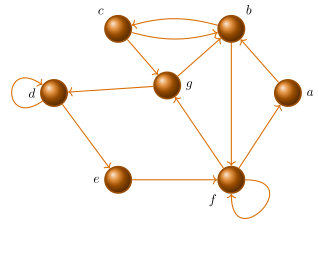
The signature Σ\Sigma consists of the two-place predicate symbol E(2)E^{(2)}, the individual variables a,…,ga, \ldots , g, and others. The interpretation G\mathfrak {G} is depicted in fig. 16; an arrow from xx to yy means that (x,y)∈E(x, y) \in E (such interpretations are called graphs; they will be studied in detail in chapter 9 and beyond). Determine which of the following formulas are true in this interpretation, and explain what they mean:

Fig. 16. The graph \mathfrak {G} from problem 133.Fig. 16. The graph \mathfrak {G} from problem 133.

?
(a)

(∀x)(∃y)(∃z)(E(x,y)∧E(z,x))(\forall x)(\exists y)(\exists z)(E(x, y) \wedge E(z, x));

(b)

(∀x)(∃y)(∃z)(E(x,y)∧E(y,z)∧E(z,x))(\forall x)(\exists y)(\exists z)(E(x, y) \wedge E(y, z) \wedge E(z, x));

(c)

(∀x)(∃z)(E(z,z)∧(E(x,z)∨(∃y)(E(x,y)∧E(y,z))))(\forall x)(\exists z)(E(z, z) \wedge (E(x, z) \vee (\exists y)(E(x, y) \wedge E(y, z))));

(d)

(∀x)(∀y)(E(x,y)→¬E(x,x)∨¬E(y,y))(\forall x)(\forall y)(E(x, y) \rightarrow \neg E(x, x) \vee \neg E(y, y));

(e)

(∃x)(∀y)(∀z)(E(x,y)∧E(y,z)→¬x≈y∧¬x≈z)(\exists x)(\forall y)(\forall z)(E(x, y) \wedge E(y, z) \rightarrow \neg x \approx y \wedge \neg x \approx z);

(f)

(∃x)(∃y)(E(x,y)∧(∀z)(E(x,z)→y≈z))(\exists x)(\exists y)(E(x, y) \wedge (\forall z)(E(x, z) \rightarrow y \approx z));

(g)

(∃x)(∀y)(∀z)(∀u)(E(g,y)∧E(y,z)∧E(z,u)→¬y≈x∧¬z≈x∧¬u≈x)(\exists x)(\forall y)(\forall z)(\forall u)(E(g, y) \wedge E(y, z) \wedge E(z, u) \rightarrow \neg y \approx x \wedge \neg z \approx x \wedge \neg u \approx x).

Problem 134

Prove theorem 43 on p. 150 (the Principle of Replacement for predicate logic): if QQ is an nn-place predicate symbol, the formulas Φ\Phi and Ψ\Psi have no free variables besides possibly x1,…,xnx_{1}, \ldots , x_{n}, and Φ≡Ψ\Phi \equiv \Psi, then (Θ)ΦQ≡(Θ)ΨQ(\Theta )_{\Phi }^{Q} \equiv (\Theta )_{\Psi }^{Q} for every formula Θ\Theta.

?
Problem 135

Prove the remaining equivalences from theorem 44 on p. 150: for any variable xx and any formulas Φ,Ψ\Phi , \Psi such that Ψ\Psi has no free occurrences of xx,

  1. ¬(∀x)Φ≡(∃x)¬Φ\neg (\forall x) \Phi \equiv (\exists x) \neg \Phi;

  2. ¬(∃x)Φ≡(∀x)¬Φ\neg (\exists x) \Phi \equiv (\forall x) \neg \Phi;

  3. Ψ∧(∀x)Φ≡(∀x)(Ψ∧Φ)\Psi \wedge (\forall x) \Phi \equiv (\forall x)(\Psi \wedge \Phi );

  4. Ψ∧(∃x)Φ≡(∃x)(Ψ∧Φ)\Psi \wedge (\exists x) \Phi \equiv (\exists x)(\Psi \wedge \Phi );

  5. Ψ∨(∀x)Φ≡(∀x)(Ψ∨Φ)\Psi \vee (\forall x) \Phi \equiv (\forall x)(\Psi \vee \Phi );

  6. Ψ∨(∃x)Φ≡(∃x)(Ψ∨Φ)\Psi \vee (\exists x) \Phi \equiv (\exists x)(\Psi \vee \Phi );

  7. (∃x)Ψ≡(∀x)Ψ≡Ψ(\exists x) \Psi \equiv (\forall x) \Psi \equiv \Psi. The source text already proves 1), 4), and 7) as worked examples; this problem asks for the remaining ones: 2), 3), 5), 6).

?
Problem 136

Prove the equivalences from theorem 47 on p. 155:

  1. (∃x)(Φ∨Ψ)≡(∃x)Φ∨(∃x)Ψ(\exists x)(\Phi \vee \Psi ) \equiv (\exists x) \Phi \vee (\exists x) \Psi;

  2. (∀x)(Φ∧Ψ)≡(∀x)Φ∧(∀x)Ψ(\forall x)(\Phi \wedge \Psi ) \equiv (\forall x) \Phi \wedge (\forall x) \Psi;

  3. (∃x)(∃y)Φ≡(∃y)(∃x)Φ(\exists x)(\exists y) \Phi \equiv (\exists y)(\exists x) \Phi;

  4. (∀x)(∀y)Φ≡(∀y)(∀x)Φ(\forall x)(\forall y) \Phi \equiv (\forall y)(\forall x) \Phi.

?
Problem 137

Prove the following equivalences:

?
(a)

(∃x)(x≈y∧Φ)≡(Φ)yx(\exists x)(x \approx y \wedge \Phi ) \equiv (\Phi )_{y}^{x};

(b)

(∀x)(x≈y→Φ)≡(Φ)yx(\forall x)(x \approx y \rightarrow \Phi ) \equiv (\Phi )_{y}^{x};

(c)

Φ∨(∃x)Φ≡(∃x)Φ\Phi \vee (\exists x) \Phi \equiv (\exists x) \Phi;

(d)

Φ∧(∀x)Φ≡(∀x)Φ\Phi \wedge (\forall x) \Phi \equiv (\forall x) \Phi.

Problem 138

Prove the entailments from theorem 48 on p. 155:

  1. (∃x)(Φ∧Ψ)⇒(∃x)Φ∧(∃x)Ψ(\exists x)(\Phi \wedge \Psi ) \Rightarrow (\exists x) \Phi \wedge (\exists x) \Psi;

  2. (∀x)Φ∨(∀x)Ψ⇒(∀x)(Φ∨Ψ)(\forall x) \Phi \vee (\forall x) \Psi \Rightarrow (\forall x)(\Phi \vee \Psi );

  3. (∃x)(∀y)Φ⇒(∀y)(∃x)Φ(\exists x)(\forall y) \Phi \Rightarrow (\forall y)(\exists x) \Phi.

?
Problem 139

Give the remaining examples showing that the entailments from theorem 48 on p. 155 — 1) (∃x)(Φ∧Ψ)⇒(∃x)Φ∧(∃x)Ψ(\exists x)(\Phi \wedge \Psi ) \Rightarrow (\exists x) \Phi \wedge (\exists x) \Psi, 2) (∀x)Φ∨(∀x)Ψ⇒(∀x)(Φ∨Ψ)(\forall x) \Phi \vee (\forall x) \Psi \Rightarrow (\forall x)(\Phi \vee \Psi ), 3) (∃x)(∀y)Φ⇒(∀y)(∃x)Φ(\exists x)(\forall y) \Phi \Rightarrow (\forall y)(\exists x) \Phi — do not hold in the reverse direction. (Example 34 already gives a counterexample for the first: on the interpretation with domain ω\omega and one-place predicate symbols OO, EE meaning "odd" and "even" respectively, the formula (∃x)O(x)∧(∃x)E(x)(\exists x) O(x) \wedge (\exists x) E(x) is true while (∃x)(O(x)∧E(x))(\exists x)(O(x) \wedge E(x)) is false. The remaining examples asked for here are for 2) and 3).)

?
Problem 140

Prove the entailment (∀x)(Φ→Ψ)⇒(∀x)Φ→(∀x)Ψ(\forall x)(\Phi \rightarrow \Psi ) \Rightarrow (\forall x) \Phi \rightarrow (\forall x) \Psi. Show that the entailment does not hold in the reverse direction.

?
Problem 141

Bring the following formulas to prenex form, QQ is a two-place predicate symbol:

?
(a)

¬(∀z)¬(∀x)(∃y)(∀u)(Q(x,y)∧Q(z,u))\neg (\forall z) \neg (\forall x)(\exists y)(\forall u)(Q(x, y) \wedge Q(z, u));

(b)

(∃x)(∀y)Q(x,y)→(∃x)(∀y)Q(y,x)(\exists x)(\forall y) Q(x, y) \rightarrow (\exists x)(\forall y) Q(y, x);

(c)

¬((∀x)((∀y)Q(x,y)→Q(x,z))∨((∀z)Q(z,x)∧¬(∃y)Q(y,x)))\neg ((\forall x)((\forall y) Q(x, y) \rightarrow Q(x, z)) \vee ((\forall z) Q(z, x) \wedge \neg (\exists y) Q(y, x))).

Problem 142

Using transformations, prove the following equivalences, where the formula Θ\Theta does not contain the variable xx free:

?
(a)

(∃x)(Φ→Ψ)≡(∀x)Φ→(∃x)Ψ(\exists x)(\Phi \rightarrow \Psi ) \equiv (\forall x) \Phi \rightarrow (\exists x) \Psi;

(b)

(∀x)(Θ→Φ)≡Θ→(∀x)Φ(\forall x)(\Theta \rightarrow \Phi ) \equiv \Theta \rightarrow (\forall x) \Phi;

(c)

(∀x)(Φ→Θ)≡(∃x)Φ→Θ(\forall x)(\Phi \rightarrow \Theta ) \equiv (\exists x) \Phi \rightarrow \Theta.