Elementary Probabilities
[170/99%]Let denote the totality of students at the University of Athens and , the sets of freshmen, sophomores, juniors, and seniors, respectively. Moreover, let denote the set of female students and the set of Cypriot students. Express in words each of the following sets:
;
;
;
;
.
Give the simplified forms of the sets:
;
;
.
Express each of the following events in terms of the events , , and , and the operations of complementation, union, and intersection:
at least one of the events , , occurs;
at most one of the events , , occurs;
none of the events , , occurs;
all three events occur;
exactly one of the events , , occurs;
and occur but not ;
occurs, if not then does not occur either.
Give the Venn diagram for each of the above.
Let denote the sample space corresponding to the chance experiment of tossing a coin three times. Let be the event that heads appear exactly twice, let be the event that at least two heads appear, and let the event that heads appear when tails have appeared at least once.
Give the elements of , , ;
Describe the events: (i) ; (ii) ; (iii) .
In each of the exercises 5--8, give the number of points in the sample space and the points of the events defined therein.
A family has 4 children. Let the events: : boys and girls alternate, : the first and fourth child are boys, : as many boys as girls, and : three successive children of the same sex.
A salesman is arranging his schedule for visiting each of three towns , , , twice. : the first and last visit are in .
Certain diseases cause cell disorders which can be distinguished into four categories. Blood tests are conducted on each of 4 patients and in each case the category is noted. Let : the patients belong to the same category, : two patients belong to the same category.
An elevator carries two persons and stops at three floors. Let : they get off at different floors, : one gets off at the first floor.
In how many ways can a lady having 10 dresses, 5 pairs of shoes, and 2 hats be dressed?
In how many ways can we place in a bookcase two works each of three volumes and two works each of four volumes, so that the volumes of the same work are not separated?
In how many ways can objects be distributed to persons if there is no restriction on the number of objects that a person may receive?
In how many ways can 5 boys and 5 girls be seated around a table so that no 2 boys sit next to each other?
Eight points are chosen on the circumference of a circle. How many chords can be drawn by joining these points in all possible ways? If the 8 points are considered vertices of a polygon, how many triangles and how many hexagons can be formed?
In how many ways can persons be seated around a table if 2 arrangements are regarded as the same when each person has the same right and left neighbors? At a dinner at which the persons are seated randomly, what is the probability that a specific husband is seated next to his wife?
In how many ways can 20 recruits be distributed into 4 groups each consisting of 5 recruits? In how many ways can they be distributed into 4 camps, each camp receiving 5 recruits?
Using 7 consonants and 5 vowels, how many words consisting of 4 consonants and 3 vowels can we form?
Show that for every and for every positive integer :
-
;
-
.
If , , , are positive integers prove that
For every integer , show the following:
-
;
-
;
-
.
Using Pascal's triangle, show that for every and positive integers , :
-
;
-
.
Using the result of Exercise 18, show that
Using the result of Exercise 21, prove that
Using the binomial theorem, show by induction that
As in Exercise 23, show that for positive integers and
Show that this is a special case of Problem 20(ii).
In the expansion of where and is a positive integer, let be the term containing . Find the values of for which becomes maximum. What is the maximum term of ?
Given , , , find the following probabilities:
Given and , show that:
,
. Give inequalities analogous to (a) and (b) for and .
For any two events and show that:
By induction show that for arbitrary events , the following inequality (due to Bonferoni) holds:
For any three events , , and , show that (cf. formula (1.1), Poincaré's theorem for events : , where for each , , the summation being over all combinations of the events taken at a time)
Application: The percentages of students who passed courses , , and are as follows: : 50, : 40, : 30, and : 35, and : 20, and 15 passed all three courses. What is the percentage of students who succeeded in at least one of the three courses?
A box contains balls numbered . A ball is drawn at random:
What is the probability that its label number is divisible by 3 or 4?
Examine the case in (a) as .
In terms of , , , , , , and express, for , the probabilities that:
-
exactly of the events , , and , occur;
-
at least of the events , , occur.
By induction prove Poincaré's theorem, i.e., formula (1.1).
If , show that has all the properties of a distance function; the symmetric difference between two sets and is defined by .
Three winning tickets are drawn from an urn of 100 tickets. What is the probability of winning for a person who buys: (a) 4 tickets? (b) only one ticket?
A bakery makes 80 loaves of bread daily. Ten of them are underweight. An inspector weighs 5 loaves at random. What is the probability that an underweight loaf will be discovered?
Find the probability that among seven persons:
no two were born on the same day of the week (Sunday, Monday, etc.);
at least two were born on the same day;
two were born on a Sunday and two on a Tuesday.
A group of boys and girls is randomly divided into two equal groups. What is the probability that each group has the same number of boys and girls?
The coefficients , , of the quadratic equation are determined by throwing a die three times. Find the probabilities that: (a) the roots are real; (b) the roots are complex.
In the game of poker a ``hand of cards'' means 5 cards randomly selected (without replacement) from a deck of 52 cards. What is the probability that a hand of cards:
consists of an ace, a queen, a jack, a king, and a ten of the same suit?
contains 4 cards of the same denomination (aces, etc.)?
consists of cards with consecutive values, except aces, jacks, kings, and queens?
In bridge, a hand of cards'' consists of 13 cards drawn at random (without replacement) from a deck of 52 cards (the 52 cards are equally distributed to four players). Find the probabilities that a hand of cards'' will contain:
-
clubs, spades, and diamonds;
-
aces ;
-
aces and kings. In a bridge game find the probabilities that:
each player has an ace;
some player has all the aces;
some player has aces and his partner aces .
Six girls are to enter a dance with 10 boys to form a ring so that every girl is between two boys:
What is the probability that some specified boy remains between 2 boys?
A spectator notices that a certain girl enters next to a certain boy. Is it random?
Five letters are selected at random one after another from the 26 letters of the English alphabet; (a) with replacement, (b) without replacement. Find, for each of the cases (a) and (b), the probabilities that the word formed: (i) contains an a'', (ii) consists of vowels, (iii) is the word woman''.
Prove that the number of ways in which indistinguishable balls can be distributed in cells (or, equivalently, the number of different solutions of the equation where are integers), equals
Consider indistinguishable balls randomly distributed in cells (Bose--Einstein statistics). What is the probability that exactly cells remain empty?
From an ordinary deck of 52 cards, cards are drawn successively until an ace appears. What is the probability that the first ace will appear: (a) at the th draw? (b) after the th card?
In a classroom there are students.
What is the probability that at least two students have the same birthday?
What is the minimum value of which secures probability that at least two have a common birthday?
letters are placed at random in envelopes. Show that the probability that each letter will be placed in a wrong envelope is .
An urn contains balls numbered in such a way that balls bear the same number for each . balls are drawn at random without replacement. Find the probability that,
exactly of the numbers will appear in the sample,
each of the numbers will appear at least once.
(Continuation of Problem 49.) Balls are drawn until each of the numbers appears at least once. What is the probability that balls will be needed?
men run out of a men's club after a fire and each takes a coat and a hat. Prove that:
the probability that no one will take his own coat and hat is
the probability that each man takes a wrong coat and a wrong hat is
Suppose every packet of the detergent TIDE contains a coupon bearing one of the letters of the word TIDE. A customer who has all the letters of the word gets a free packet. All the letters have the same possibility of appearing in a packet. Find the probability that a housewife who buys 8 packets will get:
-
one free packet,
-
two free packets.
An urn contains white and black balls. When two balls are randomly drawn the probability that both be white is .
What is the minimum value of ?
What is the minimum value of when is an even number?
What is the minimum value of the total number of balls in the urn?
If the events , are independent, show that the pairs , , also consist of independent events.
If the events , , and are mutually independent, then the pairs , , also consist of independent events.
Suppose that for the independent events , , and we have , , , and . Prove that the probability satisfies the equation
Hence conclude that
Moreover, show that
Let the events be independent and (). What is the probability that:
at least one of the events will occur?
at least of the events will occur?
exactly of the events will occur?
A die is thrown as long as necessary for an ace or a 6 to turn up. Given that no ace turned up at the first two throws, what is the probability that at least three throws will be necessary?
A parent particle can be divided into 0, 1, or 2 particles with probabilities , , , respectively. It disappears after splitting. Beginning with one particle, the progenitor, let us denote by the number of particles in the generation. Find,
,
the probability that given that .
An urn contains balls numbered . We select at random balls,
with replacement,
without replacement.
What is the probability that the largest selected number is ?
Two athletic teams and play a series of independent games until one of them wins 4 games. The probability of each team winning in each game equals . Find the probability that the series will end,
in at most 6 games,
in 6 games given that team won the first two games.
It is suspected that a patient has one of the diseases , , . Suppose that the population percentages suffering from these illnesses are in the ratio . The patient is given a test which turns out to be positive in of the cases of , of , and of . Given that out of three tests taken by the patient two were positive, find the probability for each of the three illnesses.
The population of Nicosia (Cyprus) is Greek and Turkish. of the Greeks and of the Turks speak English. A visitor to the town meets someone who speaks English. What is the probability that he is a Greek? Interpret your answer in terms of the population of the town.
Two absent-minded room mates, mathematicians, forget their umbrellas in some way or another. always takes his umbrella when he goes out, while forgets to take his umbrella with probability . Each of them forgets his umbrella at a shop with probability . After visiting three shops they return home. Find the probability that:
they have both umbrellas;
they have only one umbrella;
has lost his umbrella given that there is only one umbrella after their return.
Consider families of children and let be the event that a family has children of both sexes, and let be the event that there is at most one girl in the family. Show that the only value of for which the events and are independent is , assuming that each child has probability of being a boy.
At the college entrance examination each candidate is admitted or rejected according to whether he has passed or failed the test. Of the candidates who are really capable, pass the test; and of the incapable, pass the test. Given that of the candidates are really capable, find the proportion of capable college students.
and throw alternately a pair of dice in that order. wins if he scores 6 points before gets 7 points, in which case wins. If starts the game what is his probability of winning?
Three players , , and throw a die in that order and, by the rules of the game, the first one to obtain an ace will be the winner. Find their probabilities of winning.
players throw a biased coin whose probability of heads equals . starts (the game), plays second, etc. The first one to throw heads wins. Find the probability that () will be the winner.
Urn contains white balls and black balls. Urn contains white balls and black balls. A ball is drawn from and is placed into , and then a ball is transferred from to . Finally, a ball is selected from . What is the probability that the ball will be white?
Ten percent of a certain population suffer from a serious disease. A person suspected of the disease is given two independent tests. Each test makes a correct diagnosis of the time. Find the probability that the person really has the illness:
given that both tests are positive;
given that only one test is positive.
A player randomly chooses one of the coins , . Coin has probability of heads , and coin has probability of heads . He tosses the coin twice.
Find the probability that he obtains: (i) two heads, (ii) heads only once.
Instead of the above procedure, suppose the player can choose an unbiased (symmetric) coin, which he tosses twice. Which procedure should he follow in order to maximize the probability of at least one head?
Urn contains 5 black balls and 6 white balls, and urn contains 8 black balls and 4 white balls. Two balls are transferred from to and then a ball is drawn from .
What is the probability that this ball is white?
Given that the ball drawn is white, what is the probability that at least one white ball was transferred to ?
The Pap test makes a correct diagnosis with probability . Given that the test is positive for a lady, what is the probability that she really has the disease? How do you interpret this? Assume that one in every 2,000 women, on average, has the disease.
A secretary goes to work following one of three routes , , . Her choice of route is independent of the weather. If it rains, the probabilities of arriving late, following , , , are , , , respectively. The corresponding probabilities, if it does not rain, are , , .
Given that on a sunny day she arrives late, what is the probability that she took route ? Assume that, on average, one in every four days is rainy.
Given that on a day she arrives late, what is the probability that it is a rainy day?
At an art exhibition there are 12 paintings of which 10 are original. A visitor selects a painting at random and before he decides to buy, he asks the opinion of an expert about the authenticity of the painting. The expert is right in 9 out of 10 cases on average.
Given that the expert decides that the painting is authentic, what is the probability that this is really the case?
If the expert decides that the painting is a copy, then the visitor returns it and chooses another one; what is the probability that his second choice is an original?
What is the conditional probability that a hand at poker (see Exercise 40) consists of spades, given that it consists of black cards?
Note: Of the 52 cards of an ordinary deck, the 13 spades and 13 clubs are black whereas the 13 hearts and 13 diamonds are red.
The probability that a family has children is given by , (). It is known that a family has two boys. What is the probability that:
the family has only two children?
the family has two girls as well?
An amplifier may burn one or both of its fuses if one or both of its tubes are defective. Let the events:
The conditional probabilities of burning the fuses (given the state of the tubes, i.e., the ), appear in the following table:
Find the probabilities that:
both tubes are defective given that both fuses were burnt out;
only tube 2 is defective given that both fuses were burnt out;
only tube 2 is defective given that at least one fuse was burnt out.
The events , , have probabilities , , , respectively.
An urn contains 7 white balls numbered and 3 black balls numbered . Five balls are randomly selected,
with replacement;
without replacement.
For each of the cases (a) and (b) give the distribution:
-
of the number of white balls in the sample;
-
of the minimum number in the sample;
-
of the maximum number in the sample;
-
of the minimum number of balls needed for selecting a white ball.
(Continuation of Problem 80.) An urn contains 7 white balls numbered and 3 black balls, now numbered , and (instead of as in Problem 80). Five balls are randomly selected, (a) with replacement, (b) without replacement. As in Problem 80, give for each of the cases (a) and (b) the distribution:
-
of the number of white balls in the sample;
-
of the minimum number in the sample;
-
of the maximum number in the sample;
-
of the minimum number of balls needed for selecting a white ball.
A machine normally makes items of which are defective. Every hour the producer draws a sample of size 10 for inspection. If the sample contains no defective items he does not stop the machine. What is the probability that the machine will not be stopped when it has started producing items of which are defective.
One per thousand of a population is subject to certain kinds of accident each year. Given that an insurance company has insured 5,000 persons from the population, find the probability that at most 2 persons will incur this accident.
A certain airline company, having observed that of the persons making reservations on a flight do not show up for the flight, sells 100 seats on a plane that has 95 seats. What is the probability that there will be a seat available for every person who shows up for the flight?
Workers in a factory incur accidents at the rate of two accidents per week. Calculate the probability that there will be at most two accidents,
-
during 1 week,
-
during 2 weeks,
-
in each of 2 weeks.
Suppose that the suicide rate in a certain state is four suicides per one million inhabitants per month. Find the probability that in a certain town of population 500,000 there will be at most four suicides in a month. Would you find it surprising that during 1 year there were at least 2 months in which more than four suicides occurred?
A coin is tossed 30 times. For , what is the conditional probability that exactly heads appear given that the first 10 tosses resulted in heads. Show that the conditional probability that tosses will result in heads, given that heads appeared at least ten times, equals
How many children should a family have so that with probability 0.95 it has at least a boy and at least a girl.
Show that the Poisson probabilities satisfy the recurrence relation
and hence determine the values of for which the terms reach their maximum (for given ).
Verify that each of the following functions is a probability density function and sketch its graph.
The amount of bread (in hundreds of kilos) that a bakery sells in a day is a random variable with density
-
Find the value of which makes a probability density function.
-
What is the probability that the number of kilos of bread that will be sold in a day is, (a) more than 300 kilos? (b) between 150 and 450 kilos?
-
Denote by and the events in (a) and (b), respectively. Are and independent events?
Suppose that the duration in minutes of long-distance telephone conversations follows an exponential density function;
Find the probability that the duration of a conversation:
will exceed 5 minutes;
will be between 5 and 6 minutes;
will be less than 3 minutes;
will be less than 6 minutes given that it was greater than 3 minutes.
A number is randomly chosen from the interval . What is the probability that:
its first decimal digit will be a 1;
its second decimal digit will be a 5;
the first decimal digit of its square root will be a 3?
The height of men is normally distributed with mean cm and standard deviation cm.
-
What is the percentage of the population of men that have height,
-
greater than 167 cm,
-
greater than 170 cm,
-
between 161 cm and 173 cm?
-
-
In a random sample of four men what is the probability that:
-
all will have height greater than 170 cm;
-
two will have height smaller than the mean (and two bigger than the mean)?
-
A machine produces bolts the length of which (in centimeters) obeys a normal probability law with mean 5 and standard deviation . A bolt is called defective if its length falls outside the interval .
What is the proportion of defective bolts that this machine produces?
What is the probability that among ten bolts none will be defective?
Consider a shop at which customers arrive at random at a rate of twenty persons per hour. What is the probability that the time intervals between succesive arrivals will be:
shorter than 3 minutes;
longer than 4 minutes.
Suppose that of the customers buy a certain object. Find the distribution of the number of customers who buy an object in an hour.
If is a continuous random variable with cumulative distribution function and density function , show that the random variable is also continuous and express its cumulative distribution function and density in terms of and .
(Continuation of Problem 97.) Find the density of when has:
the normal distribution ;
the Laplace distribution (see (2.9));
the Cauchy distribution (see (2.12)).
As in Exercises 97 and 98 with .
If the is normally distributed then is said to have a lognormal distribution. Find its density.
Show that the integral becomes minimum when is the median of the distribution with density .
Let denote the density function of the random variable . Suppose that has a symmetric distribution about , that is, for every . Show that the mean equals , provided it exists.
Show that provided the second moments exist.
Show that .
For every set of real numbers, we define the indicator function by
Show that
If , show that .
Show that the mean of a random variable has the property
Show that for a continuous random variable with density function and cumulative distribution function
Consequently, in the graph below .
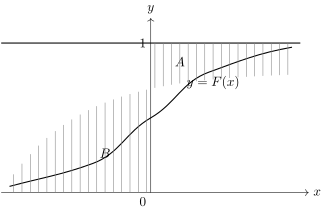
If the th moment of the random variable with distribution function exists, show that
Show that the first moments determine the first central moments and, conversely, that the first central moments with the mean determine the first moments.
If is bounded, i.e., there is a constant such that , then has moments of every order.
If the -order moment exists, then show that there exist all ().
Show that a necessary condition for the mean of a random variable with distribution function to exist is that
In a lottery, numbers are selected from the numbers . Find the variance of the sum of the selected numbers.
An urn contains white balls and black balls; balls are drawn at random,
with replacement,
without replacement.
What is the expected number of white balls in the sample?
A student takes a multiple-choice test consisting of two problems. The first one has 3 possible answers and the second one has 5. The student chooses, at random, one answer as the right one from each of the two problems. Find:
the expected number, , of the right answers of the student;
the .
Generalize.
In a lottery that sells 3,000 tickets the first lot wins $1,000, the second $500, and five other lots that come next win $100 each. What is the expected gain of a man who pays 1 dollar to buy a ticket?
A die is thrown until the result ``ace or even number'' appears three times. Find the expected number of throws:
in one performance of the experiment;
in ten repetitions.
pays 1 dollar for each participation in the following game: three dice are thrown; if one ace appears he gets 1 dollar, if two aces appear he gets 2 dollars and if three aces appear he gets 8 dollars; otherwise he gets nothing. Is the game fair, i.e., is the expected gain of the player zero? If not, how much should the player receive when three aces appear to make the game fair?
A player has 15 dollars. If heads appear on the first toss he receives 1 dollar and he withdraws from the game. If tails appear he bets 2 dollars and if he wins the second toss he withdraws; otherwise he continues playing on a bet of 4 dollars. If he loses, he bets the remaining amount of 8 dollars. What is the expected gain of the player?
Of the parcels mailed abroad 10 never reach their destination. Two books may be sent separately or in a single parcel. Each book is worth $2. The postage for each book sent separately is 10¢ and for both books in a single parcel 15¢. For each of the two ways of mailing, find:
the probability that both books reach their destination;
the probability that at least one book reaches its destination;
the expected net (after postage) value of the commodities reaching their destination.
For each of the three criteria (a), (b), and (c), which way of mailing is preferable?
Two indentical coins are thrown once in such a way that if one shows heads so does the other (dependent). Let and be the total number of heads that appear. Find the mean and the variance of the random variable .
Two different coins with probabilities of heads and are thrown independently. Find the mean and the variance of the random variable as defined in (a).
Let be a random variable with distribution function
Plot the graph of and then evaluate . Give an example of a random variable that has the above distribution.
If the random variable is , show that the random variable , where and denote the distribution function and the density of , respectively, has mean value .
The truncated Poisson distribution with the zero class missing has probability function
Find and .
Three players , , and play a game as follows: At the first stage and play against each other while stays out of the game. The winner plays against at the second stage. Then the winner of the second game plays against the last loser, and so on. The winner is declared the one who wins two games in succession. Find the elements (simple events) of the sample space of all possible outcomes of the game. If the probability of each player winning a game is , determine the probabilities of the corresponding possible outcomes and show that their sum equals one.
A symmetrical coin is tossed until the same result appears twice in succession. Describe the sample space in terms of the results H (heads'') and T (tails''). Find the probabilities of the events:
the experiment terminates earlier or at the seventh trial;
an even number of trials is required.
What is the expected number of trials?
A pair of dice is tossed six times. What is the probability that all the faces will appear twice?
A deck of 52 cards is divided among four players so that each of them gets 13 cards (game of bridge). Find the probability that at least one player will have a complete suit (spades, hearts, diamonds, clubs).
Two coins and have a probability of falling heads and , respectively. You win a bet if in three tosses you get at least two heads in succession. You toss the coins alternately starting with either coin. If , what coin would you select to start the game?
Ten pairs of shoes are in a closet. Four shoes are selected at random. Find the probability that there will be at least one pair among the four shoes selected.
Let cells be numbered . We randomly throw balls into them. The process is continued until a ball falls in the cell bearing the number 1. What is the probability that:
throws will be necessary?
more than throws will be necessary?
(Continuation of Problem 132.) The process terminates when any one of the cells receives two balls.
What is the probability that more than throws will be necessary?
What is the expected number of throws?
From a usual deck of cards we draw one card after another. What is the probability that:
the th card will be the first ace?
the first ace will appear among the first cards?
The 52 cards of an ordinary deck of cards are placed successively one after the other and from left to right. Find the probability that the thirteenth spade will appear before the thirteenth diamond.
Three balls are drawn at random one after another and without replacement from balls numbered . Find the probability that the first will bear a number smaller than that of the second ball.
An urn contains kinds of objects all in the same proportion. Objects are drawn with replacement, one after another, until each kind appears at least once. What is the probability that objects will be required?
A newspaper dealer gets papers every day for sale. The number of papers sold is a random variable following the Poisson distribution with parameter . For each paper sold he earns 1 cent, for each unsold paper he loses cents. Let denote the net gain of the dealer. Find:
;
How many newspapers should he get every day in order to maximize his profit?
Three numbers are selected at random one after another and without replacement from numbers . What is the probability that the first number drawn will be the smallest and the second number the largest?
The events , , and are independent with , , and . Find the probability that at least two will occur among the three events.
We throw four coins simultaneously and we repeat it once more. What is the probability that the second throw will result in the same configuration as the first throw when the coins are:
distinguishable;
indistinguishable.
An urn contains white balls and black balls. We draw balls successively and without replacement one after another until a white ball appears for the first time. Let be the required number of draws. Find:
the distribution of ;
.
Using the result of (a) show the identity
where .
(Continuation of Problem 142.) Let and draw balls successively and without replacement one after another until all the balls are drawn. What is the probability that in a stage of the experiment the same number of white and black balls has been drawn?
Let be a partition of the sample space and . Show the following theorem of total probability:
Each of the three Misses T. C---Rena, Nike, and Galatea---wants to accompany me on a trip. Since I cannot take all of them, I play the following game: I say to them, ``I will think of one of the numbers 1, 2, 3. Rena, you guess first. If you guess right you will come with me; otherwise Nike will guess next. If she guesses right she will come with me. Otherwise Galatea will accompany me''. Galatea complains that the game is unfair. Is she right? Suppose every one of them writes down on a piece of paper the number which she guesses I thought of and I follow the above sequence checking Rena's number first, etc. This is repeated until one is chosen to come with me. Galatea and Nike protest this time. Are they justified?
A die is thrown times. Find the probability that each of () given faces of the die appears at least once.
The folded normal distribution has density
Determine the constant and then evaluate the mean of the distribution.
Suppose the lifetime of an electric lamp of a certain type obeys a normal law with mean hours and standard deviation . In a random sample of four lamps:
What is the probability that all four lamps have a lifetime greater than 200 hours?
The random sample of four lamps is placed in an urn and then we randomly draw one lamp from it; what is the probability that the lamp will have a lifetime greater than 200 hours?
Generalize the conclusion.
The game of “craps” is played as follows. The gambler throws two dice. If at the first throw he gets 7 or 11 he wins, and if he gets 2, 3, or 12 he loses. For each of the other sums the game is continued in two ways:
the gambler continues throwing the two dice until he wins with a 7 or he loses with the results of the outcome of the first throw;
the gambler continues until he loses with 7 or wins with the result of the first throw.
What is the probability of the gambler winning in cases (a) and (b)?
Two gamblers and agree to play as follows. They throw two dice and if the sum of the outcomes is , receives dollars from , otherwise pays dollars. Determine so that the game is fair.
An urn contains white balls and red balls. We draw two balls at first, and then another two, and so on, until all the balls are drawn. Find the probability that each of the selected pairs consists of a white ball and a red ball.
Each of two urns and contains balls numbered 1 to . We draw one ball from each of the urns. Find the probability that the ball drawn from bears a number smaller than that drawn from .
The rumor mongers (see Feller, 1957, p. 55). In a town of inhabitants, a person tells a rumor to a second person, who in turn repeats it to a third person, and so on. At each step the recipient of the rumor is chosen at random from the inhabitants available.
-
Find the probability that the rumor will be told times without, (a) returning to the originator, (b) being repeated to any person. Do the same problem when at each step the rumor is told to persons.
-
In a large town where the rumor mongers constitute of the population, what is the probability that the rumor does not return to the originator?
Pascal’s problem. In the game of tossing a fair coin, the first one to obtain successes (heads or tails) wins. Show that the game is fair (i.e., each gambler has a probability of winning equal to ). Suppose that the game was interrupted when the first gambler had won tosses and the second gambler had won tosses (). Calculate for each gambler the probability of winning if the game is continued. Hence deduce how the stake should be divided after interrupting the game.
Chebyshev’s problem. Find the probability that a given fraction (where and are integers) is irreducible.
Let denote Euler's function, i.e., the number of (positive) integers which are primes relative to and smaller than . Using a probabilistic argument, show that
where the product extends over all prime divisors of .
Assume that the number of insect colonies in a certain area follows the Poisson distribution with parameter , and that the number of insects in a colony has a logarithmic distribution with parameter . Show that the total number of insects in the area is a negative binomial with parameters and .
Electronic tubes come in packages, each containing tubes. Let denote the probability that a package contains defective tubes (). A sample of tubes is taken from a package and it is observed that tubes are defective.
What is the probability that the selected package actually contains () defective tubes?
If according to customer demand a package is considered not acceptable whenever it contains defective tubes, what is the probability that the package is not accepted?
The probability that customers visit a supermarket in one day is , . Two out of three customers, on average, buy a certain type of item. The probability that an item is defective is .
What is the probability that a customer buys a nondefective item?
Given that nondefective items were sold, show that the conditional probability that customers visited the shop is given by
A manufacturer sells an item for $1. If the weight of the item is less than , it cannot be sold and it represents a complete loss. The weight of an item follows the normal distribution ; the cost per item is given by (, positive constants). Determine the mean so that the expected profit is maximized.
A clerk lives at and works at and he starts work at 9 a.m. The clerk always takes the train from to which is supposed to reach at 8:40 a.m. Buses from leave for every 15 minutes and the bus which leaves at 8:45 a.m. is supposed to arrive at 8:56 a.m.
The train on average experiences delays of 2 minutes and has a standard deviation of 4 minutes. The bus always leaves on time, but arrives on average after a 2-minute delay and a standard deviation of 3 minutes. What is the probability that the clerk arrives late? The clerk's employer drives to his office; he leaves at 8:45 a.m. and the driving time to the office has a mean value of 12 minutes and a standard deviation of 2 minutes. Find the probability that:
both, clerk and employer, arrive late;
the employer arrives earlier than the clerk.
Assume that the distributions involved are normal.
Quality control. In a continuous manufacturing process the percentage of defective articles is . To maintain the quality of the product at a certain standard, the articles are examined, one by one, until a sequence of fixed length appears with no defective article. Then total inspection terminates and only a certain fraction of the product is chosen at random for inspection until a defective article appears when the above process of inspection continues. Under the described sampling scheme find:
the probability of a defective sequence, i.e., that a defective article is not followed by successive good articles;
the expected number of articles in a defective sequence. Hence deduce the expected number, (i) of defective sequences, (ii) of inspected articles, after a defective article;
the expected proportion of the product subject to inspection;
the expected percentage of defective articles going out for sale provided that any discovered defective article is replaced by a good one;
for given values of and , what value , say, of maximizes .
The dilemma of the convict. Three convicts , , and appeal for parole and the board decides to free two of them. The convicts are informed of this decision but are not told who the two to be set free are. The guard, who is 's friend, knows which convicts are going to be set free. sees that it would not be right to ask the guard about his own fate, but thinks that he might ask for the name of one of the other two who will be set free. He supposes that before he asks the probability of his being set free is , and when the guard answers that is pardoned, for example, the probability that he will be set free is lessened to , because either and will be set free or and . Having thought about this, is afraid to ask the guard. Is his fear justified?
Collection of coupons. In each box of a given product there is a coupon with a number from 1 to 6. If a housewife succeeds in getting the series 1--6 she receives a free box of the product. How many boxes must she buy, on average, before she gets a free one?
In a row of 19 seats in an amphitheatre 10 male students and 9 female students sit at random. Find the expected number of successive pairs of seats in which a male student and a female student sit.
We used the fact that the mean of a sum of random variables is equal to the sum of the mean values of the corresponding random variables, no matter whether the variables are (statistically) independent or not.
, , and are about to play the following fatal game. Each one has a gun and will shoot at his target---, , and taking turns at each other in that order---and it is assumed that any one who is hit will not be shot at again. The shots, one after another, continue until one of the players remains unhit. What strategy should follow?
Samuel Pepys (who was about to place a bet) asked Newton which of the following events , , or is more probable: ---at least one six when 6 dice are thrown; ---at least two sixes when 12 dice are thrown; and ---at least three sixes when 18 dice are thrown. Which answer (the correct one) did Newton give?
Birthday holidays. The Worker's Legal Code in Erehwon specifies as a holiday any day during which at least one worker in a certain factory has a birthday. All other days are working days. How many workers must the factory employ so that the number of working man-days is maximized during the year?
Bertrand’s paradox. A chord is randomly chosen in a circle of radius . What is the probability that the length of is less than ?
The variety of solutions exhibited is due to insufficient description of the corresponding random experiment which determines the choice of the chord. Thus in (a) we essentially choose at random a point in the circle and require the probability that lies in a smaller homocentric cycle. In (b) the points and are randomly chosen on the circumference, whereas in (c) we can imagine a cylinder rolling on a diameter of the circle (say ) and the equally likely events correspond to equal intervals on the diameter (irrespective of their position on the diameter).
The neophyte at the horseraces. At a horserace a neophyte better, who is about to bet a certain amount, wants to choose the best horse. It is assumed that no two horses are the same. The better looks at the horses as they pass by, one after another, and he can choose as the winner any one of the horses, but he cannot bet on a horse he has already let pass. Moreover, he can tell whether any horse passing by is better or worse compared with the preceding ones. Suppose horses take part in the race. How should he proceed to choose the horse to bet on in order to maximize his probability of winning? What proportion of horses should he wait to pass by before he makes his bet when is large? (It is assumed that horses parade in front of the neophyte in a random order.)