Chapter I
[22/100%]Indicate three vectors in the plane such that any vector of this plane can be expanded in them with positive coefficients.
Prove that the point lies on the segment if and only if there exists a number such that for any point the equality holds. If is given, in what ratio does the point divide the segment?
A regular hexagon is given, . Find the coordinates of the vector in the basis .
In some basis in the plane the coordinates of the vectors and are given. Verify that and are linearly independent. Find the coordinates of in the basis .
Three points and are given. Find a point such that . Having solved the analogous problem for four points, prove that in a triangular pyramid the segments joining the vertices with the centroids of the opposite faces intersect in one point.
A parallelogram is given. In it , the angle is equal to . Find the coordinates of the point in the coordinate system .
Three points are given. Find the coordinates of the vertex of the parallelogram .
Draw in the plane the sets of points whose polar coordinates are related by the relations
.
Let be a spherical coordinate system. Let us introduce a Cartesian rectangular coordinate system , where is directed along , and the angle from to is measured in the direction of increase of the polar angle. Write the formulas expressing the Cartesian coordinates in terms of the spherical ones.
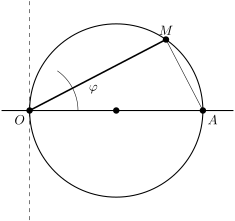 Fig. 2
Derive the formulas for a change of basis and a change of coordinate system on a straight line. How do the coordinates of the points of the line change if, with the origin unchanged, the length of the basis vector is doubled?
Let be the midpoint of the side of the triangle . Write the formulas of transition from the coordinate system , to the coordinate system .
A Cartesian coordinate system is given. How is the coordinate system , situated relative to it if the formulas of transition have the form , .
 Fig. 4
Suppose that in some basis the scalar product is computed by the formula . Prove that the basis is orthonormal.
Using the properties of scalar multiplication, prove that the altitudes of an arbitrary triangle intersect in one point.
 Fig. 5
Draw a regular triangle and take the length of its side to be 1. Draw in the same figure the basis biorthogonal to the basis .
Find the sum of the vector projections of a vector onto the sides of a given regular triangle.
Vectors are constructed perpendicular to the faces of an arbitrary tetrahedron, equal in length to the areas of these faces and directed towards the vertices opposite to the faces. Prove that the sum of these vectors is equal to 0.
A trihedral angle is given. Using the properties of the cross product, find an expression for one of its dihedral angles in terms of the plane angles.
Suppose that in an oriented plane a positive basis is given such that and . Find the area of the oriented parallelogram built on the vectors and .
Under what condition on the change-of-basis matrix from one basis to another are both bases oriented in the same way? The question is posed both for the plane and for space.
What is the dimension of the vectors of the reciprocal basis if the vectors of the basis are measured in centimeters?
Suppose that the sides of the triangle are equal to the medians of the triangle . It is required to find the ratio of the areas of these triangles.
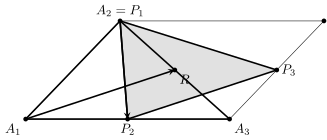 Fig. 7