Optimization Involving Trees
[51/98%]Show that if the vertex set of a connected graph is partitioned into two nonempty sets and , the disconnecting set consisting of all edges of joining vertices in and vertices in is a cut set if the subgraph has exactly two components.
The deletion of an edge belonging to a spanning tree of a graph from defines a partition of into two subsets and , creating a disconnecting set of the graph. Show that this disconnecting set is a cut set of .
If is a spanning tree in a graph , the cut set of formed by deleting an edge of , denoted by , is called the fundamental cut set of with respect to relative to edge . Find the number of cut sets of a connected graph with vertices with respect to a spanning tree.
If is a spanning tree in , any edge in that is not an edge in is called a chord of . The unique cycle in formed by the path in joining and and edge , denoted by , is called the fundamental cycle of with respect to relative to edge . Find the number of fundamental cycles of a connected graph with respect to a spanning tree.
Let be a connected graph in which is a cycle, is a cut set, and is a spanning tree. Show that:
the number of edges common to and is even,
at least one edge of is a chord of ,
at least one edge of is an edge of .
Let be an edge of a spanning tree in a graph . Show that
if is any edge (other than ) in the fundamental cut set is a chord of and is an edge of the fundamental cycle ; and
is not an edge of the fundamental cycle relative to any chord that is not an edge in .
Let be a chord of a spanning tree in a graph . Show that
if is any edge (other than ) in the fundamental cycle is an edge of and is an edge of the fundamental cut set ; and
is not an edge of the fundamental cut set relative to any edge of that is not an edge in .
Show that if and are two spanning trees in and if is an edge of and a chord of , there exists an edge in such that is a chord of and is a spanning tree in .
If no two edge weights of a connected graph are equal, show that has a unique minimum spanning tree.
Show that if a connected weighted graph contains a unique edge of minimum weight, is an edge of every M.S.T. of .
Show that a spanning tree in a weighted graph is a minimum spanning tree if and only if every edge of is a minimum weight edge in the fundamental cut set relative to that edge.
Show that if in a weighted connected graph there is an edge that is a maximum weight edge in any cycle that contains , there is an M.S.T. in that does not contain . In particular, if the weight of exceeds the weight of every edge in any cycle that contains , then no M.S.T. in contains as an edge.
A spanning tree in a graph is a minimum spanning tree if and only if every edge not in is a maximum weight edge in the fundamental cycle defined by that edge.
Prove Theorem 4.1: Kruskal's algorithm solves the M.S.T. problem in a network.
If is an edge incident at vertex of a connected weighted graph and if for every edge incident at , there exists an M.S.T. of that contains as an edge. In particular, if , every M.S.T. of contains .
If is the set of vertices of any subgraph of a minimal spanning tree of a graph and if is any edge of minimum weight in the disconnecting set , there exists an M.S.T. that contains as an edge and that has as a subgraph.
Prove Theorem 4.2: Prim's algorithm solves the M.S.T. problem.
Obtain a minimum spanning tree in the graph shown in Fig. 4-18.
 Fig. 4-18
Suppose we are using Prim's algorithm to obtain an M.S.T. in the graph of Fig. 4-18. At the current stage, is the set of vertices of the tree , which is a subtree of a minimum spanning tree to be obtained by this method. Select the next edge for inclusion, and list the edges after this selection is made.
Obtain a maximum weight spanning tree in the graph of Fig. 4-18.
Let be a weighted digraph, and let be a branching in . An arc is called a -eligible arc if the arcs in constitute a branching. Show that is -eligible if and only if there is no directed path in from to .
Let be a directed cycle in , and let be a branching in . Show that no arc in is -eligible if and only if contains exactly one arc.
Show that if is a critical subgraph of a weighted digraph , there is a maximum weight branching in such that for every cycle in , the set has exactly one arc.
Show that the cycles in a critical graph of a weighted digraph are , there exists a maximum weight branching of such that (i) has exactly one arc for each ; and (ii) if no in is directed to a vertex in the cycle , the unique arc in is an arc of minimum weight in for each .
Prove that the maximum weight branching algorithm solves the maximum weight branching problem.
Show that a maximum weight branching in the network shown in Fig. 4-21 cannot be obtained by the greedy algorithm.
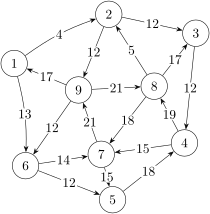 Fig. 4-21
 Fig. 4-22
Find a maximum weight branching in the network shown in Fig. 4-24.
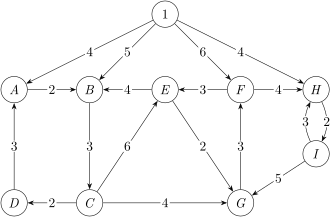 Fig. 4-24
Find a maximum weight branching on the network shown in Fig. 4-26.
 Fig. 4-26
Prove Theorem 4.3: A digraph has an arborescence if and only if it is quasi-strongly connected.
Prove Theorem 4.4: Let be a minimum weight arborescence rooted at vertex in a weighted digraph with distinct arc weights, and let be the subgraph obtained from by choosing the arc of minimum weight directed to each vertex other than . Then the set has exactly one arc for every cycle in .
Obtain a minimum weight arborescence in the digraph shown in Fig. 4-24.
Obtain a minimum weight arborescence in the digraph shown in Fig. 4-26.
Prove Theorem 4.5: An independent system is a matroid if and only whenever and are two independent sets with the property that has more elements than , there exists an element such that is an independent set.
Prove Theorem 4.6: The rank function of a matroid satisfies the following four properties: the rank of the empty set is 0, (ii) if , (iii) the function is submodular: , and (iv) the rank of a singleton set is either 0 or 1.
Prove Theorem 4.7: If is an integer-valued function defined on the power set of a finite set satisfying the four properties listed in Theorem 4.6, and if , the pair is a matroid.
Prove Theorem 4.8: A solution of the problem of finding a maximum weight independent set in an independent system can be obtained by using the greedy algorithm for every nonnegative weight function defined on its ground set if and only if the independent system is a matroid.
If is a partition of a finite set and if , show that the pair is a matroid (known as a partition matroid on ), and find its rank function.
If is a bipartite graph, show that we can obtain two partition matroids on : one using the set and the other using .
If is a directed graph, show that it is possible to obtain two partition matroids on the set of the arcs on the digraph.
Let be a finite set with a weight function defined on , and let be a collection of matroids defined on the same ground set . The -matroid cardinality intersection problem is the problem of finding a subset of maximum cardinality that is independent in each of the matroids. The -matroid weighted intersection problem is the problem of finding a subset of maximum weight that is independent in each of the matroids. Show that:
the former is a special case of the latter
the maximum weight branching problem and the minimum weight arborescence problem are 2 -matroid weighted intersection problems.
The span of any subset of the ground set of a matroid is a maximal superset of having the same rank as . Show that the span of a set is unique.
Find the weight of a minimum spanning tree in the network whose weight matrix is the following matrix:
In Problem 4.42, suppose we have to find a spanning tree of minimum weight that contains the two edges of maximum weight in the network. Find the weight of T.
Find the weight of a maximum weight spanning tree in the network of Problem 4.42.
Find the weight of a maximum weight branching in the directed network , where and with weights , and 2, respectively.
Find the weight of a maximum weight branching in the directed network , where and with weights , and 3, respectively.
Find the weight of a maximum weight branching in the directed network , where and with weights , and 1, respectively.
Find the weight of a minimum weight arborescence rooted at vertex 1 in the directed network , where and with weights , and 2, respectively.
Find the weight of a minimum weight arborescence rooted at vertex 1 in the directed network , where and with weights , and 6, respectively.
Give an example of a matroid and two subsets of the ground set such that the inequality in the submodularity relation involving these two subsets is a strict inequality.
Find the circuits and the bases of a -uniform matroid.