Eulerian and Hamiltonian Graphs
[107/87%]If the degree of each vertex in a graph is at least two, show that there is a cycle in the graph.
Show that a connected graph is Eulerian if and only if the degree of each vertex of the graph is even.
(The Königsberg Bridge Problem) The two islands (say the East Island and the West Island) in the river Pregel (known as Pregolya these days) that flows from east to west through the city of Königsberg (now known as Kaliningrad) in eastern Prussia (now a part of Russia) were connected by a bridge. Two bridges connected the west island to the north shore , and two bridges connected it to the south shore . A bridge connected the east island and the north shore, and another bridge connected it to the south shore. Show that the following problem posed to Leonard Euler (in 1736) by the citizens of Königsberg is not solvable: Start from one of these four land masses in the city and return to that point after walking along each bridge exactly once.
Solve the modified Königsberg bridge problem by:
deleting two edges from the graph,
constructing two new edges,
deleting an edge and constructing an edge.
Show that a graph is Eulerian if and only if it is connected and if the set of its edges can be partitioned into a disjoint union of cycles.
Show that a connected graph is Eulerian if and only if every edge in it belongs to an odd number of cycles.
Show that any trail constructed by Fleury's algorithm in an Eulerian graph is an Eulerian circuit.
Using Fleury's algorithm, obtain an Eulerian circuit in the graph of Fig. 3-18.
 Fig. 3-18
If the number of odd vertices in a connected graph is , show that the set can be partitioned into subsets such that the edges in each subset constitute a trail between two odd vertices.
Locate the odd vertices in the graph of Fig. 3-19 and then partition the set of edges in the graph into subsets such that the edges in each subset constitute a trail.
 Fig. 3-19
Prove Theorem 3.2: A connected graph is semi-Eulerian if and only if the number of odd vertices in it is exactly two. Furthermore, in a semi-Eulerian graph, any Eulerian trail is between its two odd vertices.
Prove that a weakly connected digraph is Eulerian if and only if the indegree of each vertex is equal to its outdegree.
A weakly connected digraph is semi-Eulerian if and only if there are two vertices and in it such that (1) (outdegree of indegree of , (2) (outdegree of indegree of , and (3) the outdegree of every other vertex is equal to its indegree. Show that in a weakly connected digraph satisfying these three properties, any directed Eulerian trail is from to .
If every vertex in a graph is even, no edge in that graph is a bridge.
Find all positive integers such that is:
Eulerian
semi-Eulerian.
If is the line graph of a simple graph , show that is Eulerian whenever is Eulerian.
Show that if the line graph of a simple graph is Eulerian, it is not necessary that is Eulerian.
Show that a digraph that has an Eulerian circuit is a strongly connected digraph. Is the converse true?
Show that a digraph that has an Eulerian trail is a unilaterally connected digraph. Is the converse true?
Is there an Eulerian graph of even order and odd size?
Is there an Eulerian graph of odd order and even size?
Show that if the degree of every vertex of a connected multigraph is 4, the graph has two spanning subgraphs such that (1) the degree of each vertex in these two subgraphs is 2, (2) the two subgraphs have no edge in common, and (3) is the union of the sets of edges of these two subgraphs.
Obtain a 2-factor decomposition of the 4-regular graph shown in Fig. 3-20.
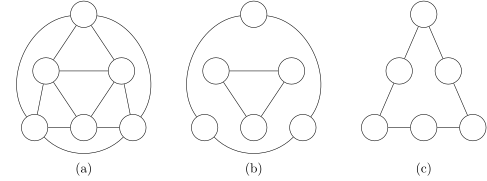 Fig. 3-20
Obtain a 2-factor decomposition of the complete bipartite graph .
A graph is said to be an even graph if the degree of every vertex in the graph is even. Find the number of nonequivalent labeled even graphs with vertices with labels .
A graph is randomly Eulerian from a vertex if every trail in the graph starting from can be extended to a circuit terminating at that consists of all the edges of the graph. Show that the graph in Fig. 3-22 is randomly Eulerian only from vertex 1.
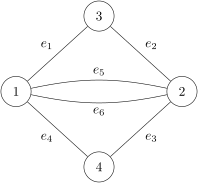 Fig. 3-22
Give an example of a graph that is randomly Eulerian from every vertex in it
Give an example of an Eulerian graph that is not randomly Eulerian from any of its vertices.
Prove that
if is randomly Eulerian from vertex of , every cycle in passes through ; and
if every cycle in a Eulerian graph passes through one of its vertices, is randomly Eulerian from that vertex.
Show that if is randomly Eulerian from is acyclic. Also show that if is a vertex in an Eulerian graph such that is acyclic, is randomly Eulerian from .
If graph is randomly Eulerian from a vertex, show that the degree of that vertex is equal to , which is the maximum among the degrees of all its vertices. Show that an arbitrary Eulerian graph need not be randomly Eulerian from a vertex of maximum degree.
Show that if is randomly Eulerian from and if is another vertex such that both and have the same degree, is randomly Eulerian from as well.
A graph is randomly Eulerian if it is randomly Eulerian from every vertex in the graph. Obtain a necessary and sufficient condition for a graph to be randomly Eulerian.
Show that if a graph is not randomly Eulerian, it is randomly Eulerian from at most two of its vertices.
A digraph is a randomly Eulerian digraph from a vertex if every directed trail of the digraph starting from can be extended to an Eulerian circuit. Prove that:
an Eulerian digraph is randomly Eulerian from a vertex if and only if every directed cycle in the digraph passes through ;
if a digraph is randomly Eulerian from vertex , the maximum outdegree among its vertices is equal to the outdegree of ;
if a digraph is randomly Eulerian from and if is another vertex such that both and have the same outdegree, the digraph is randomly Eulerian from also;
if an Eulerian digraph of order is not randomly Eulerian from every vertex, it is randomly Eulerian from at most vertices.
If is the set , any linear arrangement (repetitions are allowed) using some of or all these numbers is called a word in the alphabet . Any word with numbers from is called an -letter word in . The set of all -letter words in the alphabet with numbers is denoted by . The de Bruijn digraph is constructed by the following inductive procedure. Suppose all the words in are known for . The vertex set of is . If is any -letter word, and if and are numbers (not necessarily distinct) in , draw arcs (for each ) from vertex it to vertex as varies from 0 to . Then the arc from to represents the -letter word . Find the order and size of the de Bruijn digraph , and show that it is an Eulerian digraph.
Construct the de Bruijn digraph .
If is a word in , construct the arcs:
incident from the vertex
incident to in .
If and are two positive integers and if , a sequence , where each is in , is called a de Bruijn sequence, denoted by , if and only if any -letter in is of the form , where is at most and where addition of the subscripts is modulo . (Equivalently, these numbers in the sequence form a circular arrangement such that any choice of consecutive (in the clockwise direction) numbers in this arrangement gives a unique word.) Show that a de Bruijn sequence exists for every choice of and .
Obtain a de Bruijn sequence such that any three-letter word using 0,1, and 2 can be obtained from this sequence.
A rotating drum has sectors. The problem is to assign each sector the label 0 or 1 such that no two sequences of consecutive labels are the same. Solve this problem when:
.
Show that there are two unique four-letter binary words that can be deleted from the set of all such words so that any of the remaining words can be obtained by selecting four consecutive elements in a binary sequence placed in a circular arrangement. Obtain such a binary sequence.
(Bondy and Chvátal) Let and be two nonadjacent vertices in a simple graph of order such that the sum of their degrees is at least , and let be the graph obtained from by joining these two nonadjacent vertices. Then is Hamiltonian if and only if is Hamiltonian.
The closure of a graph of order is obtained from by recursively joining pairs of nonadjacent vertices whose degree sum is at least until no such pair exists. Show that every graph has a unique closure.
Show that a graph is Hamiltonian if and only if its closure is Hamiltonian.
Show that to establish a graph is Hamiltonian, it is sufficient if we show that its closure is complete.
Give an example of a Hamiltonian graph whose closure is not complete.
(Chvátal's Theorem) If the vertices of a graph are labeled such that their degrees can be arranged as a sequence , and if whenever is Hamiltonian.
If the vertices of a graph are labeled such that their degrees can be arranged as a sequence , and if whenever and is Hamiltonian.
If the vertices of a graph are labeled such that their degrees can be arranged as a sequence , and if whenever is Hamiltonian.
Prove Ore's theorem (Theorem 3.5) using Posa's theorem.
Point out the implications regarding sufficient conditions (established in this sequel) for the existence of a spanning cycle in a graph.
Show that Chvátal's condition is not a necessary condition for the existence of a spanning cycle in a graph.
Show that Chvátal's theorem is stronger than Bondy's theorem.
Show that Bondy's theorem is stronger than Posa's theorem.
Show that Posa's theorem is stronger than Ore's theorem.
Show that Ore's theorem is stronger than Dirac's theorem.
If is a graph with vertices and edges (where is at least three), and if is Hamiltonian
Show that the converse is not true by exhibiting a counterexample
Show that the inequality with this bound on the size of the graph is "sharp" in the sense that there is a non-Hamiltonian graph whose size is one less than this bound.
If is a bipartite graph with , and if the degree of each vertex is more than is Hamiltonian.
Show that if is Eulerian, its line graph is Hamiltonian. Give a counterexample to show that the converse is not true.
Show that if a graph is Hamiltonian, its line graph is Hamiltonian. Give a counterexample to show that the converse is not true.
Prove Theorem 3.7: A graph with vertices ( is at least three) is Hamiltonian-connected if the sum of the degrees of any two nonadjacent vertices is more than . In particular, it is Hamiltonian-connected if the degree of each vertex is more than .
Give a counterexample to show that the sufficient conditions established in Problem 3.60 for a graph to be Hamiltonian-connected are not necessary conditions.
Define the concept of closure in the context of graphs that are Hamiltonian-connected. Show that the closure of thus defined is unique. State and prove the appropriate theorem in this context.
Give an example of a Hamiltonian-connected graph whose closure as defined in Problem 3.62 is not complete.
If is a graph with vertices and edges (where is at least three), and if is Hamiltonian-connected
Show that the condition is sufficient but not necessary by exhibiting a counterexample.
Show that if a graph with vertices and edges is Hamilton-connected, it is necessary that . Show that this condition is by no means sufficient for a graph to be Hamiltonian-connected.
A Hamiltonian graph is said to be strongly Hamiltonian if every edge in the graph belongs to a Hamiltonian cycle. Give an example of:
a strongly Hamiltonian graph
a Hamiltonian graph that is not strongly Hamiltonian.
Show that a Hamiltonian-connected graph is a strongly Hamiltonian graph. Is the converse true?
Obtain a sufficient condition for a graph to be strongly Hamiltonian.
Show that if the degree sum of every pair of nonadjacent vertices in a non-Hamiltonian-connected graph with three or more vertices is at least (where is some positive integer), the graph contains a path of length .
If the degree sum of every pair of nonadjacent vertices in a graph of order is at least , the graph has a Hamiltonian path. In particular, if the degree of each vertex is at least , the graph has a Hamiltonian path.
A graph is randomly traceable if a Hamiltonian path results upon starting from any vertex and successively proceeding to any adjacent vertex that is not yet in the path. Furthermore, if has at least three vertices and the terminal vertex of each such path is adjacent to the initial vertex, the graph is called randomly Hamiltonian. Obviously, cyclic graphs and complete graphs with three or more vertices are randomly traceable and randomly Hamiltonian. Show that:
is randomly traceable if and only if it is randomly Hamiltonian,
every randomly traceable graph is Hamiltonian.
Show that if is a Hamiltonian cycle in a randomly Hamiltonian graph and if there is an edge in the graph between and , there is an edge between and for . (Here the addition of the subscripts is modulo .)
Show that if is a Hamiltonian cycle in a randomly Hamiltonian graph and if there is an edge between and (for some ), is a complete graph.
Let be a randomly Hamiltonian graph of order , and let be any fixed Hamiltonian cycle in this graph. The edges in are called cycle edges, and the edges not in are called diagonal edges. Any cycle consisting of cycle edges and exactly one diagonal edge is called an outer -cycle. Show that the minimum value of such that has an outer -cycle is either 3 or 4. Furthermore, if , the graph is a complete graph, and if , the number of vertices in the graph is even.
Show that a graph with three or more vertices is randomly Hamiltonian if and only if it is a cyclic graph or a complete graph or a complete bipartite graph with equal number of vertices in each part.
Show that the cyclic graph is the only graph that is both randomly Eulerian and randomly Hamiltonian.
A graph is strongly randomly traceable if for every two distinct vertices and , a Hamiltonian path between and exists whenever we start from and successively proceed to another vertex not yet encountered, with the restriction that will be chosen only when there is no other alternative. Show that a graph of order is a strongly randomly traceable graph if and only if it is the complete graph .
The outdegree of a vertex in a tournament can be considered as the score of the player represented by that vertex. A player with maximum score is a winner. If is a player who has defeated a winner in the tournament, show that has defeated some player who has defeated .
A graph (digraph) of order is vertex-pancyclic if every vertex is contained in a cycle (directed cycle) of length for every . Show that a strongly connected tournament is vertex-pancyclic.
Prove Theorem 3.13: A tournament is Hamiltonian if and only if it is strongly connected.
Obtain a necessary and sufficient condition to be satisfied by a vertex in a tournament so that there is a Hamiltonian path starting from that vertex.
A tournament is irreducible whenever is a subset of , there should be an arc from a vertex in to a vertex in . Show that in a tournament , the following concepts are equivalent:
is Hamiltonian,
is strongly connected,
is irreducible.
Show that every tournament is either a strongly connected digraph or a digraph that can be converted into a strongly connected digraph by reversing the orientation of exactly one arc.
The sequence of nonnegative integers is called a score sequence (of a tournament) if there exists a tournament of order whose vertices can be labeled so that the outdegree of each is for each . Show that a nondecreasing sequence of nonnegative integers is the score sequence of a transitive tournament if and only if the sequence is .
Show that the sequence of nondecreasing nonnegative integers is a score sequence of a tournament if and only if for with equality holding when .
Show that the sequence of nondecreasing nonnegative integers is a score of a strongly connected tournament if and only if for and .
If is a connected graph with odd vertices, find the minimum number of trails in such that every edge in the graph is an edge in exactly one of these trails.
Show that if a multidigraph has an Eulerian walk but not an Eulerian circuit, exactly one vertex has an excess of one indegree and exactly one vertex has an excess of one outdegree.
Show that if a graph has a circuit of odd length, it has a cycle of odd length.
Suppose in a group of people , any two of them together know all the other people in the group. Show that these people can be seated around a circular table so that each person is seated between two acquaintances.
Show that a -regular graph with vertices is Hamiltonian.
Show that any -regular simple graph with vertices is Hamiltonian.
A nontrivial connected graph is Eulerian if and only if every block in the graph is Eulerian.
Find the number of Hamiltonian graphs in .
Find the number of Hamiltonian cycles in .
Show that if is odd, the set of edges of can be partitioned into disjoint Hamiltonian cycles.
Thirteen mathematicians are attending a six-day conference. Each night they sit around a circular table for dinner so that no two persons sit next to each other more than once and so that each person gets a chance to sit to next to each other person exactly once during those six nights.
It is known that is the score sequence of a tournament. Is it a score sequence of a strong tournament?
It is known that is the score sequence of a tournament. Is it a score sequence of a strong tournament?
Show that the sum of the squares of the terms in the score sequence of a tournament is equal to the sum of the squares of the indegrees of the vertices.
Show that a regular tournament is strongly connected.
Show that if is the score sequence of a tournament, is also a score sequence of a tournament, where for .
Examine the case when the inequalities in the statement of Problem 3.85 are all equalities.
Show that in a tournament involving players, the number of players with the score is at most 1.
Show that if is an odd number other than 1, there is a tournament of order in which every vertex is a winner.
Show that the -cube (see Solved Problem 1.56) is a Hamiltonian graph.
For what value of is the -cube graph an Eulerian graph?
Show that the de Bruijn digraph is a Hamiltonian graph.