Connectivity
[116/91%]Prove Theorem 2.1: Every walk in a graph between and contains a path between and , and every directed walk from to in a digraph contains a directed path from to .
Prove Theorem 2.2: If is the adjacency matrix of a simple graph , where , the entry in the th power of is the number of different walks of length between the vertices and . In particular, the diagonal entry in is the degree of vertex for each . (See Solved Problem 2.2.)
If the edges in a graph are labeled and the set of paths between two vertices and are labeled , the path matrix is the binary matrix in which the entry corresponding to the path is 1 if contains the edge and 0 otherwise. Obtain a path matrix between vertices 1 and 3 in Fig. 2-2.
Let be the incidence matrix of the simple graph in which , and the paths between vertex and vertex are labeled . If is the path matrix, the (binary) product is the binary matrix in which the only nonzero entries are those in the th and th rows. (Multiplication of binary matrices here is .)
Verify the assertion in Problem 2.4 by considering a path matrix in Fig. 2-2.
If the edge set in a simple graph is labeled and the set of cycles is labeled , the cycle matrix of the graph is the binary matrix defined as follows. In the row corresponding to the th cycle , the entry is 1 if and only if is an edge in . Obtain a cycle matrix of the graph of Fig. 2-3.
Let be the incidence matrix of the simple graph , where , and the cycles in are labeled . If is the cycle matrix, the (binary) matrix product and the (binary) matrix product are zero matrices. (Multiplication of binary matrices here is .)
Verify the assertion of Problem 2.7 by considering the cycle matrix in Fig. 2-3.
Show that a graph is bipartite if and only if every component of is bipartite.
Prove Theorem 2.3: A simple graph with three or more vertices is bipartite if and only if it has no odd cycles.
Prove Theorem 2.4: For any graph .
Exhibit a graph for which the inequality established in Problem 2.11 is strict.
A matrix is called a totally unimodular (TU) matrix if the determinant of every square submatrix is either -1 or 0 or 1. Show that each entry in a TU matrix is -1 or 0 or 1 but that the converse is not true.
Show that the matrix in which each element is -1 or 0 or 1 is a TU matrix if it satisfies the following two conditions: (i) no column can have more than two nonzero elements, and (ii) it is possible to partition the set of rows of the matrix into sets and such that if and are the two nonzero elements in column , row and row belong to the same subset of the partition if and only if they are of opposite sign.
Show that the following are both TU matrices:
the incidence matrix of a digraph
the incidence matrix of a bipartite graph.
Show that a graph is bipartite if and only if its incidence matrix is a totally unimodular matrix.
The smallest number of colors needed to color the vertices of a graph such that each vertex gets a unique color and no two adjacent vertices get the same color is called the chromatic number (or vertex chromatic number) of the graph. Show that a graph is bipartite if and only if its chromatic number is two.
Show that the following are equivalent in a simple graph :
is bipartite,
has no odd cycles,
the incidence matrix of is a totally unimodular matrix,
the chromatic number of is two.
Suppose each set in a family of subsets of a finite set is represented as a vertex. Two vertices representing two distinct subsets belonging to the family are joined by an edge if they have at least one element in common. The simple graph thus constructed is called the intersection graph of the family of subsets of the given set. Construct the intersection graph of the family of subsets of the set with the family , where , and .
Show that every simple graph is (isomorphic to) the intersection graph of a family of subsets of a finite set.
The intersection number of a graph is the minimum number of elements in a set such that is an intersection graph of a family of subsets of . Show that the intersection number of a connected graph cannot exceed its size.
Construct:
a connected graph such that its intersection number is equal to its size
a connected graph such that its intersection number is less than its size.
Show that the intersection number of a connected graph with at least four vertices is equal to its size if and only if it has no triangles.
Find the intersection number of , where .
The intersection graph of a finite family of open intervals of the real line is called an interval graph. Show that the cyclic graph with vertices is (isomorphic to) an interval graph only when .
Show that:
any induced subgraph of an interval graph is an interval graph,
an arbitrary subgraph of an interval graph need not be an interval graph.
A graph is called a chordal graph if in every cycle in there is an edge (belonging to ) joining two nonadjacent (in ) vertices. Show that every interval graph is a chordal graph.
Show that a graph is chordal if and only if is not an induced subgraph of for any .
Give an example of a chordal graph that is not an interval graph.
The graph is called an indifference graph if for every positive number , there exists a mapping from to the set of real numbers such that if and only if and are adjacent. Show that the graph in Fig. 2-14 is an indifference graph.
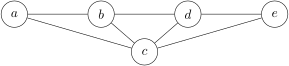 Fig. 2-14
Show that every indifference graph is an interval graph.
By constructing an example, show that an interval graph need not be an indifference graph.
Show that every indifference graph is an interval graph, every interval graph is a chordal graph, and every chordal graph is an intersection graph.
An interval graph is called a unit interval graph if the length of the open interval that corresponds to a vertex is the same for every vertex. Show that a graph is an indifference graph if and only if it is a unit interval graph.
A digraph is a transitive digraph if there is an arc from to whenever there is an arc from to and there is an arc from to for any set of three distinct vertices , and in . A simple graph is a transitively orientable graph (or a comparability graph) if has an orientation that is a transitive digraph. Show that the complement of an interval graph is a transitively orientable graph.
Obtain a transitive orientation for the complement of the interval graph .
Show that if the complement of is transitively orientable, it is not necessary that is an interval graph by constructing an example.
Suppose is a simple graph with at least one edge. The line graph (also known as the interchange graph, adjoint graph, derived graph, or edge graph) of is the graph , where there is a one-to-one correspondence from to such that there is an edge between and if and only if the edges and have a vertex in common. Construct the line graph of the graph of .
Find the line graph of the graph shown in Fig. 2-18(a).
Show that the line graph of is the intersection graph of a family of subsets of the product set .
If is the vertex in the line graph that corresponds to the edge joining vertex and vertex in , find the degree of in .
Find the order and size of .
Find the order and size of the line graph of a simple graph with vertices and edges.
Suppose is a simple graph with five vertices with degrees , and 3. Find the number of vertices and edges in .
Find the line graph of:
a simple path with edges, where ,
the cyclic graph with edges, where .
Show that there is no graph such that .
Construct an example to show that if and are isomorphic, it is not necessary that and are isomorphic.
Show that:
a graph is isomorphic to its line graph if and only if the degree of each vertex is 2,
a connected graph is isomorphic to its line graph if and only if it is a cyclic graph,
the line graph of a connected graph is (isomorphic to) if and only if is (isomorphic to) when .
Let be the set of all the vertices and edges of a graph with vertices and edges. Construct a graph in which two elements and are joined by an edge if:
and are adjacent vertices in ,
is a vertex and is an edge such that one of the vertices of is , or
if both and are edges, they have a vertex in common.
The graph thus constructed is called the total graph of the graph. Construct the total graph of the complete graph with three vertices.
Show that a graph is a tree if and only if there is a unique path between every pair of vertices in the graph.
Show that a graph is a tree if and only if it is connected and every edge in it is a bridge.
Show that a graph with vertices is a tree if and only if it is connected and has edges.
Show that a graph with vertices is a tree if and only if it is acyclic and has edges.
Show that a graph is a tree if and only if it is acyclic and whenever any arbitrary two vertices in are joined by an edge, the resulting enlarged graph has exactly one cycle.
Show that a graph is a tree if and only if it is connected and whenever any two arbitrary vertices in are joined by an edge, the resulting enlarged graph has exactly one cycle.
Prove Theorem 2.5: The following are equivalent in a graph with vertices.
-
is a tree.
-
There is a unique path between every pair of vertices in .
-
is connected, and every edge in is a bridge.
-
is connected, and it has edges.
-
is acyclic, and it has edges.
-
is acyclic, and whenever any two arbitrary nonadjacent vertices in are joined by an edge, the resulting enlarged graph has a unique cycle.
-
is connected, and whenever any two arbitrary nonadjacent vertices in are joined by an edge, the resulting enlarged graph has a unique cycle.
Prove Theorem 2.7: A graph is connected if and only if it has a spanning tree.
Prove Theorem 2.8: Let be a simple graph with vertices. If a spanning subgraph satisfies any two of the following three properties, it will satisfy the third property also. (i) is connected. (ii) has edges. (iii) is acyclic.
Show that if a graph is disconnected, its complement is connected.
A vertex of degree 1 in a graph is called a terminal vertex (or pendant vertex or end-vertex). Show that every tree of order two or more has at least two terminal vertices.
Show that the vector of positive integers, where is the degree vector of a tree with vertices if and only if .
Prove Theorem 2.6: The center of a tree is either a singleton set consisting of a unique vertex or a set consisting of two adjacent vertices.
A path between two distinct vertices in a connected graph is a diametral path if there is no other path in whose length is more than the length of . Show that:
every diametral path in a tree will pass through its central vertices,
the center of a tree can be located once a diametral path in the tree is discerned.
A tree with exactly one vertex of degree 2 in which the degree of every nonterminal vertex (other than ) is 3 is called a binary tree, and the root of the binary tree is the unique vertex of degree 2. Show that the number of vertices in a binary tree is odd.
Show that the number of terminal vertices in a binary tree with vertices is .
Show that if is a tree with vertices and is a graph with is isomorphic to a subgraph of .
Show that a tree with vertices is isomorphic to a subgraph of the complement of the cyclic graph with vertices.
A graph is said to be a unicyclic graph if it has exactly one cyclic subgraph. Show that if any two of the following conditions are satisfied in a graph with vertices and vertices, the third condition also is satisfied:
is connected,
is unicyclic,
.
Show that each labeled tree with vertices corresponds to a unique vector , where for .
Find the unique vector corresponding to the labeled tree shown in Fig. 2-19.
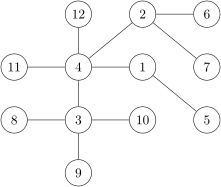 Fig. 2-19
Show that every vector with components, where each component is an element of , corresponds to a unique labeled tree with vertices.
Obtain the unique labeled tree corresponding to the vector ].
Prove Theorem 2.9 (Cayley's theorem): The number of distinct labeled trees with vertices is , which is also equal to the number of spanning trees in
Show that the number of distinct labeled trees with vertices is
Show that the number of spanning trees in is also .
A directed tree such that there is a unique vertex of indegree zero and that the indegree of every other vertex is 1 is called an arborescence rooted at . Find the number of distinct labeled arborescences with vertices.
A tree with vertices is an edge-labeled tree if each edge is assigned a unique positive integer between 1 and . Show that the number of distinct edge-labeled trees with labeled edges and unlabeled vertices is .
Let be an undirected graph with labeled vertices and labeled edges. Assign each edge an arbitrary orientation, and let be the incidence matrix of the resulting digraph. Show that:
if is connected, the rank of is ;
the determinant of any nonsingular submatrix of is either -1 or 1.
Suppose an arbitrary incidence matrix of a connected graph with vertices is defined as in Problem 2.77. The reduced incidence matrix is the matrix obtained from by deleting a row, say the th row. Show that any submatrix of matrix is nonsingular if and only if the edges corresponding to the columns of constitute the edges of a spanning tree in .
Show that if is the reduced incidence matrix (as defined in Problem 2.77) of a connected graph and if is its transpose, the number of spanning trees in is equal to the determinant of .
If is an edge in graph is the subgraph of obtained from by deleting from . After edge joining the vertices and is deleted, suppose the vertices and are merged to constitute a single vertex. The resulting graph is called the contracted graph obtained by contracting edge and is denoted by G.e. If is the number of spanning trees in , show that (G.e).
Show that if , where are subtrees of such that every pair of subtrees have at least one vertex in common, the entire set of subtrees have a vertex in common.
Obtain a DFS spanning tree starting the search from vertex 2 in the graph shown in Fig. 2-20.
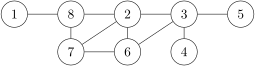 Fig. 2-20
Show that a digraph is strongly connected if and only if the following property is satisfied: For every nonempty subset of vertices, there exists an arc from a vertex in to a vertex in the complement of .
Show that if a tournament has a directed circuit, it has a directed triangle.
If is a tournament with vertices, the vector whose components are the outdegrees arranged in a nondecreasing order is called the score vector of the tournament. A tournament is a transitive tournament if whenever and are arcs, is also an arc. Show that a tournament with vertices is transitive if and only if its score vector is .
Suppose is the digraph obtained from a strongly connected mixed graph (see Section 2.2) by deleting an undirected edge from and replacing every other edge in by two arcs in opposite directions. Let be the set of all vertices such that there is a directed path in from to consisting of at least one arc. Likewise, let be the set of all vertices such that there is a direct path in from to consisting of at least one arc. If is not in and is not in is a bridge in the mixed graph.
Show that if is a strongly connected mixed graph, it is possible to convert any edge that is not a bridge into an arc such that the resulting mixed graph is also strongly connected.
Prove Theorem 2.10 (Robbins's theorem): A graph is strongly orientable if and only if it is connected and has no bridges.
Suppose is a connected graph in which no edge is a bridge, and let be the DFS spanning (directed) tree obtained by starting the search from a fixed vertex called the root of the tree. Show that there is a directed path in to every vertex from root .
Let be a connected simple graph in which no edge is a bridge, and let be a DFS spanning tree in the graph. Assume that is the unique label of vertex assigned to it during the search, as in Problem 2.88. If is any edge that is not used as an arc in and if is any vertex such that , there is a directed path in from to .
Suppose and are as in Problem 2.89. If there is a directed path in from vertex to vertex and a directed path in from another vertex to , either there is a directed path from to or from to in tree .
Suppose and are as in Problem 2.89 with the same labeling as before. If is an edge not in and if , the edge is converted into an arc from to . Thus each edge in is now converted into an arc, giving an orientation of graph based on the depth first search. The length of the (unique) path in from the root to vertex is denoted by . If and is any vertex with , there is a directed path in from to .
Let and be as in Problem 2.91. Show that there is a directed path in from every vertex to the root.
Prove Theorem 2.11 (Roberts's theorem): The orientation procedure using the depth first search in a connected graph with no bridges yields a strongly connected digraph. (This is another way of establishing Robbins's theorem. Thus the proof given here may be called Roberts's proof of Robbins's theorem.)
Show that a vertex of a connected graph is a cut vertex if and only if there exist two distinct vertices and such that every path between these two vertices passes through .
Show that any nontrivial graph has at least two vertices that are not cut vertices.
Show that an edge of a connected graph is a bridge if and only if there exist vertices and such that every path between these two vertices contains this edge.
Show that an edge is a bridge if and only if no cycle contains that edge.
A nontrivial connected graph is called a nonseparable graph if it has no cut vertices. A subgraph of a graph is a block in graph if is nonseparable and maximal with respect to this property: If there is a nonseparable subgraph such that is a subgraph of . Obtain the blocks of the graph in Fig. 2-21.
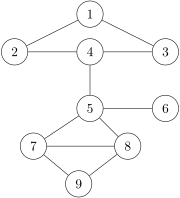 Fig. 2-21
Show that two blocks have at most one vertex in common. What distinguishing feature does a vertex common to two blocks have?
Show that is 2-connected if and only if is connected with at least three vertices but no cut vertices.
Show that the center of a connected graph is a subset of the set of vertices of a block.
Show that in a graph with vertices, the length of a path cannot exceed and the length of a cycle cannot exceed .
Show that a graph with vertices is connected if and only if no entry in is zero, where is its adjacency matrix.
Show that the sum of the diagonal elements of the second power of the adjacency matrix is twice the number of edges of the graph.
Find the intersection number for when .
Let be the total graph of the graph , where . Let be the degree of in
Find the degree of in
If is an edge in joining and , find the degree of in
Find the number of edges in if has edges.
If both and its complement are trees, find the order of .
Find the number of edges in a forest with vertices and trees.
Show that a tree is a bipartite graph.
Show that if a tree has exactly two terminal vertices, the degree of every other vertex is 2 and thus it is a path.
Find the number of terminal vertices in a tree with vertices.
Show that if the degree of every nonterminal vertex in a tree is 3, the number of vertices in the tree is even.
In a tree with 14 terminal vertices, the degree of every nonterminal vertex is either 4 or 5. Find the number of vertices of degree 4 and of degree 5.
Find the number of distinct labeled trees with five vertices.
If is the subgraph obtained by deleting an edge from , find the number of spanning trees in .
Show that a bipartite graph is a transitively orientable graph but not conversely.