Tangent lines and normal planes of space curves
[48/77%]Write the tangent line and normal plane equations at the given point for the following curve: , , ; at the point .
Write the tangent line and normal plane equations at the given point for the following curve: , , ; at the point .
Write the tangent line and normal plane equations at the given point for the following curve: , ; at the point .
Write the tangent line and normal plane equations at the given point for the following curve: , ; at the point .
Write the tangent line and normal plane equations at the given point for the following curve: , ; at the point .
Find a point on the curve , , at which the tangent line is parallel to the plane .
Prove that the tangent line to the helix , , makes a constant angle with the axis.
Prove that the curve
intersects all the generating lines of the cone at the same angle.
Prove that the loxodrome
(where is the longitude of a point on the Earth, and is the latitude of a point on the Earth) intersects all meridians of the Earth at a constant angle.
Given the curve
where is a differentiable function. Find the tangent of the angle formed by the tangent line to the curve at the point with the plane.
Find the derivative of the function
at the point along the direction of the tangent line, at this point, to the curve , , .
Find the equation of the tangent to the curve
Find the tangent to the preceding curve that is parallel to the plane .
Find the cosines of the angles with the axes for the tangent to the curve
For the curve
find the points at which the tangent is parallel to the plane or .
Find the tangent to the curve
at the point .
Find the tangent to the curve
at the point .
Find the tangent to the curve
at the point .
Find the cosines of the angles with the axes for the tangent to the curve
The same question (find the cosines of the angles with the axes for the tangent) as in the preceding problem, for the circle
A tangent is drawn to the curve
at the point where . Find its length from the point of tangency to the plane .
Find the angle between the tangent to the curve
and the vector drawn from the origin to the point of tangency.
Find the normal plane to the curve
At the point where , find the normal plane to the curve
Prove that the normal planes of the curve
pass through the line
Find the derivative of the vector function and write the equation of the tangent at an arbitrary point of its hodograph, if:
;
.
Find the equation of the tangent to the curve:
at ;
at .
Write the equation of the tangent to the curve
at . What angle does this tangent make with the axis ?
Find the equation of the tangent line and the normal plane of the curve at an arbitrary point of it.
Find the tangent to Viviani's curve (see problem 42) parallel to the plane .
At which points is the tangent to the curve parallel to the plane ?
Find the normal plane of the curve , perpendicular to the line .
Find the tangent to the curve at the point .
Find the cosines of the angles with the coordinate axes made by the tangents to the curve .
A tangent is drawn to the curve at the point where . Find the length of the segment of this tangent from the point of tangency to the plane .
Prove that the normal planes of the curve pass through the line .
Prove that the tangents to the curve make a constant angle with some fixed direction.
The coordinates of the points of a certain curve satisfy the relation
Prove that the tangents to this curve are tangent to the sphere .
Prove that the tangents to the curve
intersect the plane of the variables and in the circle .
Write the equation of the tangent and the normal plane of the curve at the point . What curve results from the intersection of the tangents with the plane of the variables ?
Find the equation of the normal plane at an arbitrary point of the curve .
Prove that all normal planes of Viviani's curve pass through the origin.
Prove that if all normal planes of a space curve pass through a fixed point, then the curve is spherical.
Prove that the curve intersects all the generators of the cone at one and the same angle.
Prove that the curves of intersection of the cylinders with the surface intersect, at a right angle, all the generators of this surface belonging to one family.
Prove that the curve lies on the surface of a paraboloid and intersects, at a right angle, all its generators of one family.
The curve called a loxodrome is defined by the equation
where is the latitude and the longitude of a point on the sphere. Prove that it intersects the meridians of the sphere at an angle whose tangent equals .
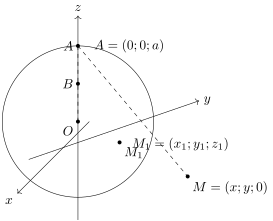
Fig. 24.8
Let us formulate the definition of the stereographic projection of a plane onto a sphere tangent to it. Suppose that in the space a Cartesian rectangular coordinate system is fixed, and a sphere of radius with center at the point , tangent to the plane of the variables and (Fig. 24.8), is given. Its equation has the form
Let us join by a line the top point of the sphere, i.e., the point , with an arbitrarily fixed point of the plane of the variables and . Then the point at which this line intersects the sphere (53) is called the stereographic projection of the point onto the sphere (53), and the point is called the stereographic projection of the point of the sphere onto the plane in question. The stereographic projection establishes a one-to-one correspondence between the points of the plane and the sphere with the point removed. The coordinates of the points and are related by
Write the equations of the osculating, normal, and rectifying planes at an arbitrary point of the curve:
the helix ;
;
;
;
;
.