Asymptotic notation and growth rates of functions

[26/69%]
Show
LaTeX

Prove that:

lim⁡x→+∞xnax=0(a>1,n>0). \lim _{x\to +\infty }\frac{x^{n}}{a^{x}}=0 \quad (a>1,n>0) .
?

Prove that:

lim⁡x→+∞lg⁡axxε=0(a>1,ε>0). \lim _{x\to +\infty }\frac{\lg _{a}x}{x^{\varepsilon }}=0 \quad (a>1,\varepsilon >0) .
?

Find the following limit: lim⁡x→01x100e−1x2\lim \limits_{x\to 0}\dfrac {1}{x^{100}}e^{-\frac{1}{x^{2}}}.

?

Find the following limit: lim⁡x→+0xln⁡x\lim \limits_{x\to +0}x\ln x.

?

Let o(f(x))o(f(x)) denote, as x→ax\to a, an arbitrary infinite function of lower order than the function f(x)f(x), and let O(f(x))O(f(x)) denote, as x→ax\to a, an arbitrary infinite function of the same order (in the generalized sense) as the function f(x)f(x), where f(x)>0f(x)>0.

Prove:

?
(a)

o{o[f(x)]}=o[f(x)]o\left\{ o\left[f(x)\right]\right\} =o\left[f(x)\right];

(b)

O{o[f(x)]}=o[f(x)]O\left\{ o\left[f(x)\right]\right\} =o\left[f(x)\right];

(c)

o{O[f(x)]}=o[f(x)]o\left\{ O\left[f(x)\right]\right\} =o\left[f(x)\right];

(d)

O{O[f(x)]}=O[f(x)]O\left\{ O\left[f(x)\right]\right\} =O\left[f(x)\right];

(e)

O[f(x)]+o[f(x)]=O[f(x)]O\left[f(x)\right]+o\left[f(x)\right]=O\left[f(x)\right];

(f)

O[f(x)]⋅O[g(x)]=O[f(x)g(x)]O\left[f(x)\right]\cdot O\left[g(x)\right]=O\left[f(x)g(x)\right].

Let x→+0x\to +0 and n>0n>0. Prove

?
(a)

CO(xn)=O(xn)CO(x^{n})=O(x^{n}) (CC is a constant);

(b)

O(xn)+O(xm)=O(xn)O(x^{n})+O(x^{m})=O(x^{n}) (n⩽mn\leqslant m);

(c)

O(xn)O(xm)=O(xn+m)O(x^{n})O(x^{m})=O(x^{n+m}).

Let x→+∞x\to +\infty and n>0n>0. Prove

?
(a)

CO(xn)=O(xn)CO(x^{n})=O(x^{n});

(b)

O(xn)+O(xm)=O(xn)O(x^{n})+O(x^{m})=O(x^{n}) (n⩾mn\geqslant m);

(c)

O(xn)O(xm)=O(xn+m)O(x^{n})O(x^{m})=O(x^{n+m}).

Let x→+0x\to +0. Prove the following equalities:

?
(a)

2x−x2=O∗(x)2x-x^{2}=O^{*}(x);

(b)

xsin⁡x=O∗(x32)x\sin \sqrt{x}=O^{*}\left(x^{\frac{3}{2}}\right);

(c)

xsin⁡1x=O(∣x∣)x\sin \dfrac {1}{x}=O(\left|x\right|);

(d)

ln⁡x=o(1xε)\ln x=o\left(\dfrac {1}{x^{\varepsilon }}\right) (ε>0\varepsilon >0);

(e)

x+x+x∼x8\sqrt{x+\sqrt{x+\sqrt{x}}}\sim \sqrt[8]{x};

(f)

arctg⁡1x=O(1)\operatorname {arctg}\dfrac {1}{x}=O(1);

(g)

(1+x)n=1+nx+o(x)(1+x)^{n}=1+nx+o(x).

Let x→+∞x\to +\infty. Prove the following equalities:

?
(a)

2x3−3x2+1=O∗(x3)2x^{3}-3x^{2}+1=O^{*}(x^{3});

(b)

x+1x2+1=O∗(1x)\dfrac {x+1}{x^{2}+1}=O^{*}\left(\dfrac {1}{x}\right);

(c)

x+x2sin⁡x=O(x2)x+x^{2}\sin x=O(x^{2});

(d)

arctg⁡x1+x2=O∗(1x2)\dfrac {\operatorname {arctg}x}{1+x^{2}}=O^{*}\left(\dfrac {1}{x^{2}}\right);

(e)

ln⁡x=o(xε)\ln x=o(x^{\varepsilon }) (ε>0\varepsilon >0);

(f)

xpe−x=o(1x2)x^{p}e^{-x}=o\left(\dfrac {1}{x^{2}}\right);

(g)

x+x+x∼x\sqrt{x+\sqrt{x+\sqrt{x}}}\sim \sqrt{x};

(h)

x2+xln⁡100x∼x2x^{2}+x\ln^{100}x\sim x^{2}.

Prove that when xx is sufficiently large, the following inequalities hold:

?
(a)
(b)

ln⁡1000x<x\ln^{1000}x<\sqrt{x};

(c)

x10ex<e2xx^{10}e^{x}<e^{2x}.

Let x→+∞x\to +\infty and fn(x)=xnf_{n}(x)=x^{n} (n=1,2,…n=1,2,\ldots). Prove that:

?
(a)

each of the functions fn(x)f_{n}(x) increases faster than the one preceding it, fn−1(x)f_{n-1}(x);

(b)

the function exe^{x} increases faster than each of the functions fn(x)f_{n}(x) (n=1,2,…n=1,2,\ldots).

Let x→+∞x\to +\infty and fn(x)=xnf_{n}(x)=\sqrt[n]{x} (n=1,2,…n=1,2,\ldots). Prove that:

?
(a)

each of the functions fn(x)f_{n}(x) increases more slowly than the one preceding it, fn−1(x)f_{n-1}(x);

(b)

the function f(x)=ln⁡xf(x)=\ln x increases more slowly than each of the functions fn(x)f_{n}(x) (n=1,2,…n=1,2,\ldots).

Prove that for any sequence of functions

f1(x),f2(x),…,fn(x),…(x0<x<+∞), f_{1}(x),f_{2}(x),\ldots ,f_{n}(x),\ldots \quad (x_{0}<x<+\infty ) ,

one can exhibit a function f(x)f(x) that, as x→+∞x\to +\infty, increases faster than each of the functions fn(x)f_{n}(x) (n=1,2,…n=1,2,\ldots).

?

x2+10x+100<0.001x3x^{2}+10x+100<0.001x^{3};

?

Show that 2ln⁡n=o(n)2^{\ln n}=o(n) and 2log⁡(2n)=O(n)2^{\log (2 n)}=O(n).

?

Show that (log⁡n)10≺n10≺2(log⁡n)10(\log n)^{10} \prec n^{10} \prec 2^{(\log n)^{10}}.

?

Compare the following three functions using the ≺\prec notation:

2nlog⁡n,n(log⁡n)2,(log⁡n)2n 2^{n^{\log n}}, \quad n^{(\log n)^{2}}, \quad (\log n)^{2^{n}}
?

Compare 2log⁡∗n2^{\log { }^{*} n} with nn using the ≺\prec notation.

?

Suppose that f(n)≺g(n)f(n) \prec g(n). Is it true that for any increasing function h(n)h(n) with lim⁡n→∞h(n)=∞,h(f(n))≺h(g(n))\lim_{n \rightarrow \infty } h(n)=\infty , h(f(n)) \prec h(g(n))? Present a proof or a counterexample.

?

Prove that log⁡(k+1)≺log⁡(k)n\log^{(k+1)} \prec \log^{(k)} n for any k≥0k \geq 0.

?

Denote log⁡∗∗n=min⁡{k∣(log⁡∗)(k)n≤1,k≥1}\log^{* *} n=\min \left\{ k \mid \left(\log^{*}\right)^{(k)} n \leq 1, k \geq 1\right\}. Compare log⁡∗∗n\log^{* *} n with log⁡∗n\log^{*} n.

?

Recall the Ackermann function AA defined in Exercise 8 of Section 4.8.

?
(a)

Compare the function f(n)=A(n,n)f(n)=A(n, n) with 22n2^{2^{n}}.

(b)

Compare the function g(n)=max⁡{k∣A(k,k)≤n}g(n)=\max \left\{ k \mid A(k, k) \leq n\right\} with log⁡∗n\log^{*} n.

Suppose we are given three pegs and nn disks, with all nn disks having different size. Initially, the nn disks are stacked in decreasing size, from bottom to top, in the first peg (see Figure 6.1). The Tower of Hanoi problem is to transfer the entire tower of nn disks from the first peg to the second peg, moving one disk at a time and never putting a larger disk on top of a smaller disk. What is the fastest solution to this problem? Is the fastest solution feasible for size n=64n=64 (the size of the original Tower of Hanoi problem)?
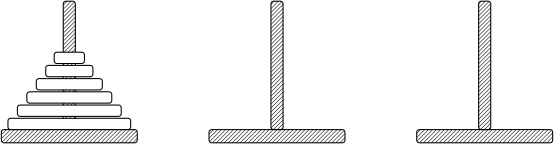
Figure 6.1: The Tower of Hanoi problem.Figure 6.1: The Tower of Hanoi problem.

?

Show that the function 2log⁡n2^{\sqrt{\log n}} grows slower than every function in the polynomial sequence, but faster than every function in the poly-log sequence.

?

Suppose f(n)≺g(n)f(n) \prec g(n). Show that there exists a function h(n)h(n) such that f(n)≺h(n)≺g(n)f(n) \prec h(n) \prec g(n).

?

Show that log⁡∗n≺log⁡(m)n\log^{*} n \prec \log^{(m)} n for any constant integer m≥1m \geq 1.

?

References

[Dem97] Demidovich B.P. Сборник задач и упражнений по математическому анализу. 13-е изд., Издательство Московского университета / Издательство "ЧеРо", 1997.
[DuKo01] Du D., Ko K. Problem Solving in Automata, Languages, and Complexity. John Wiley & Sons, 2001.