Green's function of an ODE boundary value problem
[31/65%]Find the spectrum, the eigenvalues, the eigenfunctions, and the norm of the operator in , defined by the formula .
Find the norm, the spectrum, the eigenvalues and the eigenfunctions of an operator in , defined by the formula , in the following cases:
;
;
;
;
;
.
Transform an integral equation , into a differential one and solve it:
;
.
In the space , find the solution of the following integral equations for all values :
;
.
In the space , find the solution of the integral equation for all values :
if
;
.
In the space , find the solution of the integral equation for all values :
if
;
.
In the space , find the solution of the integral equation for all values :
if
;
.
In the space , find the eigenvalues and eigenfunctions of the integral operator
if
In the space , find the eigenvalues and eigenfunctions of the integral operator
if
;
-2.
Consider the Sturm-Liouville operator with , , and for each of the following boundary conditions find the eigenvalues , the eigenvectors , and the Green function :
;
;
and ;
and .
Given the function
where
and are both continuous. Prove that the given function satisfies the equation
At the point of a homogeneous string (), subject to the action of a strong tension and fastened at the ends and , a weight is suspended (Fig. 15.22).
 Fig. 15.22
Prove that the equation of the sag of the string has the form
A heavy homogeneous string is fastened at the point and is subject at the point to the action of a horizontal force (Fig. 15.23).
 Fig. 15.23
Prove that the equilibrium equation of the string has the form
Hint. The tension of the string at the point is taken equal to .
A homogeneous string of length is fastened by the end to a fixed axis and rotates about this axis with constant angular velocity. To the point of such a string a force is applied (Fig. 15.24).
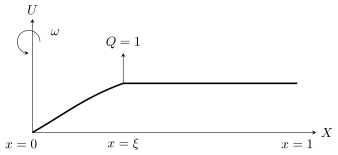 Fig. 15.24
Prove that the equation of relative equilibrium of the string has the form
Hint. The tension of the string at the point , caused by the centrifugal force, is taken equal to
Prove that for a continuously distributed load, the equation of the sag of the string has the form
where denotes the magnitude of the load, computed per unit length of the string.
Hint. Use the result of problem 5900 (problem 5900: for , for ).
Prove that the problem of small vibrations of a fastened string can be reduced to solving the homogeneous Fredholm equation
where the symmetric kernel has the form given in problem 5901 (problem 5901: for , for ).
On a homogeneous string, fastened at the ends, a continuously distributed force acts
Prove that the problem of forced vibrations of such a string reduces to solving the inhomogeneous Fredholm equation
Reduce to an integral equation the problem of finding the solutions of the equation
under the boundary conditions: bounded, .
Reduce to an integral equation the problem of finding the solutions of the equation
under the boundary conditions: , .
Construct the integral equation whose fundamental functions are the Legendre functions of order :
boundary condition: bounded at and .
Solve problem 5943 for the case of the Legendre polynomials.
Hint. Consider the equation
Construct the integral equation whose fundamental functions are the Hermite polynomials:
at .
Hint. Set .
Construct the integral equation whose fundamental functions are the Laguerre polynomials:
bounded at and .
Hint. Set .
Having found the corresponding Green's function, replace the equation
by an integral one.
Having found the corresponding Green's function, replace the equation
by an integral equation.
Having found the corresponding Green's function , replace the equation
by an integral one.
Let and let be a function continuous on the segment . Show that the function
satisfies on the segment the equation .
Consider the operator defined by
where .
Prove that is a compact self-adjoint operator.
Find the spectrum and the norm .
Define
and define by
Show that the eigenvalues of are , that the corresponding eigenfunctions are , and that each eigenspace is onedimensional. Hint: If , the equation implies that is infinitely differentiable, that , and that . The case can be treated separately.
Show that the above eigenfunctions form an orthogonal basis for .
Suppose . Discuss the equation .
Show that is also a compact operator on , the space of all continuous functions on [0,1]. Hint: If is uniformly bounded, then is equicontinuous.
Consider the following three boundary value problems. The differential equation is
where is given. The choices of boundary conditions are
(i) .
(ii) .
(iii) and .
Show that each of these problems has a unique solution such that is absolutely continuous and . Hint: Combine Example 13.4 with Theorem 13.13.
Do this also by solving the problems explicitly.
Show that if
for all , and , then .