Jensen's formula

[27/70%]
Show
LaTeX
?
(a)

Let f(z)f(z) be a holomorphic function in the disc ∣z∣<r\left|z\right| < r whose zeros in this disc are given by a1,a2,…,ana_1, a_2, \ldots , a_n counted with multiplicity. Suppose further that ∣aj∣<r\left|a_j\right| < r for all j=1,2,…,nj = 1, 2, \ldots , n, and ∣f(0)∣=1\left|f(0)\right| = 1. Jensen's formula states that

12π∫02πlog⁡∣f(reiθ)∣ dθ=∑j=1nlog⁡r∣aj∣. \frac{1}{2\pi } \int _0^{2\pi } \log \left|f(re^{i\theta })\right|\, d\theta = \sum _{j=1}^{n} \log \frac{r}{\left|a_j\right|}.

Prove this.

(b)

With the hypotheses and notations of (a), let n(t)n(t) be the number of aja_j (j=1,2,…,nj = 1, 2, \ldots , n) such that ∣aj∣<t\left|a_j\right| < t. Using Jensen's formula, show that

∫0rn(t)t dt=12π∫02πlog⁡∣f(reiθ)∣ dθ. \int _0^r \frac{n(t)}{t}\, dt = \frac{1}{2\pi } \int _0^{2\pi } \log \left|f(re^{i\theta })\right|\, d\theta .
(c)

For r<Rr < R deduce an estimate on n(r)n(r) in terms of max⁡0≤θ≤2πlog⁡∣f(Reiθ)∣\max_{0 \leq \theta \leq 2\pi } \log \left|f(Re^{i\theta })\right|.

(d)

What can be said about the zeros of bounded holomorphic functions in the unit disc?

Let f(z)f(z) be regular in the disk ∣z∣⩽r\left|z\right| \leqslant r and have, inside the disk, roots a1,a2,…,ana_{1}, a_{2}, \ldots , a_{n}, distinct from zero. By joining each of the zeros aνa_{\nu } with a cut to the circle ∣z∣=r\left|z\right| = r and integrating the corresponding function over the resulting contour, prove Jensen's formula:

ln⁡f(0)+∑ν=1nln⁡r∣aν∣=12π∫02πln⁡∣f(reiφ)∣ dφ. \ln f(0)+\sum _{\nu =1}^{n} \ln \frac{r}{\left|a_{\nu }\right|} = \frac{1}{2\pi }\int _{0}^{2\pi } \ln \left|f(re^{i\varphi })\right|\, d\varphi .
?

Prove that if, under the conditions of the previous problem (problem 5509), the maximum of ∣f(z)∣\left|f(z)\right| equals MM, ∣f(0)∣=m\left|f(0)\right| = m, and NN is the number of zeros of f(z)f(z) in the disk ∣z∣⩽re\left|z\right| \leqslant \frac{r}{e}, then

N⩽ln⁡Mm. N \leqslant \ln \frac{M}{m}.
?

Let zνz_{\nu } be the roots of an entire function f(z)f(z), and

0<∣z1∣⩽∣z2∣⩽∣z3∣⩽⋯⩽∣zN−1∣⩽R<∣zN∣, 0 < \left|z_{1}\right| \leqslant \left|z_{2}\right| \leqslant \left|z_{3}\right| \leqslant \cdots \leqslant \left|z_{N-1}\right| \leqslant R < \left|z_{N}\right|,

while for the function f(z)f(z) the inequality

∣f(z)∣<Ce∣z∣σ \left|f(z)\right| < Ce^{\left|z\right|^{\sigma }}

holds. Prove that for ∣z∣⩽3R\left|z\right| \leqslant 3R

∣f(0)∣<∣f(z)∏ν=1N−1(1−zzν)∣<Ce(3R)σ2N−1. \left|f(0)\right| < \left|\frac{f(z)}{\prod _{\nu =1}^{N-1} \left(1-\dfrac {z}{z_{\nu }}\right)}\right| < \frac{Ce^{(3R)^{\sigma }}}{2^{N-1}}.
?

Let the function f(z)f(z) be regular and different from zero for ∣z∣≤r\left|z\right|\leq r. Prove that the geometric mean of ∣f(z)∣\left|f(z)\right| on the circle ∣z∣=r\left|z\right|=r

e12π∫02πlog⁡∣f(reiϑ)∣ dϑ=lim⁡n→∞∣f(r)f(rωn)f(rωn2)⋯f(rωnn−1)∣n=∣f(0)∣. e^{\frac{1}{2\pi }\int _{0}^{2\pi } \log \left|f(re^{i\vartheta })\right|\, d\vartheta } = \lim _{n\to \infty } \sqrt[n]{\left|f(r)f(r\omega _{n})f(r\omega _{n}^{2})\cdots f(r\omega _{n}^{n-1})\right|} = \left|f(0)\right|.
?
Remark.
?

log⁡f(z)\log f(z) is regular for ∣z∣≤r\left|z\right|\leq r.

The function f(z)f(z) is regular in the disk ∣z∣≤r\left|z\right|\leq r and does not vanish for z=0z=0; the zeros of f(z)f(z) in the disk are z1,z2,…,znz_{1},z_{2},\ldots ,z_{n}, where each multiple zero is represented with its multiplicity. Then the geometric mean of ∣f(z)∣\left|f(z)\right| on the circle ∣z∣=r\left|z\right|=r is

e12π∫02πlog⁡∣f(reiϑ)∣ dϑ=∣f(0)∣ rn∣z1z2⋯zn∣. e^{\frac{1}{2\pi }\int _{0}^{2\pi } \log \left|f(re^{i\vartheta })\right|\, d\vartheta } = \left|f(0)\right|\, \frac{r^{n}}{\left|z_{1}z_{2}\cdots z_{n}\right|}.
?
Remark.
?

f(z)=(z−z1)(z−z2)⋯(z−zn)f∗(z)f(z)=(z-z_{1})(z-z_{2})\cdots (z-z_{n})f^{*}(z), f∗(z)f^{*}(z) regular and different from 00 for ∣z∣≤r\left|z\right|\leq r.

Under the hypothesis of problem 120 the geometric mean of ∣f(z)∣\left|f(z)\right| on the disk ∣z∣≤r\left|z\right|\leq r,

g(r)=e1πr2∫0r∫02πlog⁡∣f(ϱeiϑ)∣ ϱ dϱ dϑ \mathfrak {g}(r) = e^{\frac{1}{\pi r^{2}}\int _{0}^{r}\int _{0}^{2\pi } \log \left|f(\varrho e^{i\vartheta })\right|\, \varrho \, d\varrho \, d\vartheta }

is always smaller than the geometric mean of ∣f(z)∣\left|f(z)\right| on the circle ∣z∣=r\left|z\right|=r,

G(r)=e12π∫02πlog⁡∣f(reiϑ)∣ dϑ. \mathfrak {G}(r) = e^{\frac{1}{2\pi }\int _{0}^{2\pi } \log \left|f(re^{i\vartheta })\right|\, d\vartheta }.

We have in fact

g(r)G(r)=e−n2(1−∣z1∣2+∣z2∣2+⋯+∣zn∣2nr2). \frac{\mathfrak {g}(r)}{\mathfrak {G}(r)} = e^{-\frac{n}{2}\left(1-\dfrac {\left|z_{1}\right|^{2}+\left|z_{2}\right|^{2}+\cdots +\left|z_{n}\right|^{2}}{nr^{2}}\right)}.
?

We assume that the function f(z)f(z) is meromorphic in the disk ∣z∣≤1\left|z\right|\leq 1, regular and non-zero on the boundary and at the origin. The zeros of f(z)f(z) in ∣z∣≤1\left|z\right|\leq 1 are a1,a2,…,ama_{1},a_{2},\ldots ,a_{m} and the poles b1,b2,…,bnb_{1},b_{2},\ldots ,b_{n} (multiple zeros and poles are listed with correct multiplicity). Then we have Jensen's formula

log⁡∣f(0)∣+log⁡1∣a1∣+log⁡1∣a2∣+⋯+log⁡1∣am∣ \log \left|f(0)\right| + \log \frac{1}{\left|a_{1}\right|} + \log \frac{1}{\left|a_{2}\right|} + \cdots + \log \frac{1}{\left|a_{m}\right|} −log⁡1∣b1∣−log⁡1∣b2∣−⋯−log⁡1∣bn∣=12π∫02πlog⁡∣f(eiϑ)∣ dϑ. - \log \frac{1}{\left|b_{1}\right|} - \log \frac{1}{\left|b_{2}\right|} - \cdots - \log \frac{1}{\left|b_{n}\right|} = \frac{1}{2\pi }\int _{0}^{2\pi } \log \left|f(e^{i\vartheta })\right|\, d\vartheta .
?
Remark.
?

Draw circles of radius ε\varepsilon around the zeros and poles in the open disk ∣z∣<1\left|z\right|<1 so that these circles do not have points in common with each other nor with the circle ∣z∣=1\left|z\right|=1. Connect the ε\varepsilon-circles with the unit circle by paths that do not intersect each other (e.g.by radii of the unit circle if all the poles and zeros have different argument, cf.diagram).
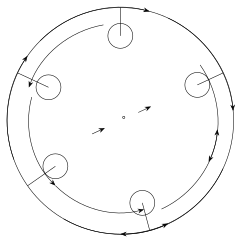
By excluding the ε\varepsilon-disks and the connecting paths we reduce the disk ∣z∣<1\left|z\right|<1 to a simply connected region Rε\mathfrak {R}_{\varepsilon }. Compute the integral ∫log⁡f(z)z dz\displaystyle \int \frac{\log f(z)}{z}\, dz along the positively oriented boundary of Rε\mathfrak {R}_{\varepsilon }.

The function f(z)f(z) is meromorphic in the disk ∣z∣≤R\left|z\right|\leq R, regular and different from 00 on the circle ∣z∣=R\left|z\right|=R and it has inside the circle the zeros a1,a2,…,ama_{1},a_{2},\ldots ,a_{m} and the poles b1,b2,…,bnb_{1},b_{2},\ldots ,b_{n}, counted with correct multiplicities. If the point z=reiϑz=re^{i\vartheta }, r<Rr<R, is neither a zero nor a pole we have

log⁡∣f(z)∣+∑μ=1mlog⁡∣R2−aμ‾z(aμ−z)R∣−∑ν=1nlog⁡∣R2−bν‾z(bν−z)R∣ \log \left|f(z)\right| + \sum _{\mu =1}^{m} \log \left|\frac{R^{2}-\overline{a_{\mu }}z}{(a_{\mu }-z)R}\right| - \sum _{\nu =1}^{n} \log \left|\frac{R^{2}-\overline{b_{\nu }}z}{(b_{\nu }-z)R}\right| =12π∫02πlog⁡∣f(ReiΘ)∣ R2−r2R2−2Rrcos⁡(Θ−ϑ)+r2 dΘ. = \frac{1}{2\pi }\int _{0}^{2\pi } \log \left|f(Re^{i\Theta })\right|\, \frac{R^{2}-r^{2}}{R^{2}-2Rr\cos (\Theta -\vartheta )+r^{2}}\, d\Theta .
?

The function f(z)f(z) is meromorphic in the half-plane Re(z)≥0\mathrm{Re}\left(z\right)\geq 0, regular and non-zero on its boundary and it has inside the half-plane the zeros a1,a2,…,ama_{1},a_{2},\ldots ,a_{m} and the poles b1,b2,…,bnb_{1},b_{2},\ldots ,b_{n}, counted with correct multiplicity. If f(z)f(z) is regular at infinity (but also under weaker conditions on its behaviour at infinity) and if f(z)f(z) is regular and non-zero at z=x+iyz=x+iy, x>0x>0, we have

log⁡∣f(z)∣+∑μ=1mlog⁡∣z+aμ‾z−aμ∣−∑ν=1nlog⁡∣z+bν‾z−bν∣ \log \left|f(z)\right| + \sum _{\mu =1}^{m} \log \left|\frac{z+\overline{a_{\mu }}}{z-a_{\mu }}\right| - \sum _{\nu =1}^{n} \log \left|\frac{z+\overline{b_{\nu }}}{z-b_{\nu }}\right| =1π∫−∞+∞log⁡∣f(iη)∣ darctan⁡η−yx. = \frac{1}{\pi }\int _{-\infty }^{+\infty } \log \left|f(i\eta )\right|\, d\arctan \frac{\eta -y}{x}.
?

The function f(z)f(z) is regular in the domain

(D)r≤∣z∣≤R,−π2≤arg⁡z≤π2, (\mathfrak {D}) \qquad r\leq \left|z\right|\leq R, \quad -\frac{\pi }{2}\leq \arg z\leq \frac{\pi }{2},

different from zero on the boundary of D\mathfrak {D} and it has in D\mathfrak {D} the zeros a1,a2,…,ama_{1},a_{2},\ldots ,a_{m}, aμ=rμeiϑμa_{\mu }=r_{\mu }e^{i\vartheta_{\mu }}, μ=1,2,…,m\mu =1,2,\ldots ,m. Using the definition log⁡∣f(ϱeiϑ)∣=U(ϱ,ϑ)\log \left|f(\varrho e^{i\vartheta })\right|=U(\varrho ,\vartheta ) we have the formula

∑r<rμ<R(1rμ−rμR2)cos⁡ϑμ=1πR∫−π2+π2U(R,ϑ)cos⁡ϑ dϑ \sum _{r<r_{\mu }<R} \left(\frac{1}{r_{\mu }}-\frac{r_{\mu }}{R^{2}}\right)\cos \vartheta _{\mu } = \frac{1}{\pi R}\int _{-\frac{\pi }{2}}^{+\frac{\pi }{2}} U(R,\vartheta )\cos \vartheta \, d\vartheta +12π∫rR(1ϱ2−1R2)[U(ϱ,π2)+U(ϱ,−π2)]dϱ+χ(R), + \frac{1}{2\pi }\int _{r}^{R} \left(\frac{1}{\varrho ^{2}}-\frac{1}{R^{2}}\right)\left[U\left(\varrho ,\frac{\pi }{2}\right) + U\left(\varrho ,-\frac{\pi }{2}\right)\right]d\varrho + \chi (R),

where χ(R)\chi (R) is bounded as R→∞R\to \infty; r,f(z)r,f(z) are fixed.

?
Remark.
?

∮log⁡f(z)(1z2+1R2)dzi\displaystyle \oint \log f(z)\left(\frac{1}{z^{2}}+\frac{1}{R^{2}}\right)\frac{dz}{i} has to be computed along a path analogous to the one in problem 175.

(continued). Suppose f(z)f(z) does not vanish on ∣z∣=r\left|z\right|=r and that its zeros in the disk ∣z∣<r\left|z\right|<r are c1,c2,…,cmc_{1},c_{2},\ldots ,c_{m}. Then we have for ∣z∣<r\left|z\right|<r

log⁡f(z)=iγ+∑μ=1mlog⁡(z−cμ)rr2−cμ‾z+12π∫02πlog⁡∣f(reiϑ)∣ r+ze−iϑr−ze−iϑ dϑ, \log f(z) = i\gamma + \sum _{\mu =1}^{m} \log \frac{(z-c_{\mu })r}{r^{2}-\overline{c_{\mu }}z} + \frac{1}{2\pi }\int _{0}^{2\pi } \log \left|f(re^{i\vartheta })\right|\, \frac{r+ze^{-i\vartheta }}{r-ze^{-i\vartheta }}\, d\vartheta ,

where γ\gamma is a real constant. [Consequence of problem 231 as problem 120 is a consequence of problem 119.]

?

Let the function f(z)f(z) satisfy the following conditions:

  1. f(z)f(z) is regular, ∣f(z)∣≤M\left|f(z)\right|\leq M in the disk ∣z−s∣≤r\left|z-s\right|\leq r;

  2. f(z)f(z) does not vanish in the closed half-disk ∣z−s∣≤r\left|z-s\right|\leq r, \re(z−s)≥0\re (z-s)\geq 0;

  3. f(z)f(z) has in the disk ∣z−s∣≤23r\left|z-s\right|\leq \frac{2}{3}r the zeros c1,c2,…,clc_{1},c_{2},\ldots ,c_{l}. Then

−\ref′(s)f(s)≤2rlog⁡M∣f(s)∣−∑λ=1l\re1s−cλ. -\re \frac{f'(s)}{f(s)} \leq \frac{2}{r}\log \frac{M}{\left|f(s)\right|} - \sum _{\lambda =1}^{l} \re \frac{1}{s-c_{\lambda }}.

[We may assume s=0s=0; problems 232, 120.]

?

In contrast to the notation of problem 12, we now denote by Mk(r)M_{k}(r) and Nk(r)N_{k}(r) the maximum modulus and the number of zeros of (f(z))k(f(z))^{k} in the circle ∣z∣≤r\left|z\right| \leq r, k=1,2,3,…k = 1, 2, 3, \ldots respectively. The quotient Nk(r)log⁡Mk(r)\dfrac {N_{k}(r)}{\log M_{k}(r)} is independent of kk.

?

Let a0≠0a_{0} \neq 0. Then

M(r)≥∣f(0)∣rnr1r2⋯rn. M(r) \geq \frac{\left|f(0)\right| r^{n}}{r_{1} r_{2} \cdots r_{n}}.
?
Remark.
?

For which entire functions can the equality sign hold in this inequality?

Assuming that a0≠0a_{0} \neq 0, we have

log⁡M(r)−log⁡∣f(0)∣≥∫0rN(t)t dt. \log M(r) - \log \left|f(0)\right| \geq \int _{0}^{r} \frac{N(t)}{t} \, dt.
?

For an arbitrary entire function

lim sup⁡r→∞log⁡N(r)log⁡r≤lim sup⁡r→∞log⁡log⁡M(r)log⁡r. \limsup _{r \to \infty } \frac{\log N(r)}{\log r} \leq \limsup _{r \to \infty } \frac{\log \log M(r)}{\log r}.
?

Consider an entire function and let k>0k > 0. If the infinite integral ∫1∞r−k−1log⁡M(r) dr\int_{1}^{\infty } r^{-k-1} \log M(r) \, dr is convergent, then the infinite series ∑n=q+1∞rn−k\sum_{n=q+1}^{\infty } r_{n}^{-k} is also convergent (not vice versa!).

?

Consider a function which is regular in the interior of the unit circle, and let k>0k > 0. If the integral ∫01(1−t)k−1log⁡M(t) dt\int_{0}^{1} (1-t)^{k-1} \log M(t) \, dt is convergent then the series ∑n=1∞(1−rn)k+1\sum_{n=1}^{\infty } (1 - r_{n})^{k+1} is also convergent.

?

For an entire function whose zeros have a finite exponent of convergence λ\lambda

lim inf⁡r→∞N(r)log⁡M(r)≤λ. \liminf _{r \to \infty } \frac{N(r)}{\log M(r)} \leq \lambda .
?
Remark.
?

See problem 32.

Let LL be the maximum of the absolute values of the coefficients of the polynomial

f(z)=zn+a1zn−1+a2zn−2+⋯+an, f(z) = z^n+a_1z^{n-1}+a_2z^{n-2}+\cdots +a_n,

and let z1,z2,…,znz_1, z_2, \ldots , z_n be the zeros of f(z)f(z). Then we have

(1+∣z1∣)(1+∣z2∣)…(1+∣zn∣)≤2nn+1 L.(Problem 52 of Part Two.) (1+\left|z_1\right|)(1+\left|z_2\right|)\ldots (1+\left|z_n\right|) \leq 2^n\sqrt{n+1}\, L. \qquad \text{(Problem 52 of Part Two.)}
?

Let h(z)=c(1+z1z)(1+z2z)⋯(1+znz)h(z) = c(1+z_1 z)(1+z_2 z) \cdots (1+z_n z), ∣zν∣≦1\left|z_\nu \right| \leqq 1, ν=1,2,…,n\nu = 1, 2, \ldots , n, cc real, c>0c > 0. Then, setting g(ϑ)=∣h(eiϑ)∣2g(\vartheta ) = \left|h(e^{i\vartheta })\right|^2, we have

12π∫02πlog⁡g(ϑ) dϑ=log⁡c2. \frac{1}{2\pi } \int _0^{2\pi } \log g(\vartheta ) \, d\vartheta = \log c^2.
?

Find all complex zz for which exp⁡(exp⁡(z))=1\exp (\exp (z)) = 1. Sketch them as points in the plane. Show that there is no entire function of finite order which has a zero at each of these points (except, of course, f≡0f \equiv 0).

?

Suppose ff is entire, f(0)≠0,∣f(z)∣<exp⁡(∣z∣p)f(0) \neq 0,\left|f(z)\right| < \exp \left(\left|z\right|^{p}\right) for large ∣z∣\left|z\right|, and {zn}\left\{ z_{n}\right\} is the sequence of zeros of ff, counted according to their multiplicities. Prove that Σ∣zn∣−p−ϵ<∞\Sigma \left|z_{n}\right|^{-p-\epsilon } < \infty for every ϵ>0\epsilon > 0. (Compare with Sec. 15.20).

?

Suppose ff is an entire function, f(n)=0f(\sqrt{n}) = 0 for n=1,2,3,…n = 1,2,3, \ldots, and there is a positive constant α\alpha such that ∣f(z)∣<exp⁡(∣z∣α)\left|f(z)\right| < \exp \left(\left|z\right|^{\alpha }\right) for all large enough ∣z∣\left|z\right|. For which α\alpha does it follow that f(z)=0f(z) = 0 for all zz?

?

Suppose 0<α<1,0<β<1,f∈H(U),f(U)⊂U0 < \alpha < 1,0 < \beta < 1, f \in H(U), f(U) \subset U, and f(0)=αf(0) = \alpha. How many zeros can ff have in the disc⁡Dˉ(0;β)\operatorname {disc} \bar{D}(0 ; \beta )? What is the answer if

?
(a)

α=12,β=12\alpha = \frac{1}{2}, \beta = \frac{1}{2};

(b)

α=14,β=12\alpha = \frac{1}{4}, \beta = \frac{1}{2};

(c)

α=23,β=13\alpha = \frac{2}{3}, \beta = \frac{1}{3};

(d)

α=1/1,000\alpha = 1 / 1{,}000, β=1/10\beta = 1 / 10?

Put f(z)=exp⁡[−(1+z)/(1−z)]f(z) = \exp [-(1+z) /(1-z)]. Using the notation of Theorem 15.19, show that

lim⁡r→1μr(f)<μ∗(f) \lim _{r \rightarrow 1} \mu _{r}(f) < \mu ^{*}(f)

although f∈H∞f \in H^{\infty }. Note the contrast with Theorem 15.24.

?

References

[CJP+11] Chen J., Jiang G., Pan Y., Qin T., Tong Y., Wu Q., Xu S., Li T. Problems and Solutions in Mathematics. 2nd ed., World Scientific, 2011.
[ГюКу03] Гюнтер Н.М., Кузьмин Р.О. Сборник задач по высшей математике. 13-е изд., Издательство «Лань», 2003.
[PóSz98] Pólya G., Szegő G. Problems and Theorems in Analysis. Springer, 1998.
[Rud87] Rudin W. Real and Complex Analysis. 3rd ed., McGraw-Hill, 1987.