Green's function for boundary value problems

[25/68%]
Show
LaTeX

Let Ω⊆R3\Omega \subseteq \mathbb {R}^{3} be bounded and open with smooth boundary. Let u∈C1(Ω‾)∩C2(Ω)u \in C^1(\overline{\Omega }) \cap C^2(\Omega ) solve

Δu+k2u=0in Ω  (k>0). \Delta u + k^2 u = 0 \quad \text{in } \Omega \; (k > 0).

Derive an appropriate mean-value property for the solution.

?

At the point x=ξx = \xi of a homogeneous string (ρ=1\rho = 1), subject to the action of a strong tension T0T_{0} and fastened at the ends x=0x = 0 and x=1x = 1, a weight Q=1Q = 1 is suspended (Fig. 15.22).

Fig. 15.22Fig. 15.22

Prove that the equation of the sag of the string has the form

u=K(x,ξ)={x(1−ξ)⋅1T0for x⩽ξ,ξ(1−x)⋅1T0for x⩾ξ. u = K(x,\xi ) = \begin{cases} x(1-\xi ) \cdot \dfrac {1}{T_{0}} & \text{for } x \leqslant \xi , \\ \xi (1-x) \cdot \dfrac {1}{T_{0}} & \text{for } x \geqslant \xi . \end{cases}
?

A heavy homogeneous string is fastened at the point x=1x = 1 and is subject at the point x=ξx = \xi to the action of a horizontal force Q=1Q = 1 (Fig. 15.23).

Fig. 15.23Fig. 15.23

Prove that the equilibrium equation of the string has the form

u=K(x,ξ)={−ln⁡ξ,for x⩽ξ,−ln⁡x,for x⩾ξ. u = K(x,\xi ) = \begin{cases} -\ln \xi , & \text{for } x \leqslant \xi , \\ -\ln x, & \text{for } x \geqslant \xi . \end{cases}
?
Remark.
?

Hint. The tension of the string at the point M(x)M(x) is taken equal to −x-x.

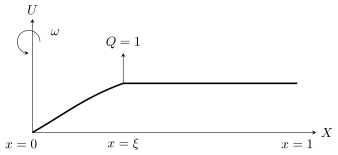
A homogeneous string of length l=1l = 1 is fastened by the end x=0x = 0 to a fixed axis and rotates about this axis with constant angular velocity. To the point x=ξx = \xi of such a string a force Q=1Q = 1 is applied (Fig. 15.24).

Fig. 15.24Fig. 15.24

Prove that the equation of relative equilibrium of the string has the form

u=K(x,ξ)={12ln⁡1+x1−xfor x⩽ξ,12ln⁡1+ξ1−ξfor x⩾ξ. u = K(x,\xi ) = \begin{cases} \dfrac {1}{2}\ln \dfrac {1+x}{1-x} & \text{for } x \leqslant \xi , \\ \dfrac {1}{2}\ln \dfrac {1+\xi }{1-\xi } & \text{for } x \geqslant \xi . \end{cases}
?
Remark.
?

Hint. The tension of the string at the point M(x)M(x), caused by the centrifugal force, is taken equal to

R=2∫x1x dx=1−x2. R = 2\int _{x}^{1} x \, dx = 1-x^{2}.

Reduce to an integral equation the problem of finding the solutions of the equation

(xy′)′+λxy=0 (xy')'+\lambda xy = 0

under the boundary conditions: y(0)y(0) bounded, y(1)=0y(1) = 0.

?

Reduce to an integral equation the problem of finding the solutions of the equation

(xy′)′+(λx−n2x)y=0 (xy')'+\left(\lambda x-\frac{n^{2}}{x}\right)y = 0

under the boundary conditions: y(0)=0y(0) = 0, y(1)=0y(1) = 0.

?

Construct the integral equation whose fundamental functions are the Legendre functions of order mm:

((1−x2)y′)′+(n(n+1)−m21−x2)y=0; \left((1-x^{2})y'\right)'+\left(n(n+1)-\frac{m^{2}}{1-x^{2}}\right)y = 0;

boundary condition: yy bounded at x=−1x = -1 and x=+1x = +1.

?

Solve problem 5943 for the case m=0m = 0 of the Legendre polynomials.

?
Remark.
?

Hint. Consider the equation

((1−x2)y′)′+n(n+1)y=12. \left((1-x^{2})y'\right)'+n(n+1)y = \frac{1}{2}.

Construct the integral equation whose fundamental functions are the Hermite polynomials:

y′′+(1−x2)y+λy=0, y''+(1-x^{2})y+\lambda y = 0,

y=0y = 0 at x=±∞x = \pm \infty.

?
Remark.
?

Hint. Set λ=−2+μ\lambda = -2+\mu.

Construct the integral equation whose fundamental functions are the Laguerre polynomials:

xy′′+(1−x)y′+λy=0; xy''+(1-x)y'+\lambda y = 0;

yy bounded at x=0x = 0 and x=+∞x = +\infty.

?
Remark.
?

Hint. Set λ=−1+μ\lambda = -1+\mu.

Having found the corresponding Green's function, replace the equation

y′′+k2y=f(x),y(0)=y(1)=0 y''+k^{2}y = f(x), \quad y(0) = y(1) = 0

by an integral one.

?

Having found the corresponding Green's function, replace the equation

y′′+k2y=f(x),y′(0)=hy(0),y′(1)=−Hy(1) y''+k^{2}y = f(x), \quad y'(0) = hy(0), \quad y'(1) = -Hy(1)

by an integral equation.

?

Having found the corresponding Green's function G(ξ,x)G(\xi ,x), replace the equation

y′′+k2y=f(x),y(0)=0,y′(1)=−hy(1) y''+k^{2}y = f(x), \quad y(0) = 0, \quad y'(1) = -hy(1)

by an integral one.

?

Having verified that the fundamental functions of the equation of problem 5950 (problem 5950: y′′+k2y=f(x)y''+k^{2}y = f(x), y(0)=0y(0) = 0, y′(1)=−hy(1)y'(1) = -hy(1), with Green's function G(ξ,x)G(\xi ,x)) equal

2(h2+kn2)h2+h+kn2sin⁡knx, \sqrt{\frac{2(h^{2}+k_{n}^{2})}{h^{2}+h+k_{n}^{2}}}\sin k_{n}x,

where knk_{n} --- the root of the equation

k=−htg⁡k, k = -h\tg k,

solve the equation

y(x)=k2∫01G(ζ,x)y(ζ) dζ+1. y(x) = k^{2}\int _{0}^{1} G(\zeta ,x)y(\zeta ) \, d\zeta + 1.
?

Verify that for the equation

∂2u∂x2+∂2u∂y2=0, \frac{\partial ^{2} u}{\partial x^{2}}+\frac{\partial ^{2} u}{\partial y^{2}} = 0,

in the case of a disk of radius RR with boundary condition u=0u = 0, Green's function equals

G(x,y,ζ,η)=−12πln⁡r1r2+12πln⁡ζ2+η2R, G(x,y,\zeta ,\eta ) = -\frac{1}{2\pi }\ln \frac{r_{1}}{r_{2}} + \frac{1}{2\pi }\ln \frac{\sqrt{\zeta ^{2}+\eta ^{2}}}{R},

where r1r_{1} and r2r_{2} --- the distances from the point (x,y)(x,y) to the points

(ζ,η)and(ζR2ζ2+η2,ηR2ζ2+η2). (\zeta ,\eta ) \quad \text{and} \quad \left(\frac{\zeta R^{2}}{\zeta ^{2}+\eta ^{2}}, \frac{\eta R^{2}}{\zeta ^{2}+\eta ^{2}}\right).

Verify the symmetry of the function G(x,y,ζ,η)G(x,y,\zeta ,\eta ).

?

Verify that for the equation

∂2u∂x2+∂2u∂y2+∂2u∂z2=0 \frac{\partial ^{2} u}{\partial x^{2}}+\frac{\partial ^{2} u}{\partial y^{2}}+\frac{\partial ^{2} u}{\partial z^{2}} = 0

in the case of a sphere of radius RR with boundary condition u=0u = 0, Green's function equals

G(x,y,z,ξ,η,ζ)=14π(1r1−Rr2ξ2+η2+ζ2), G(x,y,z,\xi ,\eta ,\zeta ) = \frac{1}{4\pi }\left(\frac{1}{r_{1}}-\frac{R}{r_{2}\sqrt{\xi ^{2}+\eta ^{2}+\zeta ^{2}}}\right),

where r1r_{1} and r2r_{2} --- the distances from the point (x,y,z)(x,y,z) to the points (ξ,η,ζ)(\xi ,\eta ,\zeta ) and

(ξR2ξ2+η2+ζ2,ηR2ξ2+η2+ζ2,ζR2ξ2+η2+ζ2). \left(\frac{\xi R^{2}}{\xi ^{2}+\eta ^{2}+\zeta ^{2}}, \frac{\eta R^{2}}{\xi ^{2}+\eta ^{2}+\zeta ^{2}}, \frac{\zeta R^{2}}{\xi ^{2}+\eta ^{2}+\zeta ^{2}}\right).
?

Verify that the characteristic numbers and fundamental functions of the equation

φ(x,y)=λ∬ΩG(x,y,ζ,η)φ(ζ,η) dζ dη, \varphi (x,y) = \lambda \iint _{\Omega } G(x,y,\zeta ,\eta )\varphi (\zeta ,\eta ) \, d\zeta \, d\eta ,

where GG --- Green's function of problem 5952 (problem 5952: G(x,y,ζ,η)=−12πln⁡r1r2+12πln⁡ζ2+η2RG(x,y,\zeta ,\eta ) = -\frac{1}{2\pi }\ln \frac{r_{1}}{r_{2}}+\frac{1}{2\pi }\ln \frac{\sqrt{\zeta^{2}+\eta^{2}}}{R} for a disk of radius RR with boundary condition u=0u=0), and Ω\Omega --- a disk of radius RR, can be found by finding the characteristic numbers and fundamental functions of the equation

ψ(l)=−λ∫0RρJ(ρ,l)ψ(ρ) dρ, \psi (l) = -\lambda \int _{0}^{R} \rho J(\rho ,l)\psi (\rho ) \, d\rho ,

where

J(ρ,l)={ln⁡l−ln⁡R,ρ<l;ln⁡ρ−ln⁡R,ρ>l, J(\rho ,l) = \begin{cases} \ln l - \ln R, & \rho < l; \\ \ln \rho - \ln R, & \rho > l, \end{cases}

ρ\rho and ll --- the distances from the points (ζ,η)(\zeta ,\eta ), (x,y)(x,y) to the center of the disk.

?
Remark.
?

Hint. Pay attention to the symmetry of the boundary conditions relative to the center of the disk.

Find the characteristic numbers and fundamental functions of the equation of problem 5954 (problem 5954: φ(x,y)=λ∬ΩG(x,y,ζ,η)φ(ζ,η) dζ dη\varphi (x,y) = \lambda \iint_{\Omega } G(x,y,\zeta ,\eta )\varphi (\zeta ,\eta )\, d\zeta \, d\eta, where GG --- Green's function of problem 5952 for a disk of radius RR).

?

Find the characteristic numbers and fundamental functions of the equation

V(x,y,z)=−λ4π∭ΩV(ξ,η,ζ)G(x,y,z,ξ,η,ζ) dξ dη dζ+F(x,y,z), V(x,y,z) = -\frac{\lambda }{4\pi } \iiint _{\Omega } V(\xi ,\eta ,\zeta )G(x,y,z,\xi ,\eta ,\zeta ) \, d\xi \, d\eta \, d\zeta + F(x,y,z),

where G(x,y,z,ξ,η,ζ)G(x,y,z,\xi ,\eta ,\zeta ) --- Green's function of problem 5953 (problem 5953: G(x,y,z,ξ,η,ζ)=14π(1r1−Rr2ξ2+η2+ζ2)G(x,y,z,\xi ,\eta ,\zeta ) = \frac{1}{4\pi }\left(\frac{1}{r_{1}}-\frac{R}{r_{2}\sqrt{\xi^{2}+\eta^{2}+\zeta^{2}}}\right) for a sphere of radius RR with boundary condition u=0u=0), and Ω\Omega --- a sphere of radius RR.

?
Remark.
?

Hint. Using the symmetry relative to the center, one can conclude that the fundamental functions depend only on the distance to the origin of coordinates. Use the second-order differential equation defining these functions.

Find the solution of the equation

ΔV=λV+F(a), \Delta V = \lambda V + F(a),

where a=x2+y2+z2a = \sqrt{x^{2}+y^{2}+z^{2}}, satisfying on the boundary of a sphere of radius RR centered at the origin the condition V=0V = 0; the function VV must be given inside the sphere.

?
Remark.
?

Hint. See problem 5956 (problem 5956: find the characteristic numbers and fundamental functions of the equation V(x,y,z)=−λ4π∭ΩV(ξ,η,ζ)G(x,y,z,ξ,η,ζ) dξ dη dζ+F(x,y,z)V(x,y,z) = -\frac{\lambda }{4\pi }\iiint_{\Omega } V(\xi ,\eta ,\zeta )G(x,y,z,\xi ,\eta ,\zeta )\, d\xi \, d\eta \, d\zeta +F(x,y,z), where Ω\Omega --- a sphere of radius RR).

The fundamental functions of the equation

V(x,y,z)=λ4π∭ΩV(ξ,η,ζ)r dξ dη dζ+F(x,y,z), V(x,y,z) = \frac{\lambda }{4\pi } \iiint _{\Omega } \frac{V(\xi ,\eta ,\zeta )}{r} \, d\xi \, d\eta \, d\zeta + F(x,y,z),

where rr --- the distance between the points (x,y,z)(x,y,z) and (ξ,η,ζ)(\xi ,\eta ,\zeta ), are called the universal Korn functions.

Find the universal Korn functions, assuming that the region Ω\Omega is a sphere of radius RR.

?
Remark.
?

Hint. Owing to symmetry, the desired functions depend only on the distance aa from the point to the origin of coordinates (a=x2+y2+z2a = \sqrt{x^{2}+y^{2}+z^{2}}). The function is expressed linearly through the solutions of a certain differential equation, and the undetermined coefficients, together with the characteristic numbers, are found by substitution into the given equation. Normalization is achieved by using the differential equation.

Find the Green's function of the Dirichlet problem for the Laplace operator in the unit disk {z:∣z∣<1}\left\{ z:\left|z\right| < 1\right\}.

?

Find the Green's function of the Dirichlet problem for the Laplace operator in the upper half-plane {z:Im(z)>0}\left\{ z: \mathrm{Im}\left(z\right) > 0\right\}.

?

Find the Green's function of the Dirichlet problem for the Laplace operator in the unit half-disk {z:∣z∣<1,Im(z)>0}\left\{ z:\left|z\right| < 1, \mathrm{Im}\left(z\right) > 0\right\}.

?

Suppose d≥3,(Xt,P[x])d \geq 3,\left(X_{t}, \mathbb {P}[x]\right) is a dd-dimensional Brownian motion, and

Uf(x)=Ex[∫0∞f(Xs)ds] U f(x)=\mathbb {E}_{x}\left[\int _{0}^{\infty } f\left(X_{s}\right) d s\right]

Show that if ff is bounded and measurable with compact support, then UfU f is continuous and ∣Uf(x)∣→0\left|U f(x)\right| \rightarrow 0 as ∣x∣→∞\left|x\right| \rightarrow \infty. Show that if f∈C2f \in C^{2} with compact support, then UfU f is C2C^{2}. Show that 12ΔUf=−f\frac{1}{2} \Delta U f=-f.

?

References

[CJP+11] Chen J., Jiang G., Pan Y., Qin T., Tong Y., Wu Q., Xu S., Li T. Problems and Solutions in Mathematics. 2nd ed., World Scientific, 2011.
[ГюКу03] Гюнтер Н.М., Кузьмин Р.О. Сборник задач по высшей математике. 13-е изд., Издательство «Лань», 2003.
[ШПК15] Шабунин М.И., Половинкин Е.С., Карлов М.И. Сборник задач по теории функций комплексного переменного. 4-е изд., БИНОМ. Лаборатория знаний, 2015.
[Bas11] Bass R.F. Stochastic Processes. Cambridge University Press, 2011.