Symmetry principle (Schwarz reflection)

[28/25%]
Show
LaTeX

Let f(z)f(z) be analytic for z≠0z \neq 0, and suppose that f(1/z)=f(z)f(1/z) = f(z). Suppose also that f(z)f(z) is real for all zz on the unit circle ∣z∣=1\left|z\right| = 1. Prove that f(z)f(z) is real for all real z≠0z \neq 0.

?

Suppose ff is meromorphic in a neighborhood of D‾\overline{D} (D={∣z∣<1}D = \left\{ \left|z\right| < 1\right\}) whose only pole is a simple one at z=a∈Dz = a \in D. If f(∂D)⊆Rf(\partial D) \subseteq \mathbb {R}, show that there is a complex constant AA and a real constant BB such that

f(z)=Az2+Bz+A‾(z−a)(1−a‾z). f(z) = \frac{Az^2 + Bz + \overline{A}}{(z-a)(1-\overline{a}z)}.
?

Let γ\gamma be an arc of the unit circle. Suppose that uu and vv are harmonic in D={z:∣z∣<1}D = \left\{ z : \left|z\right| < 1\right\} and continuously differentiable on D∪γD \cup \gamma. If the boundary values satisfy u=vu = v on γ\gamma and the radial derivatives satisfy ∂u∂r=∂v∂r\dfrac {\partial u}{\partial r} = \dfrac {\partial v}{\partial r} on γ\gamma, prove that u=vu = v in DD.

?

Let 0<ε<π0 < \varepsilon < \pi, let γε\gamma_\varepsilon denote the arc {eit:ε≤t≤2π−ε}\left\{ e^{it} : \varepsilon \leq t \leq 2\pi -\varepsilon \right\} and let Ωε\Omega_\varepsilon be the complement of γε\gamma_\varepsilon in the Riemann sphere. If ff is the conformal map of the unit disk onto Ωε\Omega_\varepsilon, f(0)=0f(0) = 0, f′(0)>0f'(0) > 0, describe the part of the unit disc that ff maps onto {∣z∣>1}\left\{ \left|z\right| > 1\right\}.

?

Let ff be holomorphic in the unit disk {∣z∣<1}\left\{ \left|z\right| < 1\right\}, continuous in {∣z∣≤1}\left\{ \left|z\right| \leq 1\right\} and ∣f(z)∣=1\left|f(z)\right| = 1 whenever ∣z∣=1\left|z\right| = 1. Prove that ff is a rational function.

?

Let R\mathfrak {R} be a region symmetric with respect to the real axis, aa real. Then the power series expansion of the normed mapping function associated with aa in powers of z−az-a has only real coefficients. A similar result holds for the normed mapping function associated with the point at infinity as central point, if R\mathfrak {R} contains the point at infinity.

?

For which pairs of lines L1,L2L_{1}, L_{2} do there exist real functions, harmonic in the whole plane, that are 0 at all points of L1∪L2L_{1} \cup L_{2} without vanishing identically?

?
Problem 2.14.2 from Rudin W. "Real and Complex Analysis" [Rud87]More problems in Chapter 2.14 "Conformal Mapping"

In Theorem 11.14 the hypotheses were, in simplified form, that Ω⊂Π+,L\Omega \subset \Pi^{+}, L is on the real axis, and Im(f(z))→0\mathrm{Im}\left(f(z)\right) \rightarrow 0 as z→Lz \rightarrow L. Use this theorem to establish analogous reflection theorems under the following hypotheses:

?
(a)

Ω⊂Π+,L\Omega \subset \Pi^{+}, L on real axis, ∣f(z)∣→1\left|f(z)\right| \rightarrow 1 as z→Lz \rightarrow L.

(b)

Ω⊂U,L⊂T,∣f(z)∣→1\Omega \subset U, L \subset T,\left|f(z)\right| \rightarrow 1 as z→Lz \rightarrow L.

(c)

Ω⊂U,L⊂T,Im(f(z))→0\Omega \subset U, L \subset T, \mathrm{Im}\left(f(z)\right) \rightarrow 0 as z→Lz \rightarrow L.

In case (b), if ff has a zero at α∈Ω\alpha \in \Omega, show that its extension has a pole at 1/αˉ1 / \bar{\alpha }. What are the analogues of this in cases (a) and (c)?

Here is yet another proof of Theorem 14.22. If ff is as in 14.22, repeated use of the reflection principle extends ff to an entire function such that ∣f(z)∣=1\left|f(z)\right| = 1 whenever ∣z∣=1\left|z\right| = 1. This implies f(z)=αznf(z) = \alpha z^{n}, where ∣α∣=1\left|\alpha \right| = 1 and nn is an integer. Complete the details.

?

Denote by w(z)w(z) the function conformally mapping the angle {z:0<arg⁡z<π2}\left\{ z: 0 < \arg z < \frac{\pi }{2}\right\} onto the sector {w:∣w∣>1,0<arg⁡w<π2}\left\{ w:\left|w\right| > 1,0 < \arg w < \frac{\pi }{2}\right\} and satisfying the conditions w(1)=1,w(i)=i,w(∞)=∞w(1) = 1, w(i) = i, w(\infty ) = \infty. Having found the function w(z)w(z), verify that it:

?
(1)

conformally maps the domain shown in Fig. 29.12 onto the domain {w:Im(w)>0,∣w∣>1}\left\{ w: \mathrm{Im}\left(w\right) > 0,\left|w\right| > 1\right\};

Fig. 29.12Fig. 29.12

(2)

conformally maps the domain shown in Fig. 29.13 onto the domain {w:∣w∣>1}\left\{ w:\left|w\right| > 1\right\}.

Fig. 29.13Fig. 29.13

Denote by w(z)=w(z;z1,z2,z3)w(z) = w\left(z ; z_{1}, z_{2}, z_{3}\right) the function conformally mapping the half-disk {z:∣z∣<1,Im(z)>0}\left\{ z:\left|z\right| < 1, \mathrm{Im}\left(z\right) > 0\right\} onto the same half-disk in the ww-plane and satisfying the conditions

w(z1)=1,w(z2)=i,w(z3)=−1 w\left(z_{1}\right) = 1, \quad w\left(z_{2}\right) = i, \quad w\left(z_{3}\right) = -1

(the points z1,z2,z3z_{1}, z_{2}, z_{3} lie on the boundary of the half-disk {z:∣z∣<1,Im(z)>0}\left\{ z:\left|z\right| < 1, \mathrm{Im}\left(z\right) > 0\right\}). Determine what conditions the points z1,z2,z3z_{1}, z_{2}, z_{3} must satisfy in order for the function w(z)w(z) to conformally map the disk {z:∣z∣<1}\left\{ z:\left|z\right| < 1\right\} onto:

?
(1)

the disk {w:∣w∣<1}\left\{ w:\left|w\right| < 1\right\};

(2)

the half-plane {w:Im(w)>0}\left\{ w: \mathrm{Im}\left(w\right) > 0\right\};

(3)

the domain shown in Fig. 29.14;

Fig. 29.14Fig. 29.14

(4)

the domain shown in Fig. 29.15;

Fig. 29.15Fig. 29.15

(5)

the domain shown in Fig. 29.16;

Fig. 29.16Fig. 29.16

(6)

the domain shown in Fig. 29.17.

Fig. 29.17Fig. 29.17

Find some functions w(z)w(z) conformally mapping the domains shown in Figs. 29.18-29.29 onto the half-plane {w:Im(w)>0}\left\{ w: \mathrm{Im}\left(w\right) > 0\right\}.

?
(1)

Fig. 29.18Fig. 29.18

(2)

Fig. 29.19Fig. 29.19

(3)

Fig. 29.20Fig. 29.20

(4)

Fig. 29.21Fig. 29.21

(5)

Fig. 29.22Fig. 29.22

(6)

Fig. 29.23Fig. 29.23

(7)

Fig. 29.24Fig. 29.24

(8)

Fig. 29.25Fig. 29.25

(9)

Fig. 29.26Fig. 29.26

(10)

Fig. 29.27Fig. 29.27

(11)

Fig. 29.28Fig. 29.28

(12)

Fig. 29.29Fig. 29.29

Find some function w(z)w(z) conformally mapping the domain

{z=x+iy:x2cos⁡2α−y2sin⁡2α>1,x>0} \left\{ z = x+i y: \frac{x^{2}}{\cos ^{2} \alpha }-\frac{y^{2}}{\sin ^{2} \alpha } > 1, x > 0\right\}

(α\alpha is a constant, 0<α<π/20 < \alpha < \pi / 2) onto the half-plane {w:Im(w)>0}\left\{ w: \mathrm{Im}\left(w\right) > 0\right\}.

?

Find some function w(z)w(z) conformally mapping the domain

{z=x+iy:y2<2p(x+p2)},p>0 \left\{ z = x+i y: \quad y^{2} < 2 p\left(x+\frac{p}{2}\right)\right\} , \quad p > 0

onto the half-plane {w:Im(w)>0}\left\{ w: \mathrm{Im}\left(w\right) > 0\right\}.

?

Find some functions w(z)w(z) that conformally map the regions depicted in Fig. 29.30-29.33 onto the disk {w:∣w∣<1}\left\{ w:\left|w\right| < 1\right\}.

?
(1)

Fig. 29.30Fig. 29.30

(2)

Fig. 29.31Fig. 29.31

(3)

Fig. 29.32Fig. 29.32

(4)

Fig. 29.33Fig. 29.33

Find some function w(z)w(z) that conformally maps the region

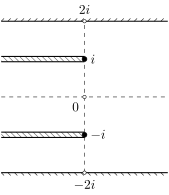
{z:z∉[kπi,kπi+i∞](k=0,±1,±2,…)} \left\{ z: z \notin [k \pi i, k \pi i+i \infty ] \quad (k = 0, \pm 1, \pm 2, \ldots )\right\}

onto the half-plane {w:Im(w)>0}\left\{ w: \mathrm{Im}\left(w\right) > 0\right\}.

?

Find some function w(z)w(z) that conformally maps the region

{z:Im(z)>0,z∉[kπ,kπ+πi](k=0,±1,±2,…)} \left\{ z: \mathrm{Im}\left(z\right) > 0, z \notin [k \pi , k \pi +\pi i] \quad (k = 0, \pm 1, \pm 2, \ldots )\right\}

onto the half-plane {w:Im(w)>0}\left\{ w: \mathrm{Im}\left(w\right) > 0\right\}.

?

Find some function w(z)w(z) that conformally maps the region {z:Im⁡>0,z∉[2k,2k+2i],z∉[2k+1,2k+1+i](k=0,±1,…)}\left\{ z: \operatorname {Im} > 0, z \notin [2 k, 2 k+2 i], z \notin [2 k+1,2 k+1+i] \quad (k = 0, \pm 1, \ldots )\right\} onto the half-plane {w:Im(w)>0}\left\{ w: \mathrm{Im}\left(w\right) > 0\right\}.

?

Find some functions w(z)w(z) that conformally map the regions depicted in Fig. 29.34-29.36 onto the half-plane {w:Im(w)>0}\left\{ w: \mathrm{Im}\left(w\right) > 0\right\}.

?
(1)

Fig. 29.34Fig. 29.34

(2)

Fig. 29.35Fig. 29.35

(3)

Fig. 29.36Fig. 29.36

Let the function f(z)f(z) be regular on {z:Im(z)>0}\left\{ z: \mathrm{Im}\left(z\right) > 0\right\}, continuous on {z:Im(z)⩾0}\left\{ z: \mathrm{Im}\left(z\right) \geqslant 0\right\}, and take real values on the real axis. Prove that the function f(z)f(z) can be regularly continued to the entire complex plane.

?

Let the function f(z)f(z) be regular on {z:0<Re(z)<1}\left\{ z: 0 < \mathrm{Re}\left(z\right) < 1\right\}, continuous on {z:0⩽Re(z)⩽1}\left\{ z: 0 \leqslant \mathrm{Re}\left(z\right) \leqslant 1\right\}, and take real values on the lines {z:Re(z)=0}\left\{ z: \mathrm{Re}\left(z\right) = 0\right\} and {z:Re(z)=1}\left\{ z: \mathrm{Re}\left(z\right) = 1\right\}. Prove that the function f(z)f(z) can be regularly continued to the entire complex plane and that the function F(z)F(z) effecting this analytic continuation satisfies the condition F(z+2)=F(z)F(z+2) = F(z).

?

Let the function f(z)f(z) be regular on {z:0<Im(z)<1}\left\{ z: 0 < \mathrm{Im}\left(z\right) < 1\right\}, continuous on {z:0⩽Im(z)⩽1}\left\{ z: 0 \leqslant \mathrm{Im}\left(z\right) \leqslant 1\right\}, and satisfy the conditions

Re(f(z))=0(Im(z)=0);Im(f(z))=0(Im(z)=1) \mathrm{Re}\left(f(z)\right) = 0 \quad (\mathrm{Im}\left(z\right) = 0) ; \quad \mathrm{Im}\left(f(z)\right) = 0 \quad (\mathrm{Im}\left(z\right) = 1)

Prove that the function f(z)f(z) can be regularly continued to the entire plane and that the function F(z)F(z) effecting this analytic continuation satisfies the condition F(z+2i)=−F(z)F(z+2 i) = -F(z).

?

Let the function f(z)f(z) be regular in the rectangle

{z:∣Im(z)∣<h,0<Re(z)<1}, \left\{ z:\left|\mathrm{Im}\left(z\right)\right| < h, 0 < \mathrm{Re}\left(z\right) < 1\right\} ,

continuous in the closure of this rectangle, and satisfy the conditions

Im(f(z))=0(Re(z)=0,∣Im(z)∣<h);Im(f(z))=1(Re(z)=1,∣Im(z)∣<h) \begin{array}{ll} \mathrm{Im}\left(f(z)\right) = 0 & (\mathrm{Re}\left(z\right) = 0,\left|\mathrm{Im}\left(z\right)\right| < h) ; \\ \mathrm{Im}\left(f(z)\right) = 1 & (\mathrm{Re}\left(z\right) = 1,\left|\mathrm{Im}\left(z\right)\right| < h) \end{array}

Prove that the function f(z)f(z) can be regularly continued to the strip {z:∣Im(z)∣<h}\left\{ z:\left|\mathrm{Im}\left(z\right)\right| < h\right\} and that the function F(z)F(z) effecting this continuation has the form iz+F1(z)i z+F_{1}(z), where the function F1(z)F_{1}(z) is regular in the strip {z:∣Im(z)∣<h}\left\{ z:\left|\mathrm{Im}\left(z\right)\right| < h\right\} and periodic with period 2.

?

Let the function f(z)f(z) be regular in the half-annulus

{z:ρ<∣z∣<R,Im(z)>0}, \left\{ z: \rho < \left|z\right| < R, \mathrm{Im}\left(z\right) > 0\right\} ,

continuous in its closure, and take real values on the segments (−R,−ρ)(-R,-\rho ) and (ρ,R)(\rho , R). Prove that the function f(z)f(z) can be regularly continued into the annulus {z:ρ<∣z∣<R}\left\{ z: \rho < \left|z\right| < R\right\} to a function regular in this annulus.

?

Let the function f(z)f(z) conformally map the rectangle {z:∣Re(z)∣<h,∣Im(z)∣<h}\left\{ z:\left|\mathrm{Re}\left(z\right)\right| < h,\left|\mathrm{Im}\left(z\right)\right| < h\right\} onto some disk (or half-plane). Prove that the regular continuation of the function f(z)f(z) is a function meromorphic in the entire plane and periodic with periods 4h4 h and 4ih4 i h.

?

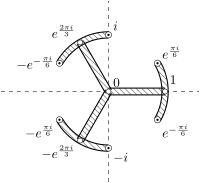
Let the function f(z)f(z) conformally map the sector

{z:∣z∣<1,0<arg⁡z<πn}, \left\{ z:\left|z\right| < 1,0 < \arg z < \frac{\pi }{n}\right\} ,

onto the triangle with the same vertices 0,1,eπi/n0,1, e^{\pi i / n}, in such a way that these vertices remain fixed. Prove that the function f(z)f(z) can be regularly continued into the disk {z:∣z∣<1}\left\{ z:\left|z\right| < 1\right\} and that the function F(z)F(z) effecting this analytic continuation conformally maps the disk {z:∣z∣<1}\left\{ z:\left|z\right| < 1\right\} onto a regular 2n2 n-gon (with center at the point 0 and one of its vertices at the point 1).

?

Prove that there is no function conformally mapping the annulus {z:1<∣z∣<R1}\left\{ z: 1 < \left|z\right| < R_{1}\right\} onto the annulus {z:1<∣z∣<R2}\left\{ z: 1 < \left|z\right| < R_{2}\right\} if R1≠R2R_{1} \neq R_{2}.

?

Let the function f(z)f(z) conformally map the half-plane {z:Im(z)>0}\left\{ z: \mathrm{Im}\left(z\right) > 0\right\} onto the region:

{w:Im(w)>0,0<Re(w)<1,∣w−12∣>12} \left\{ w: \mathrm{Im}\left(w\right) > 0,0 < \mathrm{Re}\left(w\right) < 1,\left|w-\frac{1}{2}\right| > \frac{1}{2}\right\}

Prove that the regular continuation of the function f(z)f(z) leads to a function F(z)F(z) regular in the entire extended complex plane with three punctured points (the preimages of the points 0, 1, and ∞\infty).

?

References

[deSi04] de Souza P.N., Silva J. Berkeley Problems in Mathematics. 3rd ed., Springer, 2004.
[CJP+11] Chen J., Jiang G., Pan Y., Qin T., Tong Y., Wu Q., Xu S., Li T. Problems and Solutions in Mathematics. 2nd ed., World Scientific, 2011.
[PóSz98] Pólya G., Szegő G. Problems and Theorems in Analysis. Springer, 1998.
[Rud87] Rudin W. Real and Complex Analysis. 3rd ed., McGraw-Hill, 1987.
[ШПК15] Шабунин М.И., Половинкин Е.С., Карлов М.И. Сборник задач по теории функций комплексного переменного. 4-е изд., БИНОМ. Лаборатория знаний, 2015.